Department of Family Medicine and Community Health, University of Pennsylvania, 51 North 39th Street, 6th Floor Mutch Building, PhiladelphiaPhiladelphia, PA, 19104, USA.
Center for Public Health, University of Pennsylvania, Philadelphia, PA, USA.
BMC Med Res Methodol. 2024 Oct 18;24(1):244. doi: 10.1186/s12874-024-02352-w.
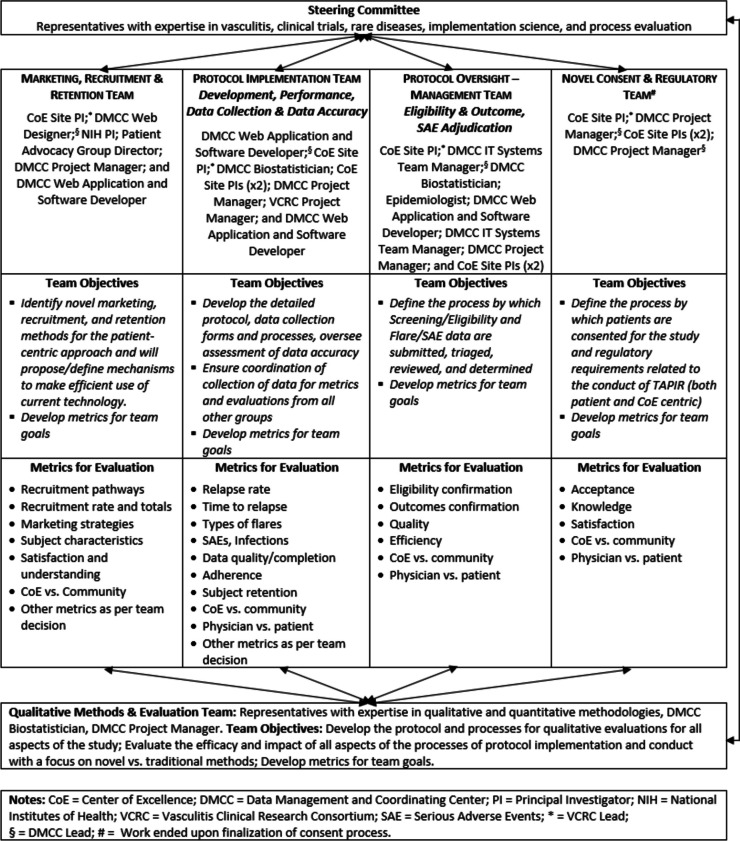
Traditional medical research infrastructures relying on the Centers of Excellence (CoE) model (an infrastructure or shared facility providing high standards of research excellence and resources to advance scientific knowledge) are often limited by geographic reach regarding patient accessibility, presenting challenges for study recruitment and accrual. Thus, the development of novel, patient-centered (PC) strategies (e.g., the use of online technologies) to support recruitment and streamline study procedures are necessary. This research focused on an implementation evaluation of a design innovation with implementation outcomes as communicated by study staff and patients for CoE and PC approaches for a randomized controlled trial (RCT) for patients with vasculitis.
In-depth qualitative interviews were conducted with 32 individuals (17 study team members, 15 patients). Transcripts were coded using the Consolidated Framework for Implementation Research (CFIR).
The following CFIR elements emerged: characteristics of the intervention, inner setting, characteristics of individuals, and process. From the staff perspective, the communication of the PC approach was a major challenge, but should have been used as an opportunity to identify one "point person" in charge of all communicative elements among the study team. Study staff from both arms were highly supportive of the PC approach and saw its promise, particularly regarding online consent procedures. Patients reported high self-efficacy in reference to the PC approach and utilization of online technologies. Local physicians were integral for making patients feel comfortable about participation in research studies.
The complexity of replicating the interpersonal nature of the CoE model in the virtual setting is substantial, meaning the PC approach should be viewed as a hybrid strategy that integrates online and face-to-face practices.
ClinicalTrials.gov NCT01940094 . Date of registration: September 10, 2013. 2) Name: The Assessment of Prednisone In Remission Trial - Patient Centric Approach (TAPIR).
Clinical Trials.gov NCT01933724 . Date of registration: September 2, 2013.
传统的医学研究基础设施依赖于卓越中心(CoE)模式(为推进科学知识提供高标准的卓越研究和资源的基础设施或共享设施),往往受到患者可及性的地理范围限制,给研究招募和入组带来挑战。因此,需要开发新的、以患者为中心(PC)的策略(例如,使用在线技术)来支持招募并简化研究程序。这项研究专注于一项设计创新的实施评估,该创新以实施结果为沟通方式,针对血管炎患者的随机对照试验(RCT),采用 CoE 和 PC 方法。
对 32 个人(17 名研究团队成员,15 名患者)进行了深入的定性访谈。使用整合实施研究框架(CFIR)对转录本进行编码。
出现了以下 CFIR 要素:干预措施的特征、内部环境、个体特征和过程。从工作人员的角度来看,沟通 PC 方法是一个主要挑战,但应该将其作为一个机会,确定一个负责研究团队所有沟通要素的“负责人”。来自两个组的研究人员都非常支持 PC 方法,并看到了其前景,尤其是在在线同意程序方面。患者报告称,他们对 PC 方法和在线技术的使用具有很高的自我效能感。当地医生对于使患者对参与研究感到舒适至关重要。
在虚拟环境中复制 CoE 模型的人际性质的复杂性相当大,这意味着 PC 方法应被视为一种混合策略,将在线和面对面的实践相结合。
1)名称:泼尼松在缓解试验 - 卓越中心方法评估(TAPIR)。
ClinicalTrials.gov NCT01940094。注册日期:2013 年 9 月 10 日。2)名称:泼尼松在缓解试验 - 患者为中心方法评估(TAPIR)。
ClinicalTrials.gov NCT01933724。注册日期:2013 年 9 月 2 日。