Institute of Neurogenetics, University of Lübeck and University Hospital Schleswig-Holstein, Ratzeburger Allee 160, 23562, Lübeck, Germany.
James and Lillian Martin Centre for Stem Cell Research, Sir William Dunn School of Pathology, University of Oxford, Oxford, UK.
BMC Genomics. 2024 Oct 19;25(1):980. doi: 10.1186/s12864-024-10902-1.
Certain structural variants (SVs) including large-scale genetic copy number variants, as well as copy number-neutral inversions and translocations may not all be resolved by chromosome karyotype studies. The identification of genetic risk factors for Parkinson's disease (PD) has been primarily focused on the gene-disruptive single nucleotide variants. In contrast, larger SVs, which may significantly influence human phenotypes, have been largely underexplored. Optical genomic mapping (OGM) represents a novel approach that offers greater sensitivity and resolution for detecting SVs. In this study, we used induced pluripotent stem cell (iPSC) lines of patients with PD-linked SNCA and PRKN variants as a proof of concept to (i) show the detection of pathogenic SVs in PD with OGM and (ii) provide a comprehensive screening of genetic abnormalities in iPSCs.
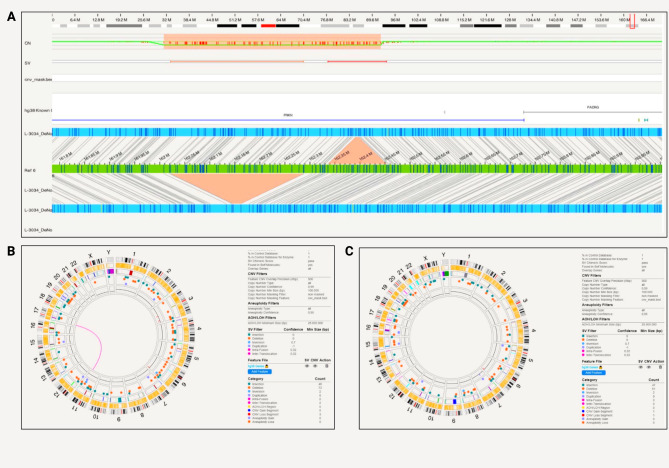
OGM detected SNCA gene triplication and duplication in patient-derived iPSC lines, which were not identified by long-read sequencing. Additionally, various exon deletions were confirmed by OGM in the PRKN gene of iPSCs, of which exon 3-5 and exon 2 deletions were unable to phase with conventional multiplex-ligation-dependent probe amplification. In terms of chromosomal abnormalities in iPSCs, no gene fusions, no aneuploidy but two balanced inter-chromosomal translocations were detected in one line that were absent in the parental fibroblasts and not identified by routine single nucleotide variant karyotyping.
In summary, OGM can detect pathogenic SVs in PD-linked genes as well as reveal genomic abnormalities for iPSCs that were not identified by other techniques, which is supportive for OGM's future use in gene discovery and iPSC line screening.
某些结构变异(SVs),包括大规模遗传拷贝数变异,以及拷贝数中性的倒位和易位,可能无法通过染色体核型研究来解决。帕金森病(PD)的遗传风险因素的鉴定主要集中在基因破坏性的单核苷酸变异上。相比之下,可能显著影响人类表型的较大 SVs 尚未得到充分探索。光学基因组图谱(OGM)代表了一种新的方法,为检测 SVs 提供了更高的灵敏度和分辨率。在这项研究中,我们使用与 PD 相关的 SNCA 和 PRKN 变体的诱导多能干细胞(iPSC)系作为概念验证,(i)使用 OGM 检测 PD 中的致病性 SVs,(ii)对 iPSC 中的遗传异常进行全面筛查。
OGM 检测到了源自患者的 iPSC 系中的 SNCA 基因三重复制和重复,而这些在长读测序中未被识别。此外,OGM 还在 iPSC 的 PRKN 基因中确认了各种外显子缺失,其中外显子 3-5 和外显子 2 的缺失无法与传统的多重连接依赖性探针扩增相吻合。在 iPSC 的染色体异常方面,在一条系中检测到了基因融合、非整倍体,但未在亲本成纤维细胞中检测到两条平衡的染色体间易位,也未在常规单核苷酸变异核型分析中识别到。
总之,OGM 可以检测到与 PD 相关基因中的致病性 SVs,以及揭示其他技术无法识别的 iPSC 的基因组异常,这支持 OGM 在基因发现和 iPSC 系筛选中的未来应用。