Department of Epidemiology, Mailman School of Public Health, Columbia University Irving Medical Center, Columbia University, New York, NY, 10032, USA.
Herbert Irving Comprehensive Cancer Center, Columbia University Irving Medical Center, Columbia University, New York, NY, 10032, USA.
Breast Cancer Res. 2024 Oct 18;26(1):145. doi: 10.1186/s13058-024-01894-7.
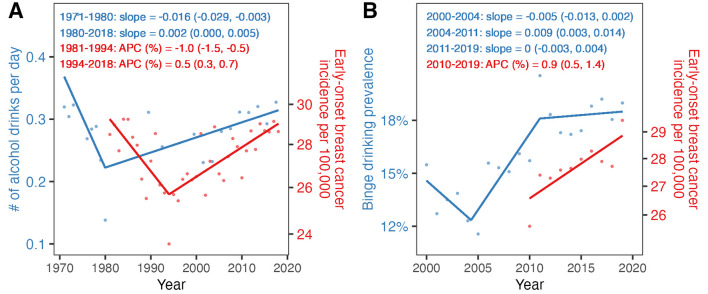
Breast cancer (BC) rates have been increasing in young women in the U.S. Alcohol is an established risk factor for breast cancer and has been consistently associated with hormone receptor positive cancers, the type of breast cancer that has been increasing the fastest in young women. Given these trends, we conducted an ecological study to examine whether alcohol consumption, and specifically binge drinking trends, were correlated with female breast cancer diagnosed under 40 years of age using breast cancer data from the Surveillance, Epidemiology, and End Results (SEER) Cancer Registry. We accounted for a latent period before cancer diagnosis by using exposure 10 years before the outcome (lag model); we also conducted a separate cumulative analysis of 10-year aggregate exposure.
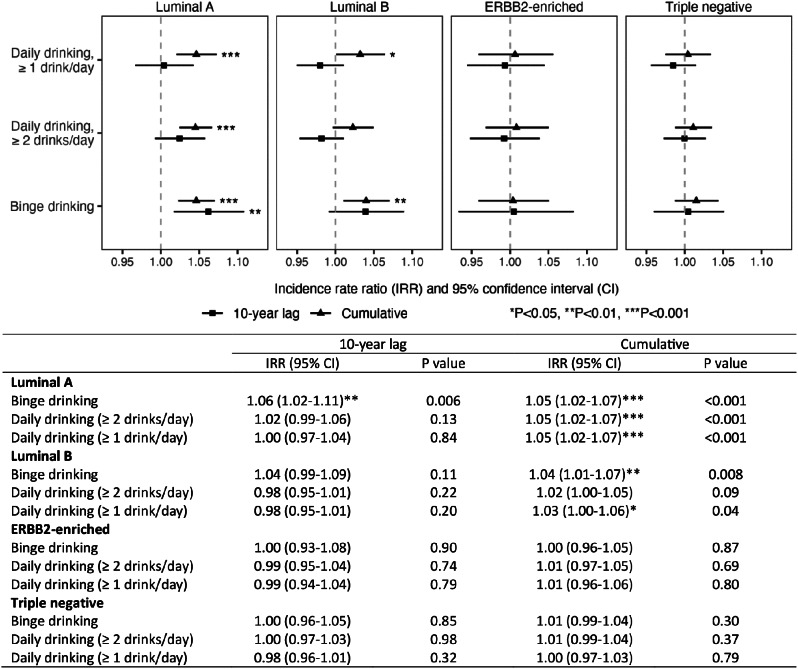
Moderate (Incidence Rate Ratio (IRR) = 1.05, 95% Confidence Interval (CI) = 1.02-1.07) and heavy (IRR = 1.05, 95% CI = 1.02-1.07)(≥ 1 and ≥ 2 drinks/day, respectively) alcohol consumption were each associated with Luminal A breast cancer but not the other molecular subtypes. Binge drinking was associated with an increased rate of early-onset Luminal A BC in both the 10-year lag model (IRR = 1.06, 95% CI = 1.02 to 1.11) and the cumulative model (IRR = 1.05, 95% CI = 1.02-1.07). Binge drinking was also associated with early-onset Luminal B BC in the cumulative model (IRR = 1.04, 95% CI = 1.01-1.07), but not associated with ERBB2-enriched or triple negative early-onset BC in either model.
These trends support the hypothesis that one reason for the increase in early-onset breast cancer is from increased alcohol intake including binge drinking.
美国年轻女性中的乳腺癌(BC)发病率一直在上升。酒精是乳腺癌的既定风险因素,并且一直与激素受体阳性癌症相关,而这种类型的乳腺癌在年轻女性中增长最快。鉴于这些趋势,我们进行了一项生态学研究,以检查使用监测,流行病学和结果(SEER)癌症登记处的乳腺癌数据,是否饮酒,特别是狂饮趋势与 40 岁以下诊断的女性乳腺癌有关。我们通过在结果发生前 10 年使用暴露来解释癌症诊断前的潜伏期(滞后模型);我们还对 10 年的累计暴露进行了单独的累积分析。
中度(发病率比(IRR)= 1.05,95%置信区间(CI)= 1.02-1.07)和重度(IRR = 1.05,95%CI = 1.02-1.07)(分别为≥1 次和≥2 次/天)酒精摄入与 Luminal A 乳腺癌均相关,但与其他分子亚型无关。狂饮与两种模型中的早期发病的 Luminal A BC 发生率增加有关,10 年滞后模型(IRR = 1.06,95%CI = 1.02 至 1.11)和累积模型(IRR = 1.05,95%CI = 1.02-1.07)。在累积模型中,狂饮还与早期发病的 Luminal B BC 相关(IRR = 1.04,95%CI = 1.01-1.07),但在两种模型中均与 ERBB2 丰富或三阴性早期 BC 无关。
这些趋势支持了这样一种假设,即早发性乳腺癌增加的原因之一是由于酒精摄入量增加,包括狂饮。