de Almeida Marcelino Ana Luísa, Heinz Viktor, Astalosch Melanie, Al-Fatly Bassam, Schneider Gerd-Helge, Krause Patricia, Kübler-Weller Dorothee, Kühn Andrea A
Movement Disorder and Neuromodulation Unit, Department of Neurology, Charité - Universitätsmedizin Berlin, Corporate Member of Freie Universität Berlin and Humboldt-Universität zu Berlin, Charitéplatz 1, 10117 Berlin, Germany.
Department of Neurology, Charité - Universitätsmedizin Berlin, Corporate Member of Freie Universität Berlin and Humboldt-Universität zu Berlin, Hindenburgdamm 30, 12200 Berlin, Germany.
Clin Park Relat Disord. 2024 Sep 27;11:100273. doi: 10.1016/j.prdoa.2024.100273. eCollection 2024.
Segmented electrodes for deep brain stimulation (DBS) of the subthalamic nucleus (STN) in Parkinson's disease (PD) enable directional current steering leading to expanded programming options.
This retrospective study covering a longitudinal period of up to 7 years compares the efficacy of segmented and non-segmented leads in motor symptom alleviation and reduction of dopaminergic medication in PD patients treated in a specialized center and assesses the long-term use of directional steering in clinical routine.
Demographic data and clinical scores before surgery and at 12-month follow-up (12MFU) as well as stimulation parameters at 12MFU and last follow-up (LFU) were assessed in all patients implanted with segmented leads between 01/2016 and 12/2019 and non-segmented leads in a corresponding time-period. Patients were classified as very good (>60 %), good (30-60 %) and poor (<30 %) responders according to DBS-induced motor improvement.
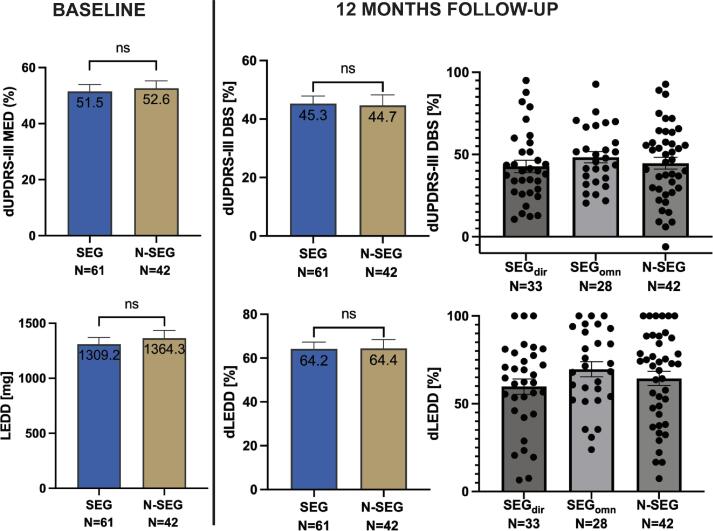
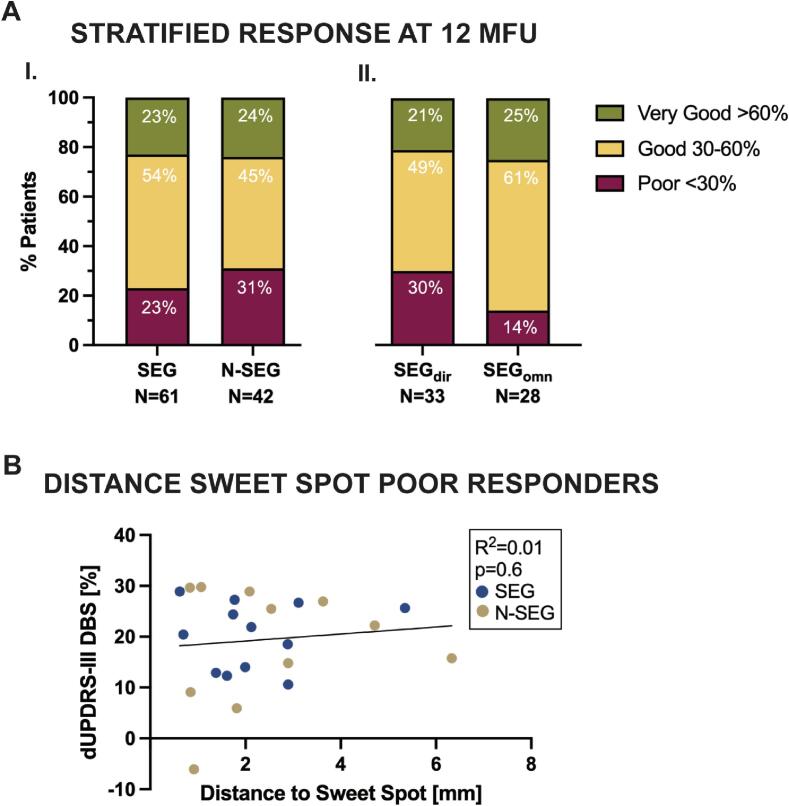
Clinical data at 12MFU was available for 61/96 patients with segmented (SEG) and 42/53 with non-segmented leads (N-SEG). Mean DBS-induced motor improvement and reduction of medication at 12MFU did not differ significantly between SEG and N-SEG groups or in a subgroup analysis of steering modes. There was a lower proportion of poor responders in the SEG compared with the N-SEG group (23% vs. 31%), though not statistically significant. At LFU, the percentage of patients set at directional steering increased from 54% to 70%.
Efficacy in reduction of motor symptoms and medication does not differ between electrode types for STN-DBS at 12 months follow-up. The use of directional steering increases over time and may account for a lower proportion of poor responders.
用于帕金森病(PD)丘脑底核(STN)深部脑刺激(DBS)的分段电极能够实现定向电流控制,从而带来更多的程控选择。
这项长达7年的回顾性研究比较了分段电极和非分段电极在专门中心接受治疗的PD患者中缓解运动症状和减少多巴胺能药物使用方面的疗效,并评估了临床常规中定向控制的长期使用情况。
对2016年1月至2019年12月期间植入分段电极以及同期植入非分段电极的所有患者,评估其手术前和12个月随访(12MFU)时的人口统计学数据和临床评分,以及12MFU和末次随访(LFU)时的刺激参数。根据DBS诱导的运动改善情况,将患者分为非常好(>60%)、好(30%-60%)和差(<30%)反应者。
61/96例植入分段电极(SEG)的患者和42/53例植入非分段电极(N-SEG)的患者有12MFU时的临床数据。SEG组和N-SEG组之间,或在控制模式的亚组分析中,12MFU时DBS诱导的平均运动改善和药物减少情况无显著差异。与N-SEG组相比,SEG组中差反应者的比例较低(23%对31%),但无统计学意义。在LFU时,设置为定向控制的患者百分比从54%增加到70%。
在12个月随访时,STN-DBS的电极类型在减轻运动症状和减少药物使用方面的疗效无差异。定向控制的使用随时间增加,可能是差反应者比例较低的原因。