Long Caiyi, Li Zihan, Feng Haoyue, Jiang Yayi, Pu Yueheng, Tao Jiajing, Yue Rensong
Hospital of Chengdu University of Traditional Chinese Medicine, Chengdu, China.
Chengdu University of Traditional Chinese Medicine, Chengdu, China.
Front Aging Neurosci. 2024 Oct 4;16:1465457. doi: 10.3389/fnagi.2024.1465457. eCollection 2024.
The role of trimethylamine oxide (TMAO) in patients with cognitive impairment remains controversial. This study aimed to assess the association between TMAO and its precursors and the prevalence of cognitive impairment.
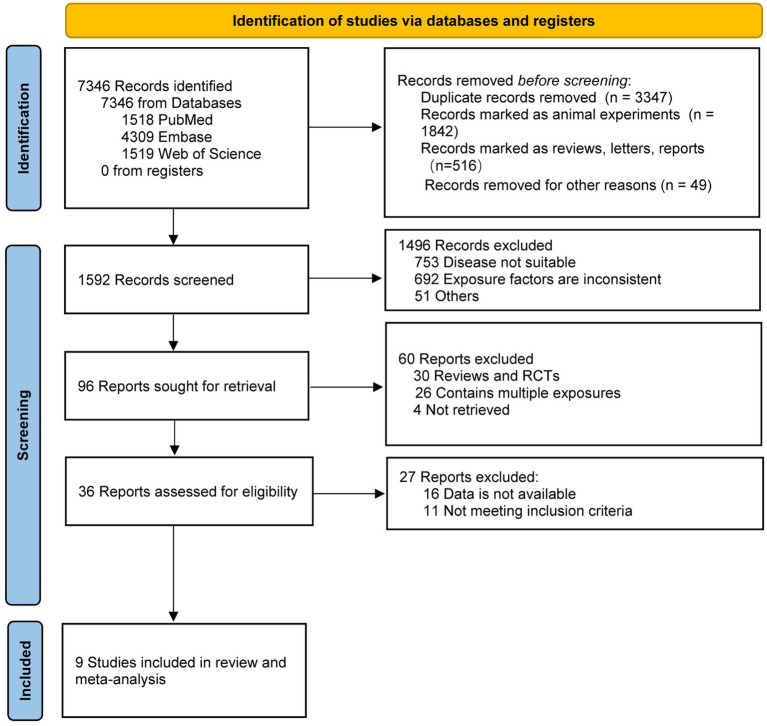
PubMed, Embase, and Web of Science databases were searched for studies that met the inclusion criteria from their inception to 14 September 2024, and references were manually searched to identify any additions. Odds ratio (OR) was assessed by random-effects modeling, subgroup analyses to identify potential sources of heterogeneity, and the Newcastle-Ottawa Scale (NOS) and the Agency for Healthcare Research and Quality (AHRQ) Inventory for qualitative evaluation.
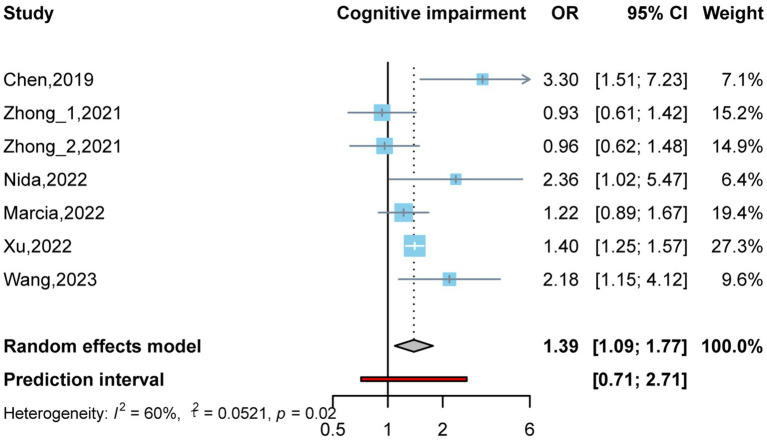
Nine studies involving 82,246 participants were included in the analysis. Meta-analyses suggested that elevated TMAO levels were strongly associated with an increased risk of cognitive impairment (OR: 1.39, 95% confidence interval [95%CI]: 1.09-1.77, < 0.05, I:60%), and consistent results were obtained across all subgroups examined and sensitivity analyses. However, in the TMAO dose-response meta-analysis and TMAO precursor meta-analyses, the results were not significantly different (dietary choline: OR: 0.93, 95%CI: 0.78-1.10, = 0.385, I:68%, plasma choline: OR: 0.65, 95%CI: 0.41-1.02, = 0.063, I:76%, plasma betaine: OR: 0.74, 95%CI: 0.52-1.05, = 0.094, I:61%).
We found that high TMAO concentrations were positively associated with the risk of cognitive impairment. TMAO is expected to be a potential risk predictor and therapeutic target for cognitive impairment. However, more high-quality studies are needed to further investigate the dose relationship between circulating TMAO concentrations and cognitive impairment.
PROSPERO, identifier: CRD42023464543.
氧化三甲胺(TMAO)在认知障碍患者中的作用仍存在争议。本研究旨在评估TMAO及其前体与认知障碍患病率之间的关联。
检索PubMed、Embase和Web of Science数据库,查找从建库至2024年9月14日符合纳入标准的研究,并手动检索参考文献以确定是否有其他补充。采用随机效应模型评估比值比(OR),进行亚组分析以识别异质性的潜在来源,并使用纽卡斯尔-渥太华量表(NOS)和医疗保健研究与质量局(AHRQ)清单进行定性评估。
分析纳入了9项研究,共82246名参与者。荟萃分析表明,TMAO水平升高与认知障碍风险增加密切相关(OR:1.39,95%置信区间[95%CI]:1.09 - 1.77,P < 0.05,I²:60%),在所有检查的亚组和敏感性分析中均获得了一致的结果。然而,在TMAO剂量反应荟萃分析和TMAO前体荟萃分析中,结果无显著差异(膳食胆碱:OR:0.93,95%CI:0.78 - 1.10,P = 0.385,I²:68%;血浆胆碱:OR:0.65,95%CI:0.41 - 1.02,P = 0.063,I²:76%;血浆甜菜碱:OR:0.74,95%CI:0.52 - 1.05,P = 0.094,I²:61%)。
我们发现高浓度的TMAO与认知障碍风险呈正相关。TMAO有望成为认知障碍的潜在风险预测指标和治疗靶点。然而,需要更多高质量的研究来进一步探究循环TMAO浓度与认知障碍之间的剂量关系。
PROSPERO,标识符:CRD42023464543