Center for Digital Psychiatry, Mental Health Services in the Region of Southern Denmark, Odense, Denmark.
Department of Psychology, University of Southern Denmark, Odense, Denmark.
JMIR Form Res. 2024 Oct 21;8:e55679. doi: 10.2196/55679.
Social anxiety disorder (SAD) is a long-term and overwhelming fear of social situations that can affect work, school, and other daily activities. Although cognitive behavioral therapy is effective, few seek treatment, and many who do start often drop out. This may be due to the component of exposure inherent to cognitive behavioral therapy, where the patient confronts feared stimuli outside the therapist's office, which they otherwise try to avoid. As an alternative, research has explored the effectiveness of virtual reality (VR)-based exposure therapy with promising results. However, few studies have investigated the feasibility of VR tools using mixed methodologies before assessing their efficacy.
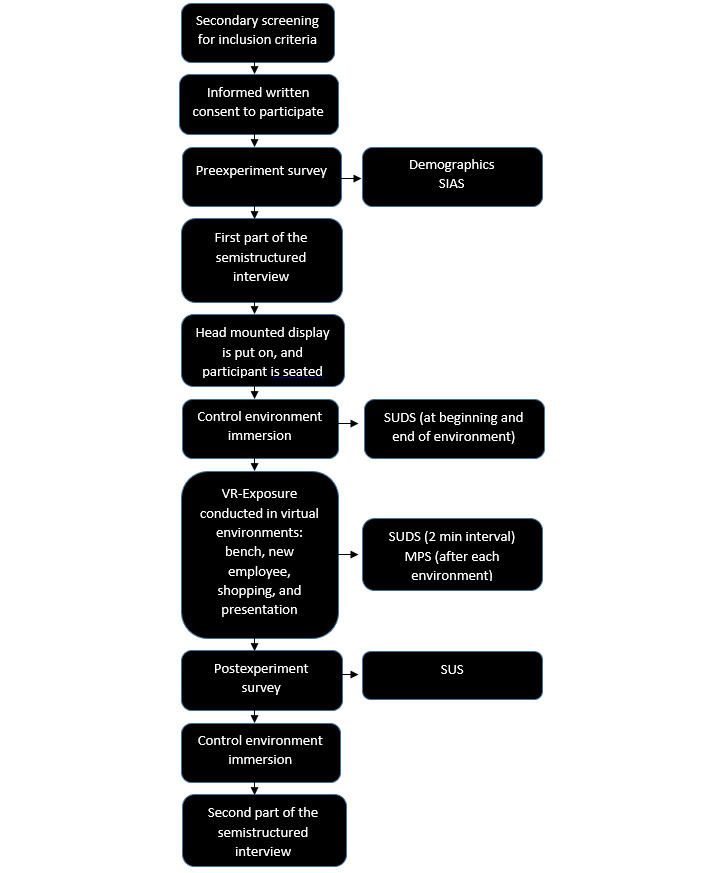
This study aims to assess the usability, feasibility, and presence of four 360° virtual environments and whether these were able to evoke anxiety in patients with SAD.
A total of 10 adult participants with SAD and 10 healthy controls were recruited for 1 experimental session (age range 21-32 y; 12/20, 60% male participants). Questionnaire and interview data were collected and analyzed. A mixed methods triangulation design was applied to analyze and compare the data.
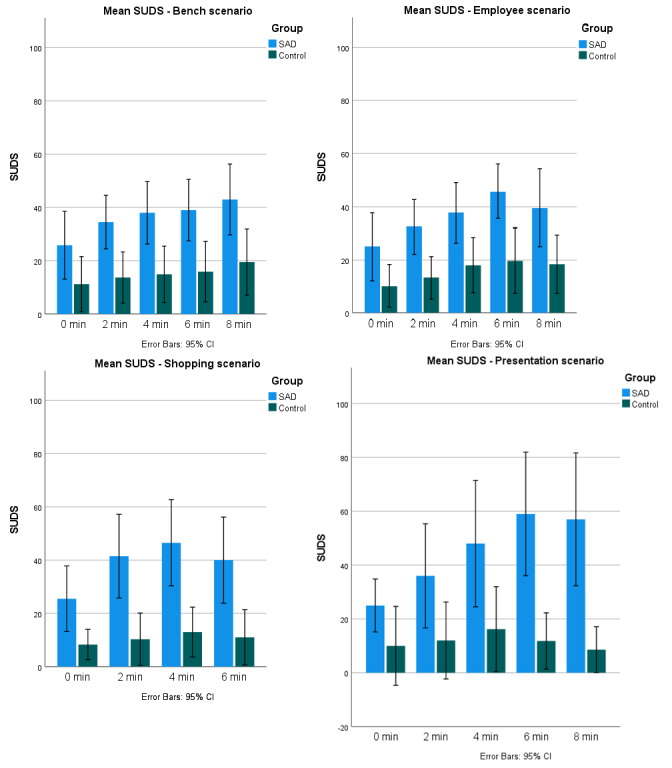
Participants with SAD experienced increased anxiety when exposed to VR, and environments were considered relevant and useful as an exposure tool. Participants with SAD reported significantly higher average anxiety levels (P=.01) and peak anxiety levels (P=.01) compared with controls during exposure; however, significant differences in anxiety when accounting for baseline anxiety levels were only found in 2 of 4 environments (P=.01, P=.01, P=.07, and P=.06). While presence scores were acceptable in both groups, participants with SAD scored significantly lower than controls. Qualitative analyses highlight this finding within the SAD group, where some participants experienced presence reduction due to being observed while in VR and in situations with reduced interaction in VR.
VR exposure with 360° videos seems to be useful as a first step of exposure therapy for patients with SAD. Future exploration in the clinical application of VR-based exposure for SAD, as well as means of increasing presence within the virtual environments, may be useful.
社交焦虑障碍(SAD)是一种长期且强烈的对社交情境的恐惧,可能会影响工作、学业和其他日常活动。尽管认知行为疗法有效,但寻求治疗的人很少,许多开始治疗的人也经常中途退出。这可能是因为认知行为疗法中固有的暴露成分,即患者在治疗师办公室外面对他们试图避免的恐惧刺激。作为替代方法,研究已经探索了基于虚拟现实(VR)的暴露疗法的有效性,结果令人鼓舞。然而,在评估其疗效之前,很少有研究使用混合方法来探索 VR 工具的可行性。
本研究旨在评估四种 360°虚拟环境的可用性、可行性和存在性,以及它们是否能够引起 SAD 患者的焦虑。
共招募了 10 名 SAD 成年患者和 10 名健康对照者参加 1 次实验(年龄 21-32 岁;12/20,60%为男性参与者)。收集并分析问卷和访谈数据。应用混合方法三角分析设计来分析和比较数据。
SAD 患者在暴露于 VR 时会感到焦虑增加,并且环境被认为是作为暴露工具是相关且有用的。与对照组相比,SAD 患者在暴露时报告的平均焦虑水平(P=.01)和峰值焦虑水平(P=.01)显著更高;然而,仅在 4 种环境中的 2 种环境中发现了考虑基线焦虑水平后的焦虑差异(P=.01,P=.01,P=.07,和 P=.06)。虽然两组的存在感评分都可以接受,但 SAD 患者的评分明显低于对照组。定性分析突出了 SAD 组中的这一发现,其中一些参与者由于在 VR 中被观察到以及在 VR 中互动减少的情况下,存在感降低。
对于 SAD 患者,使用 360°视频的 VR 暴露似乎是暴露疗法的第一步。未来对 SAD 的 VR 基于暴露的临床应用以及增加虚拟环境中存在感的方法的探索可能会有所帮助。