Ørskov Per Trads, Lichtenstein Mia Beck, Ernst Mathias Torp, Fasterholdt Iben, Matthiesen Asge Frederik, Scirea Marco, Bouchard Stephane, Andersen Tonny Elmose
Research Unit for Digital Psychiatry, Mental Health Services in the Region of Southern Denmark, Odense, Denmark.
Department of Clinical Research, University of Southern Denmark, Odense, Denmark.
Front Psychiatry. 2022 Oct 10;13:991755. doi: 10.3389/fpsyt.2022.991755. eCollection 2022.
Social anxiety disorder (SAD) has a high prevalence and an early onset with recovery taking decades to occur. Current evidence supports the efficacy of cognitive behavioral therapy (CBT) with virtual reality (VR) exposure. However, the evidence is based on a sparse number of studies with predominantly small sample sizes. There is a need for more trials investigating the optimal way of applying VR based exposure for SAD. In this trial, we will test the efficacy of CBT with adaptive VR exposure allowing adjustment of the exposure based on real-time monitoring of the participants's anxiety level.
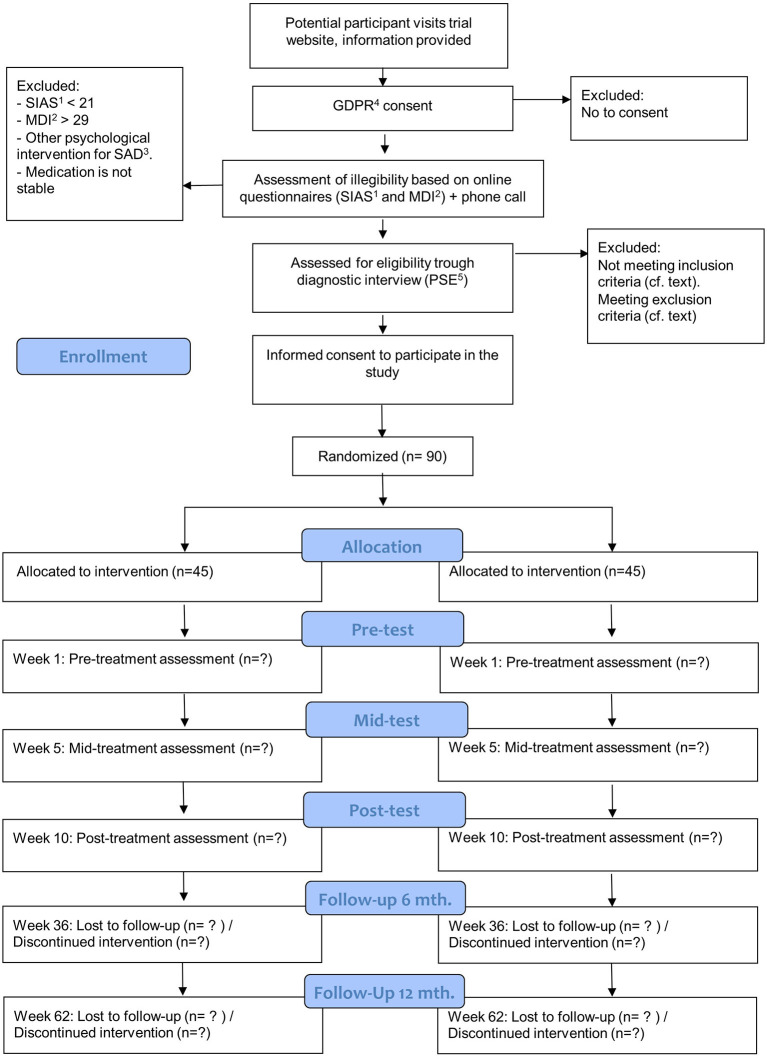
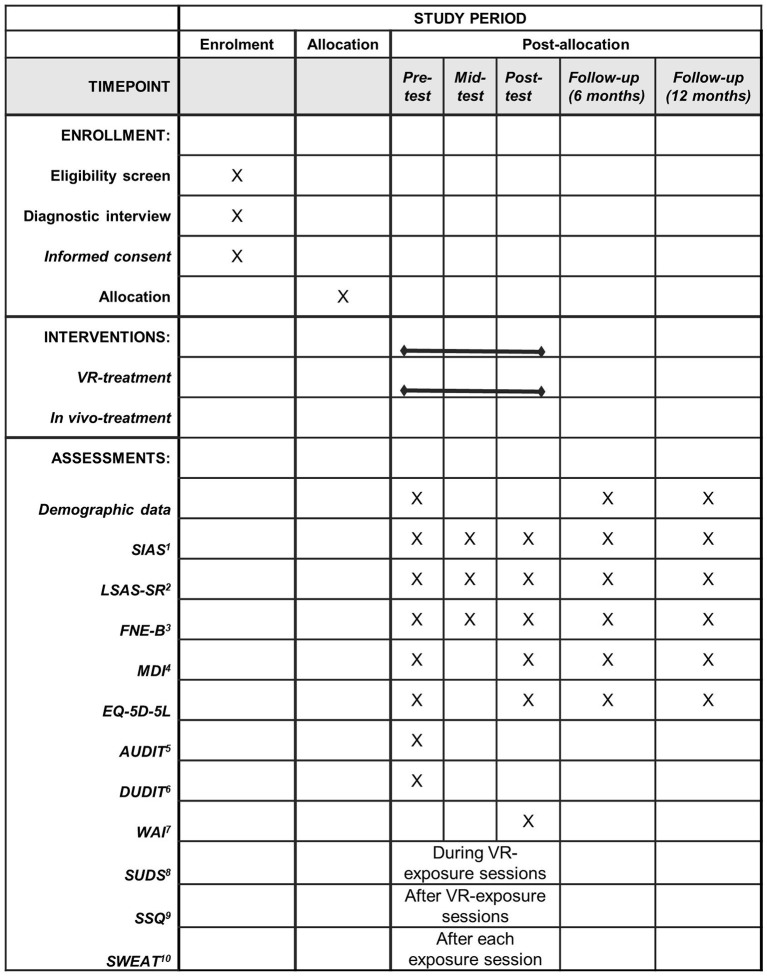
The trial is a randomized controlled, assessor-blinded, parallel-group superiority trail. The study has two arms: (1) CBT including exposure (CBT-Exp), (2) CBT including exposure therapy using individually tailored VR-content and a system to track anxiety levels (CBT-ExpVR). Treatment is individual, manual-based and consists of 10 weekly sessions with a duration of 60 min. The study includes 90 participants diagnosed with SAD. Assessments are carried out pre-treatment, mid-treatment and at follow-up (6 and 12 months). The primary outcome is the mean score on the Social Interaction Anxiety Scale (SIAS) with the primary endpoint being post-treatment.
The study adds to the existing knowledge by assessing the efficacy of CBT with adaptive VR exposure. The study has high methodological rigor using a randomized controlled trial with a large sample size that includes follow-up data and validated measures for social anxiety outcomes.
ClinicalTrials.gov, identifier: NCT05302518.
社交焦虑障碍(SAD)患病率高且发病早,恢复需数十年时间。目前的证据支持认知行为疗法(CBT)结合虚拟现实(VR)暴露的疗效。然而,该证据基于数量稀少且样本量主要较小的研究。需要更多试验来研究将基于VR的暴露应用于社交焦虑障碍的最佳方式。在本试验中,我们将测试结合适应性VR暴露的认知行为疗法的疗效,该疗法可根据对参与者焦虑水平的实时监测来调整暴露。
本试验为随机对照、评估者盲法、平行组优效性试验。该研究有两个组:(1)包括暴露的认知行为疗法(CBT-Exp),(2)包括使用个性化定制的VR内容和焦虑水平跟踪系统的暴露疗法的认知行为疗法(CBT-ExpVR)。治疗是个体化的、基于手册的,包括10次每周一次、每次60分钟的疗程。该研究纳入90名被诊断为社交焦虑障碍的参与者。在治疗前、治疗中期和随访(6个月和12个月)时进行评估。主要结局是社交互动焦虑量表(SIAS)的平均得分,主要终点是治疗后。
本研究通过评估结合适应性VR暴露的认知行为疗法的疗效,增加了现有知识。该研究采用随机对照试验,样本量大,包括随访数据和社交焦虑结局的有效测量方法,具有较高的方法学严谨性。
ClinicalTrials.gov,标识符:NCT05302518。