Kalabamu Florence Salvatory, Maliki Shaaban
Faculty of Medicine, Hubert Kairuki Memorial University.
Kairuki Hospital, Tanzania.
East Afr Health Res J. 2021;5(1):91-98. doi: 10.24248/eahrj.v5i1.655. Epub 2021 Jun 11.
Dengue is a viral disease transmitted by female Aedes mosquitoes which are commonly found in tropical and subtropical areas. There is a dramatic increase in annual incidence rate of dengue attributed to urbanisation, poor environmental management as well as increased people mobility. Outbreak of dengue have been reported in Tanzania in recent years with Dar es salaam being the most affected region. Dengue is associated with haematological derangements and itindicates the severity of the disease. These changes have not been well elucidated in Tanzanian patients. The aim of this study was to determine these derangements among dengue patients admitted at Kairuki hospital in Dar es salaam, and compare these changes with non-dengue febrile patients.
A retrospective cross sectional study was conducted among patients who were suspected to have dengue; tested for dengue IgM and their Complete Blood Count were tested during the index illness. This information was obtained from Kairuki hospital laboratory database. Haematological parameters were compared between dengue and non-dengue patients using SPSS Version 20.0. Binary logistic regression analysis was used to determine haematological predictors of dengue positive results.
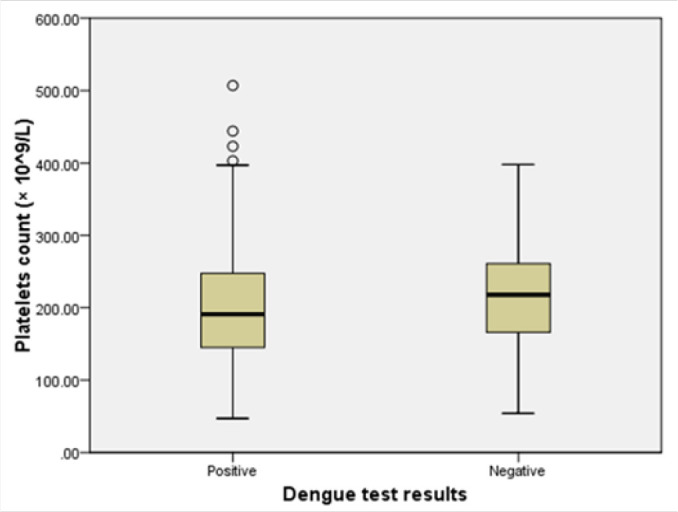
A total of 255 patients were enrolled, whereby 188(73.7%) were dengue positive and 67 (26.3%) were negative. Dengue patients had relatively low mean total white blood cell counts compared to non-dengue patients (Students test= -2.7; Furthermore, Mean lymphocyte count was significantly low in dengue patients compared to non-dengue patients (Student's (t) test=-5.1; ). Other haematological parameters were not significantly different. Lymphopenia was a significant predictor for dengue positive results (Adjusted Odd Ration =5.26 (95% CI=2.28-12.2; ).
Patients with dengue had significantly low total white blood cell and lymphocyte count compared to non-dengue febrile patients. Lymphopenia is a significant haematological predictor for dengue positive results. Case defining signs and symptoms combined with these haematological changes may be used by clinicians as a guide to order confirmatory test for suspected dengue cases.
登革热是一种由雌性伊蚊传播的病毒性疾病,常见于热带和亚热带地区。城市化、环境管理不善以及人员流动性增加导致登革热的年发病率急剧上升。近年来,坦桑尼亚报告了登革热疫情,达累斯萨拉姆是受影响最严重的地区。登革热与血液学紊乱有关,这表明了疾病的严重程度。在坦桑尼亚患者中,这些变化尚未得到充分阐明。本研究的目的是确定达累斯萨拉姆凯鲁基医院收治的登革热患者中的这些紊乱情况,并将这些变化与非登革热发热患者进行比较。
对疑似登革热的患者进行回顾性横断面研究;检测登革热IgM,并在发病期间检测其全血细胞计数。这些信息来自凯鲁基医院实验室数据库。使用SPSS 20.0版本比较登革热患者和非登革热患者的血液学参数。采用二元逻辑回归分析确定登革热阳性结果的血液学预测因素。
共纳入255例患者,其中188例(73.7%)登革热阳性,67例(26.3%)阴性。与非登革热患者相比,登革热患者的平均总白细胞计数相对较低(学生检验=-2.7;此外,与非登革热患者相比,登革热患者的平均淋巴细胞计数显著较低(学生t检验=-5.1;)。其他血液学参数无显著差异。淋巴细胞减少是登革热阳性结果的重要预测因素(调整后的比值比=5.26(95%CI=2.28-12.2;)。
与非登革热发热患者相比,登革热患者的总白细胞和淋巴细胞计数显著降低。淋巴细胞减少是登革热阳性结果的重要血液学预测因素。临床医生可将病例定义体征和症状与这些血液学变化结合起来,作为指导对疑似登革热病例进行确诊检查的依据。