• 文献检索
  • 文档翻译
  • 深度研究
  • 学术资讯
  • Suppr Zotero 插件Zotero 插件
  • 邀请有礼
  • 套餐&价格
  • 历史记录
应用&插件
Suppr Zotero 插件Zotero 插件浏览器插件Mac 客户端Windows 客户端微信小程序
定价
高级版会员购买积分包购买API积分包
服务
文献检索文档翻译深度研究API 文档MCP 服务
关于我们
关于 Suppr公司介绍联系我们用户协议隐私条款
关注我们

Suppr 超能文献

核心技术专利:CN118964589B侵权必究
粤ICP备2023148730 号-1Suppr @ 2026

文献检索

告别复杂PubMed语法,用中文像聊天一样搜索,搜遍4000万医学文献。AI智能推荐,让科研检索更轻松。

立即免费搜索

文件翻译

保留排版,准确专业,支持PDF/Word/PPT等文件格式,支持 12+语言互译。

免费翻译文档

深度研究

AI帮你快速写综述,25分钟生成高质量综述,智能提取关键信息,辅助科研写作。

立即免费体验

新诊断为 1 型糖尿病儿童的自我指导数字家庭技能管理干预的可行性和可接受性: 试点随机对照试验。

Feasibility and Acceptability of a Self-Guided Digital Family Skills Management Intervention for Children Newly Diagnosed With Type 1 Diabetes: Pilot Randomized Controlled Trial.

机构信息

Department of Psychological Science, University of Vermont, Burlington, VT, United States.

Division of Endocrinology, Department of Pediatrics, University of California Davis Medical Center, Sacramento, CA, United States.

出版信息

JMIR Form Res. 2024 Oct 21;8:e59246. doi: 10.2196/59246.

DOI:10.2196/59246
PMID:39432892
原文链接:https://pmc.ncbi.nlm.nih.gov/articles/PMC11535796/
Abstract

BACKGROUND

Family dynamics play an important role in determining the glycemic outcomes of type 1 diabetes (T1D) in children. The time interval immediately following T1D diagnosis is particularly stressful for families, and interventions to support families in adjusting their family practices to support adjustment to and management of T1D in the months following diagnosis may improve glycemic outcomes. Self-guided digital interventions offer a sustainable model for interventions to support caregivers in learning evidence-based family management skills for adjustment to and management of T1D.

OBJECTIVE

We hypothesized that a self-guided, web-based, family skills management program (addressing caregiver social support as well as family problem-solving, communication, and supportive behavior change strategies) initiated at the time of T1D diagnosis would improve glycemic outcomes in children with T1D. In this study, we report on the feasibility and acceptability of this program.

METHODS

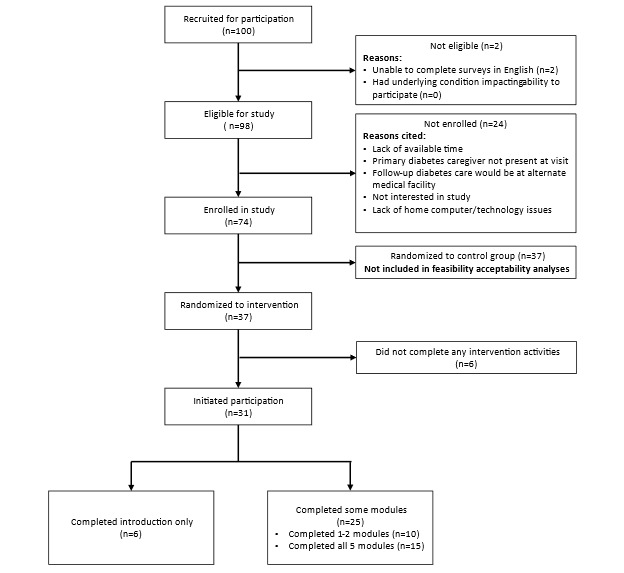
We prospectively evaluated a sample of 37 children newly diagnosed with T1D recruited from a pediatric endocrinology clinic. Parent participants were asked to complete web-based modules addressing social support, family problem-solving, communication, and supportive behavior change strategies. Module completion was analyzed for percentage completion, patterns of completion, and differences in completion rates by coparenting status. Qualitative open-ended feedback was collected at the completion of each module.

RESULTS

A total of 31 (84%) of the 37 participants initiated the web-based program. Of those 31 participants, 25 (81%) completed some content and 15 (48%) completed all 5 modules. Completion rates were higher when coparenting partners engaged in the intervention together (P=.04). Of the 18 participants given a choice about the spacing of content delivery, 15 (83%) chose to have all sessions delivered at once and 3 (17%) chose to space sessions out at 2-week intervals. Qualitative feedback supported the acceptability of the program for delivery soon after T1D diagnosis. Families reported on positive benefits, including requesting future access to the program and describing helpful changes in personal or family processes for managing T1D.

CONCLUSIONS

In this study, we found that a self-guided digital family support intervention initiated at the time of a child's T1D diagnosis was largely feasible and acceptable. Overall, rates of participation and module completion were similar to or higher than other self-guided digital prevention interventions for mental and physical health outcomes. Self-guided digital programs addressing family management skills may help prevent challenges common with T1D management and can decrease cost, increase access, and add flexibility compared to traditional interventions.

TRIAL REGISTRATION

ClinicalTrials.gov NCT03720912; https://clinicaltrials.gov/study/NCT03720912.
https://cdn.ncbi.nlm.nih.gov/pmc/blobs/c769/11535796/8fc12dddc64b/formative_v8i1e59246_fig1.jpg
摘要

背景

家庭动态在决定 1 型糖尿病(T1D)患儿的血糖控制结果方面起着重要作用。在确诊 T1D 后,家庭会面临巨大的压力。在确诊后几个月内,通过干预来支持家庭调整其家庭实践,以支持 T1D 的适应和管理,可能会改善血糖控制结果。自我指导的数字干预为支持护理人员学习适应和管理 T1D 的基于证据的家庭管理技能的干预措施提供了一种可持续的模式。

目的

我们假设在 T1D 确诊时启动自我指导的、基于网络的家庭技能管理计划(针对护理人员的社会支持以及家庭解决问题、沟通和支持行为改变策略),将改善 T1D 患儿的血糖控制结果。在这项研究中,我们报告了该计划的可行性和可接受性。

方法

我们前瞻性地评估了 37 名新诊断为 T1D 的儿童,这些儿童均来自儿科内分泌科诊所。家长参与者被要求完成网络模块,内容涉及社会支持、家庭解决问题、沟通和支持行为改变策略。分析模块完成百分比、完成模式以及共同养育状况差异对完成率的影响。在完成每个模块后收集定性的开放式反馈。

结果

共有 37 名参与者中的 31 名(84%)启动了基于网络的计划。在这 31 名参与者中,有 25 名(81%)完成了部分内容,15 名(48%)完成了所有 5 个模块。当共同养育的伴侣共同参与干预时,完成率更高(P=.04)。在 18 名参与者中,有 15 名(83%)选择一次性接收所有课程,有 3 名(17%)选择间隔两周的时间接收课程。定性反馈支持该计划在 T1D 诊断后不久即可用于交付。家庭报告了积极的好处,包括要求未来获得该计划的访问权限,并描述了在管理 T1D 方面个人或家庭流程的有益变化。

结论

在这项研究中,我们发现,在儿童 T1D 诊断时启动的自我指导的数字家庭支持干预措施在很大程度上是可行和可接受的。总体而言,参与率和模块完成率与其他用于心理健康和身体健康结果的自我指导的数字预防干预措施相似或更高。自我指导的数字程序可以帮助预防与 T1D 管理相关的常见挑战,并降低成本、增加获取途径,与传统干预相比,还能增加灵活性。

试验注册

ClinicalTrials.gov NCT03720912;https://clinicaltrials.gov/study/NCT03720912。

相似文献

1
Feasibility and Acceptability of a Self-Guided Digital Family Skills Management Intervention for Children Newly Diagnosed With Type 1 Diabetes: Pilot Randomized Controlled Trial.新诊断为 1 型糖尿病儿童的自我指导数字家庭技能管理干预的可行性和可接受性: 试点随机对照试验。
JMIR Form Res. 2024 Oct 21;8:e59246. doi: 10.2196/59246.
2
Structured, intensive education maximising engagement, motivation and long-term change for children and young people with diabetes: a cluster randomised controlled trial with integral process and economic evaluation - the CASCADE study.结构化、强化教育最大限度地提高糖尿病患儿和青少年的参与度、积极性和长期改变:一项具有整体过程和经济评估的群组随机对照试验 - CASCADE 研究。
Health Technol Assess. 2014 Mar;18(20):1-202. doi: 10.3310/hta18200.
3
An intervention to improve the quality of life in children of parents with serious mental illness: the Young SMILES feasibility RCT.改善严重精神疾病父母子女生活质量的干预措施:Young SMILES 可行性 RCT。
Health Technol Assess. 2020 Nov;24(59):1-136. doi: 10.3310/hta24590.
4
A cognitive behavioral therapy intervention to reduce fear of hypoglycemia in young adults with type 1 diabetes (FREE): study protocol for a randomized controlled trial.一项认知行为疗法干预措施,以减少 1 型糖尿病年轻患者对低血糖的恐惧(FREE):一项随机对照试验的研究方案。
Trials. 2019 Dec 30;20(1):796. doi: 10.1186/s13063-019-3876-4.
5
Feasibility and Acceptability of a Family-Based Telehealth Intervention for Families Impacted by the Child Welfare System: Formative Mixed Methods Evaluation.基于家庭的远程医疗干预对受儿童福利系统影响家庭的可行性和可接受性:形成性混合方法评估。
JMIR Form Res. 2024 Oct 15;8:e57939. doi: 10.2196/57939.
6
Behavioural interventions for type 2 diabetes: an evidence-based analysis.2型糖尿病的行为干预:一项基于证据的分析。
Ont Health Technol Assess Ser. 2009;9(21):1-45. Epub 2009 Oct 1.
7
An mHealth-Based Intervention for Adolescents With Type 1 Diabetes and Their Parents: Pilot Feasibility and Efficacy Single-Arm Study.基于移动医疗的 1 型糖尿病青少年及其父母干预措施:单臂试验可行性和疗效初步研究。
JMIR Mhealth Uhealth. 2021 Sep 14;9(9):e23916. doi: 10.2196/23916.
8
Mindfulness-based group intervention for adolescents with type 1 diabetes: initial findings from a pilot and feasibility randomized controlled trial.基于正念的团体干预在 1 型糖尿病青少年中的应用:一项初步的试点和可行性随机对照试验结果。
J Pediatr Psychol. 2024 Oct 1;49(10):769-779. doi: 10.1093/jpepsy/jsae071.
9
Using Relational Agents to Promote Family Communication Around Type 1 Diabetes Self-Management in the Diabetes Family Teamwork Online Intervention: Longitudinal Pilot Study.在糖尿病家庭团队在线干预中使用关系代理促进1型糖尿病自我管理方面的家庭沟通:纵向试点研究
J Med Internet Res. 2019 Sep 13;21(9):e15318. doi: 10.2196/15318.
10
PaRent InterventiOn to pRevent dIsordered eating in children with TYpe 1 diabetes (PRIORITY): Study protocol for a feasibility randomised controlled trial.预防1型糖尿病儿童饮食失调的家长干预措施(PRIORITY):一项可行性随机对照试验的研究方案
Diabet Med. 2022 Apr;39(4):e14738. doi: 10.1111/dme.14738. Epub 2021 Nov 12.

引用本文的文献

1
Improving Self-Efficacy, Quality of Life, and Glycemic Control in Adolescents With Type 1 Diabetes: Randomized Controlled Trial for the Evaluation of the Family-Centered Empowerment Model.提高1型糖尿病青少年的自我效能感、生活质量和血糖控制水平:评估以家庭为中心的赋权模式的随机对照试验
JMIR Form Res. 2024 Dec 10;8:e64463. doi: 10.2196/64463.

本文引用的文献

1
The prevalence of depression among parents of children/adolescents with type 1 diabetes: A systematic review and meta-analysis.1 型糖尿病患儿/青少年父母中抑郁的患病率:系统评价和荟萃分析。
Front Endocrinol (Lausanne). 2023 Mar 1;14:1095729. doi: 10.3389/fendo.2023.1095729. eCollection 2023.
2
5. Facilitating Positive Health Behaviors and Well-being to Improve Health Outcomes: Standards of Care in Diabetes-2023.5. 促进积极的健康行为和幸福感以改善健康结局:2023 年糖尿病护理标准。
Diabetes Care. 2023 Jan 1;46(Supple 1):S68-S96. doi: 10.2337/dc23-S005.
3
Effectiveness of a Web-Based Intervention to Prevent Anxiety in the Children of Parents With Anxiety: Protocol for a Randomized Controlled Trial.
基于网络的干预措施预防焦虑症父母子女焦虑的效果:一项随机对照试验方案
JMIR Res Protoc. 2022 Nov 10;11(11):e40707. doi: 10.2196/40707.
4
Parental marital relationship satisfaction predicts glycemic outcomes in children with type 1 diabetes.父母婚姻关系满意度可预测 1 型糖尿病患儿的血糖控制结果。
J Pediatr Endocrinol Metab. 2022 Sep 6;35(10):1293-1297. doi: 10.1515/jpem-2022-0392. Print 2022 Oct 26.
5
Resilience and Diabetes Distress at 3 Months Following Diagnosis Predict A1C Trajectories in Youth With Type 1 Diabetes: An Argument for Early Intervention.诊断后 3 个月的韧性和糖尿病困扰预测青少年 1 型糖尿病的 A1C 轨迹:早期干预的理由。
J Pediatr Psychol. 2022 Oct 19;47(10):1125-1134. doi: 10.1093/jpepsy/jsac046.
6
Measuring Adherence Within a Self-Guided Online Intervention for Depression and Anxiety: Secondary Analyses of a Randomized Controlled Trial.在一项针对抑郁和焦虑的自我引导式在线干预中测量依从性:一项随机对照试验的二次分析
JMIR Ment Health. 2022 Mar 28;9(3):e30754. doi: 10.2196/30754.
7
Single-Session, Internet-Based Cognitive Behavioral Therapy to Improve Parenting Skills to Help Children Cope With Anxiety During the COVID-19 Pandemic: Feasibility Study.单疗程、基于互联网的认知行为疗法改善育儿技能以帮助儿童应对 COVID-19 大流行期间的焦虑:可行性研究。
J Med Internet Res. 2022 Apr 13;24(4):e26438. doi: 10.2196/26438.
8
Understanding Self-Guided Web-Based Educational Interventions for Patients With Chronic Health Conditions: Systematic Review of Intervention Features and Adherence.理解针对慢性健康状况患者的自我引导型基于网络的教育干预措施:干预措施特征和依从性的系统评价。
J Med Internet Res. 2020 Aug 13;22(8):e18355. doi: 10.2196/18355.
9
Technology-Assisted Parenting Interventions for Families Experiencing Social Disadvantage: a Meta-Analysis.技术辅助养育干预对处于社会劣势的家庭:一项荟萃分析。
Prev Sci. 2020 Jul;21(5):714-727. doi: 10.1007/s11121-020-01128-0.
10
Parental depression and diabetes-specific distress after the onset of type 1 diabetes in children.父母在儿童 1 型糖尿病发病后的抑郁和糖尿病特有的困扰。
Health Psychol. 2019 Feb;38(2):103-112. doi: 10.1037/hea0000699. Epub 2018 Dec 20.