Hanano Maria, Rith-Najarian Leslie, Boyd Meredith, Chavira Denise
Department of Psychology, University of California, Los Angeles, Los Angeles, CA, United States.
Department of Psychology, Harvard University, Cambridge, MA, United States.
JMIR Ment Health. 2022 Mar 28;9(3):e30754. doi: 10.2196/30754.
Self-guided online interventions offer users the ability to participate in an intervention at their own pace and address some traditional service barriers (eg, attending in-person appointments, cost). However, these interventions suffer from high dropout rates, and current literature provides little guidance for defining and measuring online intervention adherence as it relates to clinical outcomes.
This study aims to develop and test multiple measures of adherence to a specific self-guided online intervention, as guided by best practices from the literature.
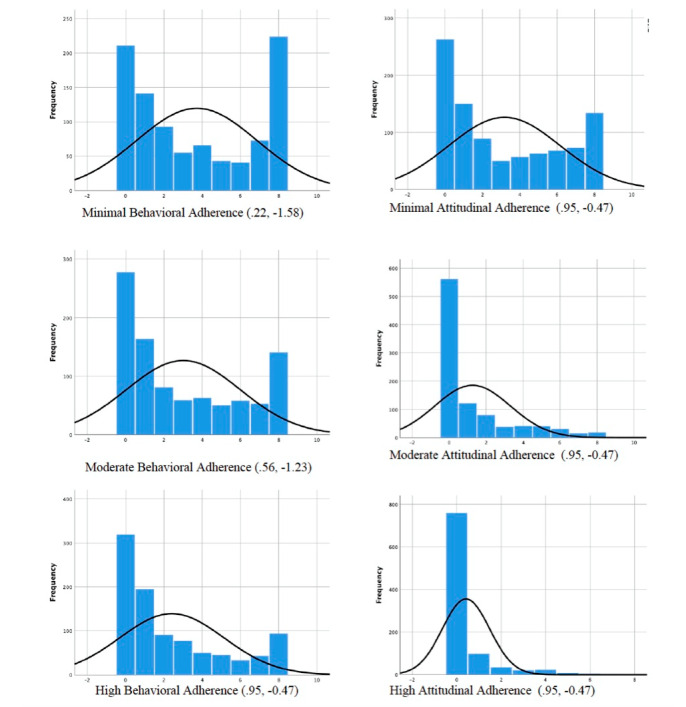
We conducted secondary analyses on data from a randomized controlled trial of an 8-week online cognitive behavioral program that targets depression and anxiety in college students. We defined multiple behavioral and attitudinal adherence measures at varying levels of effort (ie, low, moderate, and high). Linear regressions were run with adherence terms predicting improvement in the primary outcome measure, the 21-item Depression, Anxiety, and Stress Scale (DASS-21).
Of the 947 participants, 747 initiated any activity and 449 provided posttest data. Results from the intent-to-treat sample indicated that high level of effort for behavioral adherence significantly predicted symptom change (F4,746=17.18, P<.001; and β=-.26, P=.04). Moderate level of effort for attitudinal adherence also significantly predicted symptom change (F4,746=17.25, P<.001; and β=-.36, P=.03). Results differed in the initiators-only sample, such that none of the adherence measures significantly predicted symptom change (P=.09-.27).
Our findings highlight the differential results of dose-response models testing adherence measures in predicting clinical outcomes. We summarize recommendations that might provide helpful guidance to future researchers and intervention developers aiming to investigate online intervention adherence.
ClinicalTrials.gov NCT04361045; https://clinicaltrials.gov/ct2/show/NCT04361045.
自我引导式在线干预使用户能够按照自己的节奏参与干预,并克服一些传统服务障碍(如亲自预约、费用)。然而,这些干预存在高退出率,且当前文献几乎没有为定义和衡量与临床结果相关的在线干预依从性提供指导。
本研究旨在根据文献中的最佳实践,开发并测试针对特定自我引导式在线干预的多种依从性测量方法。
我们对一项为期8周的在线认知行为项目的随机对照试验数据进行了二次分析,该项目针对大学生的抑郁和焦虑。我们在不同努力程度(即低、中、高)下定义了多种行为和态度依从性测量方法。进行线性回归分析,使用依从性指标预测主要结局指标(21项抑郁、焦虑和压力量表,DASS-21)的改善情况。
在947名参与者中,747人开始了任何活动,449人提供了测试后数据。意向性分析样本的结果表明,行为依从性的高努力程度显著预测了症状变化(F4,746 = 17.18,P <.001;β = -.26,P =.04)。态度依从性的中等努力程度也显著预测了症状变化(F4,746 = 17.25,P <.001;β = -.36,P =.03)。仅启动者样本的结果有所不同,即没有任何依从性指标显著预测症状变化(P =.09 -.27)。
我们的研究结果突出了测试依从性指标以预测临床结果的剂量反应模型的不同结果。我们总结了一些建议,可能会为未来旨在研究在线干预依从性的研究人员和干预开发者提供有用的指导。
ClinicalTrials.gov NCT04361045;https://clinicaltrials.gov/ct2/show/NCT04361045