Kimura Noriyuki, Masuda Teruaki, Ataka Takuya, Matsubara Etsuro
Department of Neurology, Faculty of Medicine, Oita University, Oita, Japan.
Front Neurol. 2024 Oct 7;15:1479296. doi: 10.3389/fneur.2024.1479296. eCollection 2024.
Social isolation is a significant public health concern in aging societies. The association between conversation time and social behavior remains unclear. This study examines whether objective conversation time is associated with social activity frequency in older adults.
This prospective cohort study enrolled 855 older adults (538 women; mean age, 73.8 years) aged 65 and older, who were followed from 2015 to 2019. All participants wore a wristband sensor to measure conversation time for at least 9 days and an average of 31.3 days per year. Social behaviors were assessed through interviews, and the frequency of engagement in community activities, outings, lessons, or classes and contact frequency were assessed using a self-report questionnaire. The association between conversation time and social behavior was evaluated using multi-linear regression analysis.
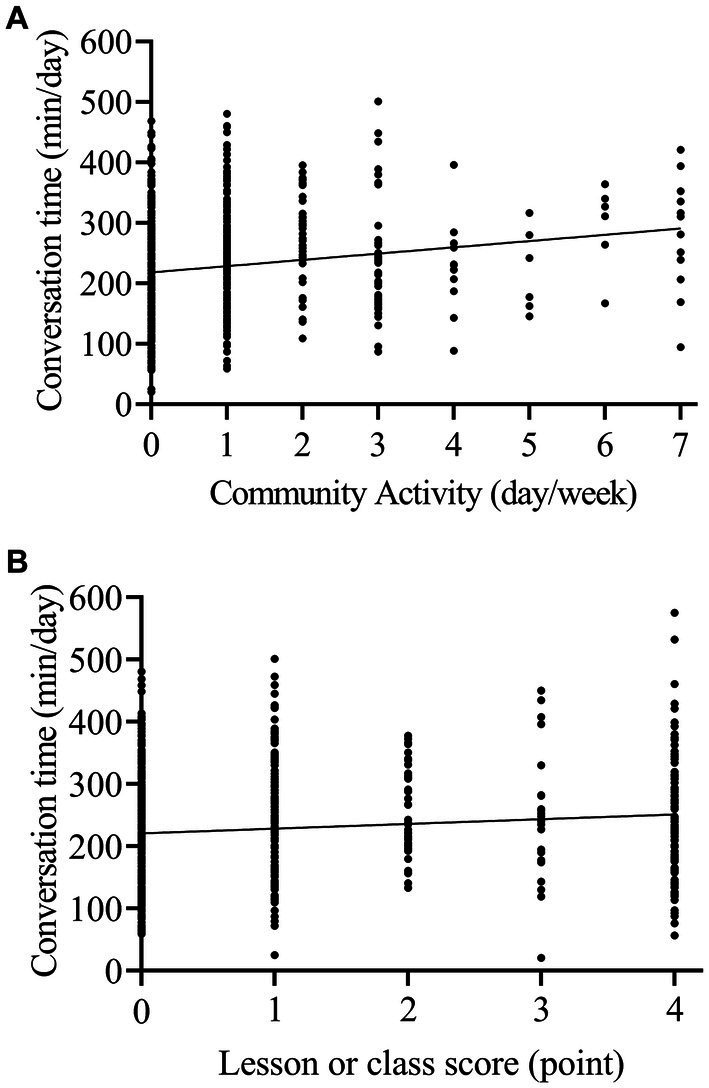
Conversation time was significantly associated with the frequency of engagement in community activities and lessons or classes after adjusting for several covariates ( = 0.181, 95% confidence interval: 0.107-0.254, < 0.001; β = 0.11, 95% confidence interval: 0.04-0.179, = 0.002).
Objectively measured conversation time using a wearable sensor is associated with social behavior and may be a valuable parameter for social isolation in older adults.
在老龄化社会中,社会隔离是一个重大的公共卫生问题。对话时间与社会行为之间的关联尚不清楚。本研究探讨客观对话时间是否与老年人的社会活动频率相关。
这项前瞻性队列研究纳入了855名65岁及以上的老年人(538名女性;平均年龄73.8岁),随访时间为2015年至2019年。所有参与者佩戴腕带传感器,以测量对话时间,每年至少9天,平均31.3天。通过访谈评估社会行为,并使用自我报告问卷评估参与社区活动、外出、课程或班级的频率以及接触频率。使用多线性回归分析评估对话时间与社会行为之间的关联。
在调整了几个协变量后,对话时间与参与社区活动以及课程或班级的频率显著相关(β = 0.181, 95%置信区间:0.107 - 0.254, P < 0.001;β = 0.11, 95%置信区间:0.04 - 0.179, P = 0.002)。
使用可穿戴传感器客观测量的对话时间与社会行为相关,可能是老年人社会隔离的一个有价值的参数。