KITE, University Health Network, 550, University Avenue, Toronto, M5G 2A2, Canada.
Department of Occupational Science and Occupational Therapy, University of Toronto, 160-500 University Avenue, Toronto, M5G 1V7, Canada.
Biomed Eng Online. 2023 Feb 27;22(1):18. doi: 10.1186/s12938-023-01080-4.
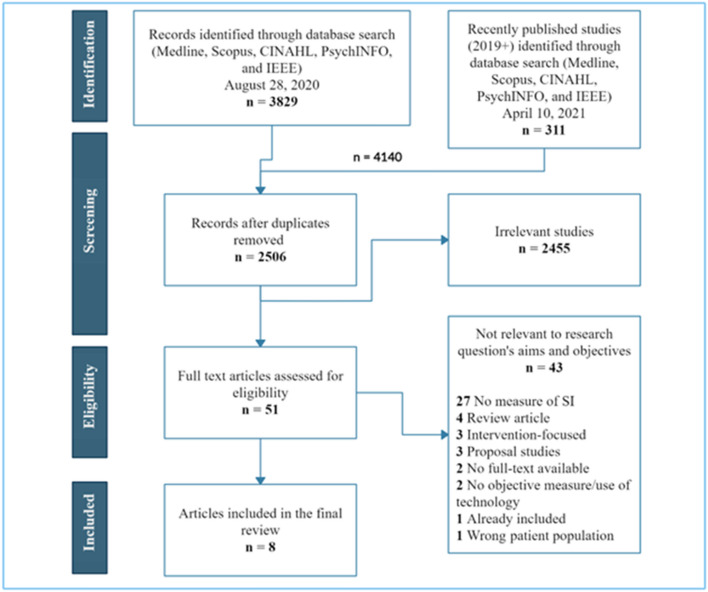
Social isolation (SI) is a state of low social interaction with peers associated with various adverse health consequences in older adults living in the community. SI is most often assessed through retrospective self-reports, which can be prone to recall or self-report biases and influenced by stigma. Ambient and wearable sensors have been explored to objectively assess SI based on interactions of a person within the environment and physiological data. However, because this field is in its infancy, there is a lack of clarity regarding the application of sensors and their data in assessing SI and the methods to develop these assessments. To understand the current state of research in sensor-based assessment of SI in older adults living in the community and to make recommendations for the field moving forward, we conducted a scoping review. The aims of the scoping review were to (i) map the types of sensors (and their associated data) that have been used for objective SI assessment, and (ii) identify the methodological approaches used to develop the SI assessment. Using an established scoping review methodology, we identified eight relevant articles. Data from motion sensors and actigraph were commonly applied and compared and correlated with self-report measures in developing objective SI assessments. Variability exists in defining SI, feature extraction and the use of sensors and self-report assessments. Inconsistent definitions and use of various self-report scales for measuring SI create barriers to studying the concept and extracting features to build predictive models. Recommendations include establishing a consistent definition of SI for sensor-based assessment research and development and consider capturing its complexity through innovative domain-specific features.
社交隔离(SI)是指与同龄人互动较少的状态,与社区中老年人的各种不良健康后果有关。SI 通常通过回顾性自我报告来评估,这可能容易受到回忆或自我报告偏差的影响,并受到污名的影响。已经探索了环境和可穿戴传感器来基于人与环境的交互和生理数据来客观评估 SI。然而,由于该领域还处于起步阶段,因此在使用传感器及其数据评估 SI 以及开发这些评估方法方面存在一些不明确之处。为了了解社区中老年人基于传感器的 SI 评估研究的现状,并为该领域的未来发展提出建议,我们进行了范围综述。范围综述的目的是:(i)绘制用于客观 SI 评估的传感器(及其相关数据)的类型图,以及(ii)确定开发 SI 评估所使用的方法。使用既定的范围综述方法,我们确定了八项相关文章。运动传感器和活动记录仪的数据通常被应用,并与自我报告测量方法相结合,用于开发客观的 SI 评估。在定义 SI、特征提取以及使用传感器和自我报告评估方面存在差异。定义 SI、使用各种自我报告量表测量 SI 的不一致性,为研究该概念和提取用于构建预测模型的特征设置了障碍。建议包括为基于传感器的评估研究和开发建立 SI 的一致定义,并考虑通过创新的特定于领域的特征来捕捉其复杂性。