Astorino Nicola Joseph, Nataliansyah M Muska, Lopez-Olivo Maria A, Adegboyega Adebola, Hirko Kelly A, Chichester Lou-Anne R, Nock Nora L, Ginex Pamela, Christy Shannon M, Levett Paul
Department of Sociology, Washington State University, 310 NW Joe Street, Pullman, WA, 99163, USA.
The genius Loci Collaboratory, Pullman, USA.
Implement Sci Commun. 2024 Oct 22;5(1):119. doi: 10.1186/s43058-024-00662-0.
Champions are integral across research in cancer, yet studies exploring their roles are limited and have produced mixed results. The current review examines and synthesizes descriptions of how champions emerged and the types of activities they most often performed. By examining evidence from across the translational research continuum, this scoping review aims to characterize the role of champions and strategies that facilitate their involvement in the implementation of cancer care interventions in both clinical and community-based settings.
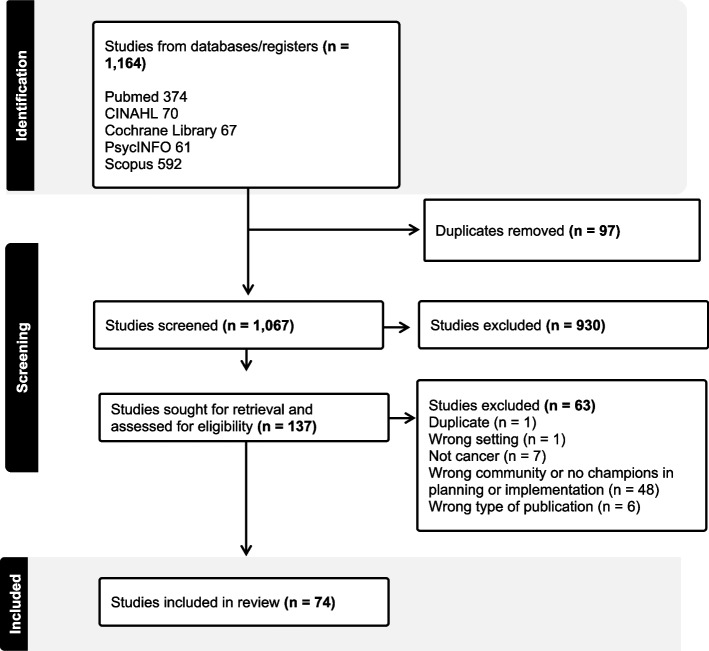
This scoping review was designed and implemented in compliance with PRISMA-ScR. The review focused on peer-reviewed articles in English-language journals. We searched five databases: PubMed (including MEDLINE), Scopus (including EMBASE), CINAHL, PsycINFO, and the Cochrane Library. Articles published from 1971 to 2022 were included. Two members of the team reviewed in duplicate each article and then a single member of the team extracted the data in Covidence, with a second member comparing the extraction to the original article. Qualitative and quantitative data were extracted and then synthesized. These data were used to summarize core champion activities and implementation strategies and to characterize barriers and facilitators to using champions in research.
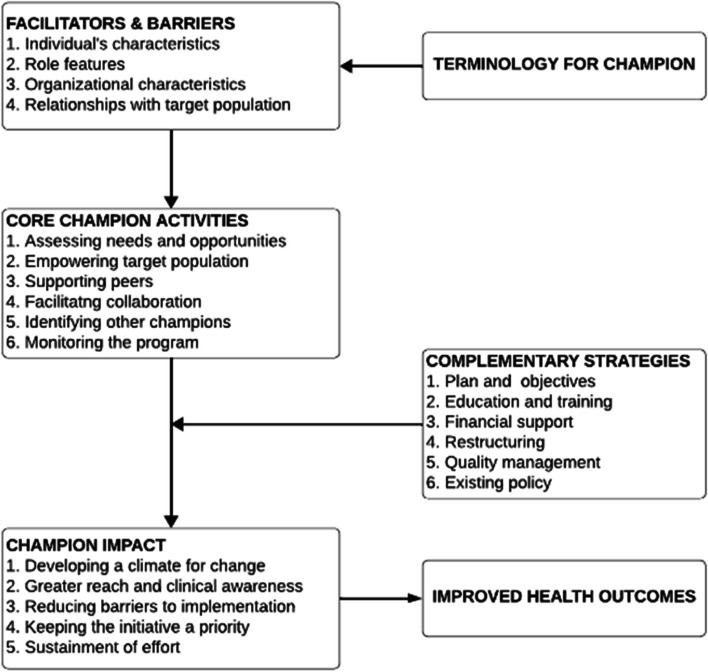
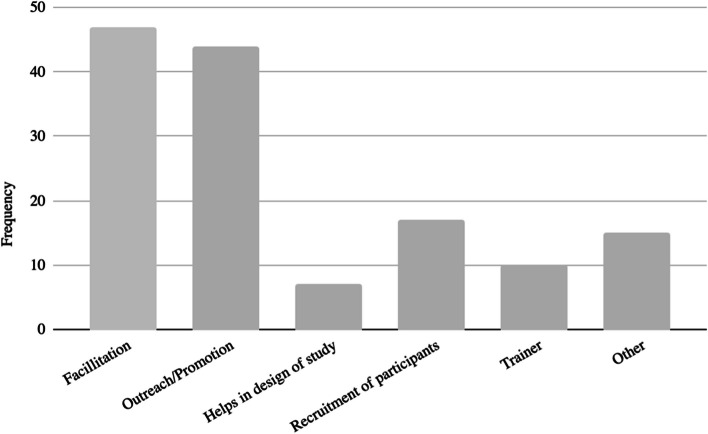
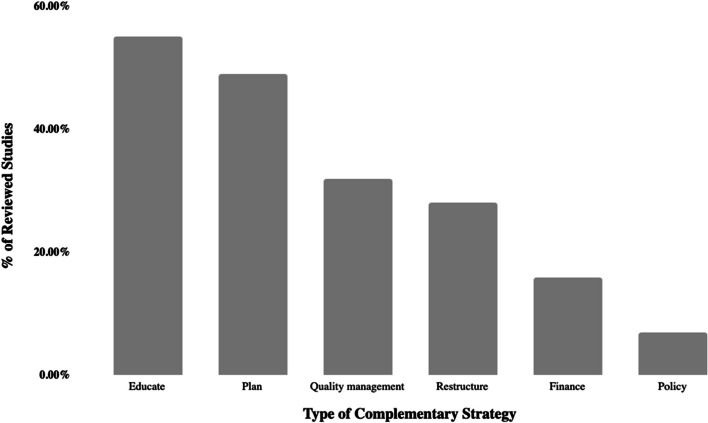
A total of 74 articles were included in the review. The qualitative synthesis highlighted facilitators and barriers to the effective use of champions. Facilitators included consideration of an individual's characteristics when identifying champions, time spent planning for the specific responsibilities of champions, working within a supportive environment, and identifying champions embedded in the target setting. Major barriers included constrained time, low self-efficacy among champions, inadequate training, high turnover rates of champions, and a lack of buy-in from organizational leadership toward the intervention. Champions also were mostly assigned their roles, had varied core activities, and used complementary strategies to empower their target populations. Champions' most frequent core activities include facilitation, outreach/promotion, and recruitment of participants into studies.
Champions were used in research of many cancer types and often serve similar roles regardless of where they are located within the translational research process. Despite their critical role, evidence is lacking on the impact of champions specifically on outcomes of many of the research studies that include them. Future research is needed to understand the nuances of champion-driven approaches across diverse cancer care settings.
倡导者在癌症研究中不可或缺,但探索其作用的研究有限且结果不一。本综述审视并综合了关于倡导者如何出现以及他们最常开展的活动类型的描述。通过审视转化研究连续体中的证据,本范围综述旨在描述倡导者的作用以及促进他们参与临床和社区环境中癌症护理干预措施实施的策略。
本范围综述的设计和实施符合PRISMA-ScR。该综述聚焦于英文期刊上的同行评议文章。我们检索了五个数据库:PubMed(包括MEDLINE)、Scopus(包括EMBASE)、CINAHL、PsycINFO和Cochrane图书馆。纳入了1971年至2022年发表的文章。团队的两名成员对每篇文章进行双人评审,然后由团队的一名成员在Covidence中提取数据,另一名成员将提取内容与原文进行比对。提取并综合了定性和定量数据。这些数据用于总结倡导者的核心活动和实施策略,并描述在研究中使用倡导者的障碍和促进因素。
本综述共纳入74篇文章。定性综合突出了有效使用倡导者的促进因素和障碍。促进因素包括在确定倡导者时考虑个人特征、花时间规划倡导者的具体职责、在支持性环境中工作以及确定目标环境中的倡导者。主要障碍包括时间受限、倡导者自我效能低、培训不足、倡导者更替率高以及组织领导层对干预措施缺乏认同。倡导者大多是被分配角色,有不同的核心活动,并使用互补策略来增强目标人群的权能。倡导者最常见的核心活动包括促进、外展/推广以及招募研究参与者。
倡导者被用于多种癌症类型的研究中,并且无论在转化研究过程中的位置如何,通常都发挥着类似的作用。尽管他们发挥着关键作用,但缺乏关于倡导者对许多纳入他们的研究结果具体影响的证据。未来需要开展研究以了解在不同癌症护理环境中倡导者驱动方法的细微差别。