Singh Lakhvir, Martin Romany, Mandrusiak Allison, Phua Rachel, Al-Hashemy Hussan, Forbes Roma
School of Health and Rehabilitation Sciences, The University of Queensland Brisbane Australia.
School of Health Sciences, The University of Tasmania Launceston Australia.
Health Sci Rep. 2024 Oct 21;7(10):e70132. doi: 10.1002/hsr2.70132. eCollection 2024 Oct.
The variables that contribute to positive and negative experiences of clinical education amongst student physiotherapists are well established. Multiple stakeholders are invested in the ongoing success of physiotherapy clinical placements given workforce challenges within the profession and the emerging relationship between clinical placements and new-graduate recruitment. However, little is known about the relationship between clinical placement experiences and the career decisions of new-graduate physiotherapists.
To explore the influence of clinical placement experiences on new-graduate physiotherapists' career intentions and decision making.
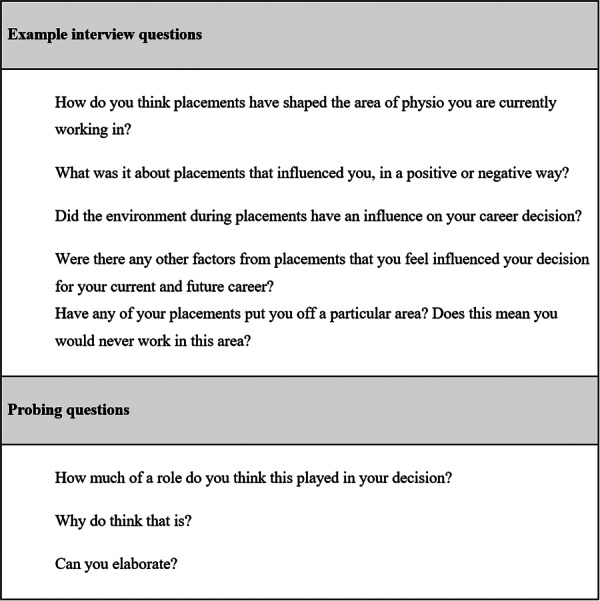
A qualitative study which used a general inductive approach. New-graduate physiotherapists (n = 18) were recruited through a snowball sampling approach and participated in semi-structured interviews. Ethical approval was obtained from The University of Queensland.
Four overarching themes were generated; (1) clinical placements impact career decisions, (2) placements as a trial for future employment to identify professional preferences, (3) feeling valued as a team member, and (4) clinical educators' shape placement experiences.
Clinical placements play a significant role in directing new-graduate physiotherapists' careers, with clinical placement viewed as an opportunity to explore one's career options. A complex interplay of clinical and nonclinical variables was acknowledged by new-graduates, with positive experiences during clinical placements considered to increase new-graduate physiotherapist intentions to work in similar settings or contexts. Factors that contributed to positive experiences included accessible mentorship from clinical educators with regular feedback, and opportunities for the students' contribution and clinical capacity to be acknowledged and valued. Recommendations are made for creating supportive workplace environments for clinical education and include prioritizing supportive mentorship.
Clinical placement providers intending to recruit new-graduates who have attended their workplace as students may benefit from implementing strategies that assist students to feel supported as valued members of the team. Additionally, the findings of this study may guide education providers when considering the training delivered to new and existing clinical placement sites with the aim of providing supported student learning environments.
影响物理治疗专业学生临床教育积极和消极体验的因素已得到充分证实。鉴于该行业的劳动力挑战以及临床实习与新毕业生招聘之间的新关系,多个利益相关者都关注物理治疗临床实习的持续成功。然而,对于临床实习经历与新毕业物理治疗师的职业决策之间的关系,我们知之甚少。
探讨临床实习经历对新毕业物理治疗师职业意向和决策的影响。
采用一般归纳法进行定性研究。通过滚雪球抽样法招募了18名新毕业物理治疗师,并参与了半结构化访谈。获得了昆士兰大学的伦理批准。
产生了四个总体主题;(1)临床实习影响职业决策,(2)实习作为未来就业的试验以确定职业偏好,(3)作为团队成员感到被重视,(4)临床教育工作者塑造实习经历。
临床实习在指导新毕业物理治疗师的职业发展方面发挥着重要作用,临床实习被视为探索职业选择的机会。新毕业生认识到临床和非临床变量之间的复杂相互作用,临床实习期间的积极经历被认为会增加新毕业物理治疗师在类似环境或背景下工作的意向。促成积极体验的因素包括临床教育工作者提供的可及的指导和定期反馈,以及学生的贡献和临床能力得到认可和重视的机会。建议为临床教育创造支持性的工作场所环境,包括优先提供支持性指导。
打算招聘曾作为学生在其工作场所实习的新毕业生的临床实习提供者,可能会从实施有助于学生作为团队中有价值成员获得支持的策略中受益。此外,本研究的结果可能会指导教育提供者在考虑为新的和现有的临床实习地点提供培训时,旨在提供支持性的学生学习环境。