Rogers Jonathan P, Mastellari Tomas, Berry Alex J, Kumar Kieron, Burchill Ella, David Anthony S, Lewis Glyn, Lees Andrew, Zandi Michael S
Division of Psychiatry, University College London, London W1T 7NF, UK.
Department of Neuropsychiatry, National Hospital for Neurology and Neurosurgery, London WC1N 3BG, UK.
Brain Commun. 2024 Oct 4;6(5):fcae347. doi: 10.1093/braincomms/fcae347. eCollection 2024.
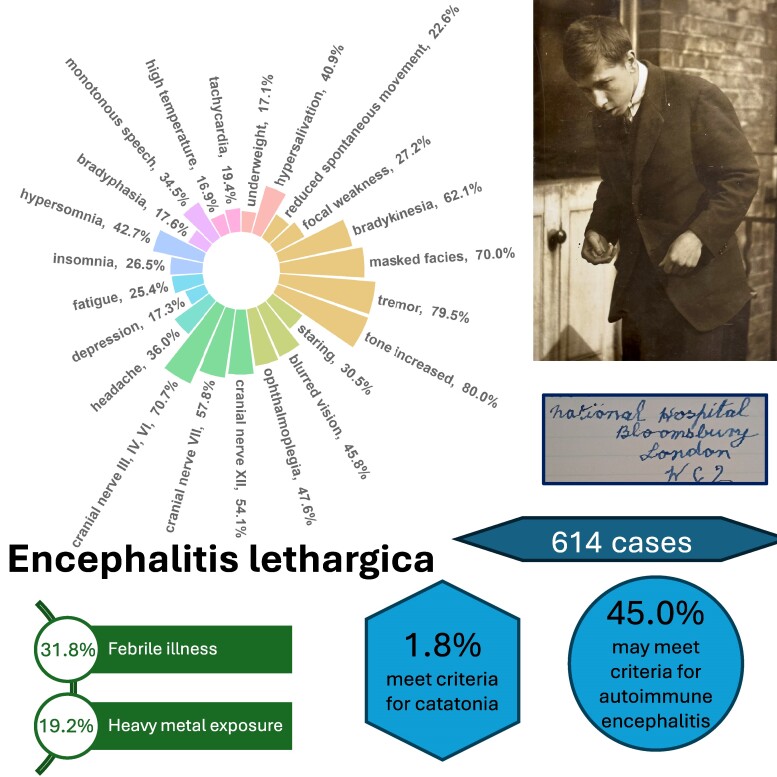
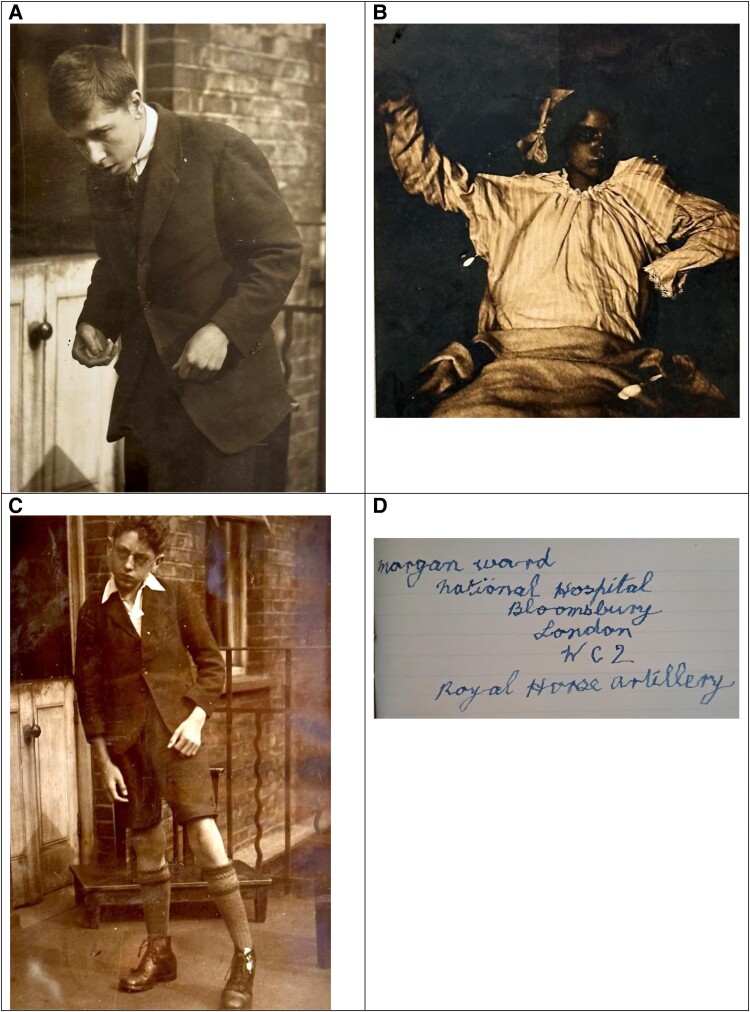
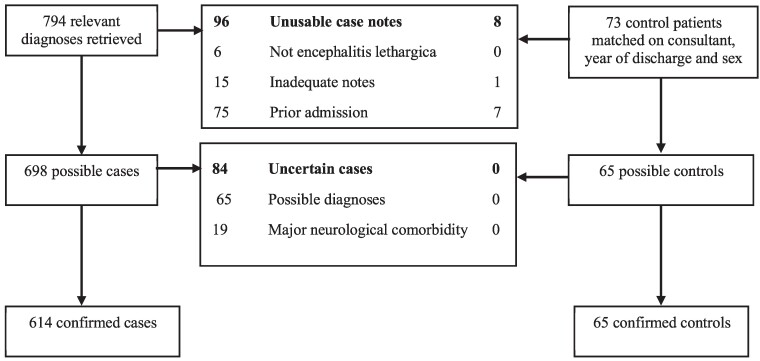
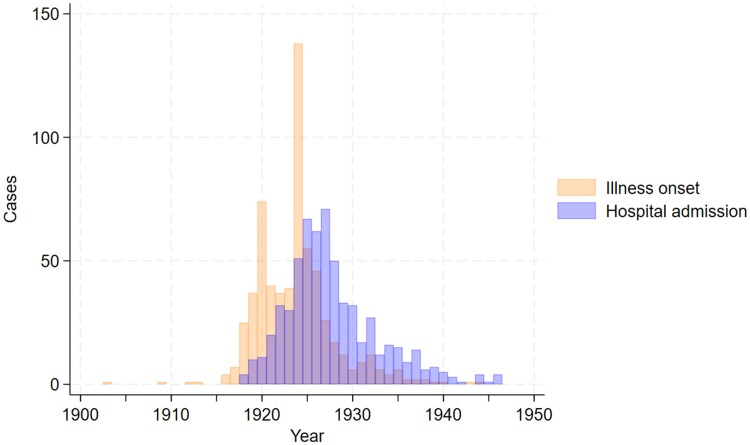
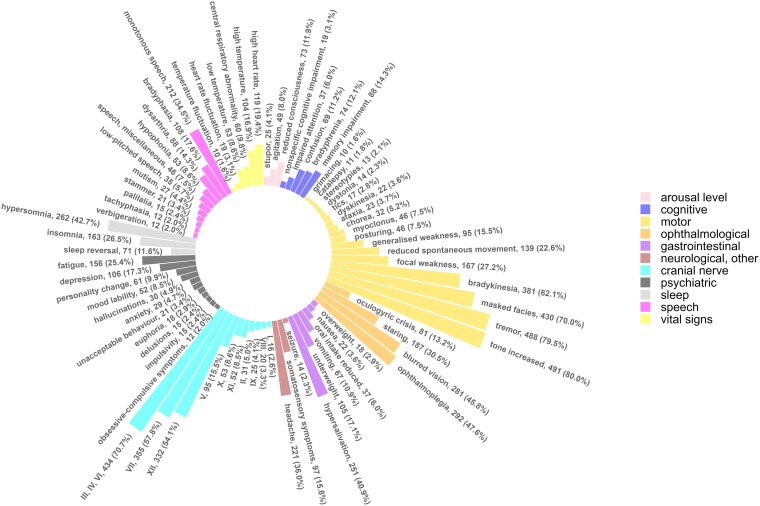
Encephalitis lethargica, an epidemic neurological illness, typically involved a severe sleep disorder and progressive parkinsonism. A century later, our understanding relies on seminal descriptions, more recent historical research and the study of small numbers of possible sporadic cases. Theories around infection, environmental toxins, catatonia and autoimmune encephalitis have been proposed. We aimed to describe the presentation of encephalitis lethargica and test these diagnostic and aetiological theories. Subjects with encephalitis lethargica were identified in the archives of the National Hospital for Neurology and Neurosurgery, UK between 1918 and 1946. Case notes were examined to establish illness temporality, clinical features and cerebrospinal fluid results. Controls from the archives were identified for 10% of cases, matching on discharge year, sex and neurologist. Clinical presentation was compared to modern diagnostic criteria for encephalitis lethargica, catatonia and autoimmune encephalitis. In a case-control design, a multilevel logistic regression was conducted to ascertain whether cases of encephalitis lethargica were associated with febrile illnesses and with environmental exposures. Six hundred and fourteen cases of encephalitis lethargica and 65 controls were identified. Cases had a median age of 29 years (interquartile range 18) and a median time since symptomatic onset of 3.00 years (interquartile range 3.52). Motor features were present in 97.6%, cranial nerve findings in 91.0%, ophthalmological features in 77.4%, sleep disorders in 66.1%, gastrointestinal or nutritional features in 62.1%, speech disorders in 60.8% and psychiatric features in 53.9%. Of the 167 cases who underwent lumbar puncture, 20 (12.0%) had a pleocytosis. The Howard and Lees criteria for encephalitis lethargica had a sensitivity of 28.5% and specificity of 96.9%. Among the cases, 195 (31.8%, 95% confidence interval 28.1-35.6%) had a history of febrile illness within one calendar year prior to illness onset, which was more common than among the controls (odds ratio 2.70, 95% confidence interval 1.02-7.20, = 0.05), but there was substantial reporting bias. There was no evidence that occupational exposure to solvents or heavy metals was associated with encephalitis lethargica. Two hundred and seventy-six (45.0%) of the cases might meet criteria for possible autoimmune encephalitis, but only 3 (0.5%) might meet criteria for probable NMDA receptor encephalitis. Only 11 cases (1.8%) met criteria for catatonia. Encephalitis lethargica has a distinct identity as a neuropsychiatric condition with a wide range of clinical features. Evidence for a relationship with infectious or occupational exposures was weak. Autoimmune encephalitis may be an explanation, but typical cases were inconsistent with NMDA receptor encephalitis.
昏睡性脑炎是一种流行性神经疾病,通常伴有严重的睡眠障碍和进行性帕金森症。一个世纪后,我们的认识依赖于开创性的描述、近期的历史研究以及对少量可能的散发病例的研究。围绕感染、环境毒素、紧张症和自身免疫性脑炎的理论已被提出。我们旨在描述昏睡性脑炎的临床表现,并检验这些诊断和病因学理论。在英国国家神经病学与神经外科医院1918年至1946年的档案中识别出昏睡性脑炎患者。检查病历以确定发病时间、临床特征和脑脊液检查结果。从档案中为10%的病例确定对照,根据出院年份、性别和神经科医生进行匹配。将临床表现与昏睡性脑炎、紧张症和自身免疫性脑炎的现代诊断标准进行比较。在病例对照设计中,进行多水平逻辑回归以确定昏睡性脑炎病例是否与发热性疾病和环境暴露有关。共识别出614例昏睡性脑炎病例和65例对照。病例的中位年龄为29岁(四分位间距为18),自出现症状起的中位时间为3.00年(四分位间距为3.52)。97.6%的病例有运动特征,91.0%有脑神经表现,77.4%有眼科特征,66.1%有睡眠障碍,62.1%有胃肠道或营养方面的特征,60.8%有言语障碍,53.9%有精神方面的特征。在167例接受腰椎穿刺的病例中,20例(12.0%)有细胞数增多。霍华德和李斯的昏睡性脑炎标准的敏感性为28.5%,特异性为96.9%。在病例中,195例(31.8%,95%置信区间28.1 - 35.6%)在发病前一个日历年内有发热性疾病史,这比对照组更常见(比值比2.70,95%置信区间1.02 - 7.20,P = 0.05),但存在大量报告偏倚。没有证据表明职业性接触溶剂或重金属与昏睡性脑炎有关。276例(45.0%)病例可能符合可能的自身免疫性脑炎标准,但只有3例(0.5%)可能符合可能的N - 甲基 - D - 天冬氨酸受体脑炎标准。只有11例(1.8%)符合紧张症标准。昏睡性脑炎作为一种具有广泛临床特征的神经精神疾病有其独特的特征。与感染或职业暴露相关的证据薄弱。自身免疫性脑炎可能是一种解释,但典型病例与N - 甲基 - D - 天冬氨酸受体脑炎不一致。