Gorelik Aaron J, Paul Sarah E, Miller Alex P, Baranger David A A, Lin Shuyu, Zhang Wei, Elsayed Nourhan M, Modi Hailey, Addala Pooja, Bijsterbosch Janine, Barch Deanna M, Karcher Nicole R, Hatoum Alexander S, Agrawal Arpana, Bogdan Ryan, Johnson Emma C
Department of Psychological & Brain Sciences, Washington University in St. Louis, St. Louis, MO, USA.
Department of Psychiatry, Washington University School of Medicine, St. Louis, MO, USA.
Psychol Med. 2024 Oct 23;54(13):1-15. doi: 10.1017/S0033291724002174.
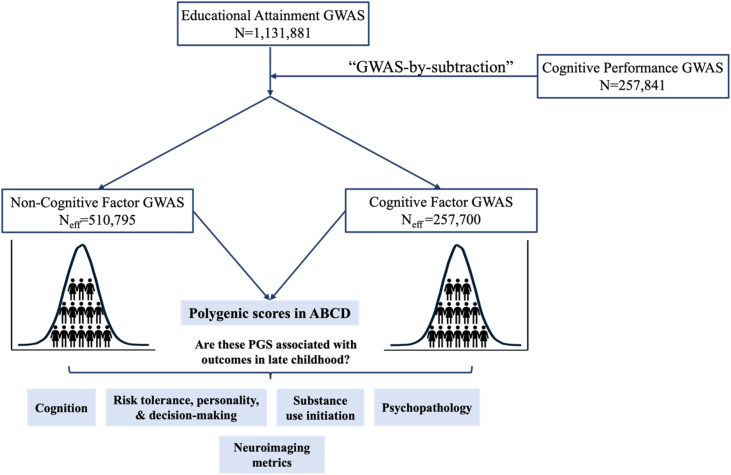
Educational attainment (EduA) is correlated with life outcomes, and EduA itself is influenced by both cognitive and non-cognitive factors. A recent study performed a 'genome-wide association study (GWAS) by subtraction,' subtracting genetic effects for cognitive performance from an educational attainment GWAS to create orthogonal 'cognitive' and 'non-cognitive' factors. These cognitive and non-cognitive factors showed associations with behavioral health outcomes in adults; however, whether these correlations are present during childhood is unclear.
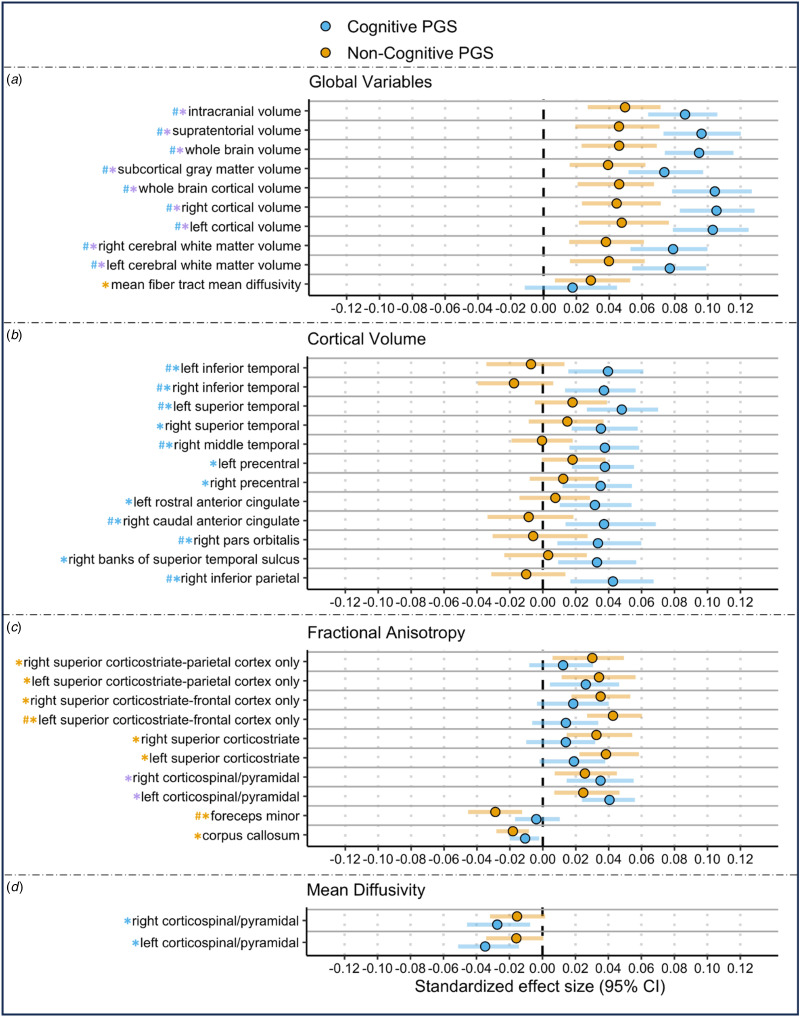
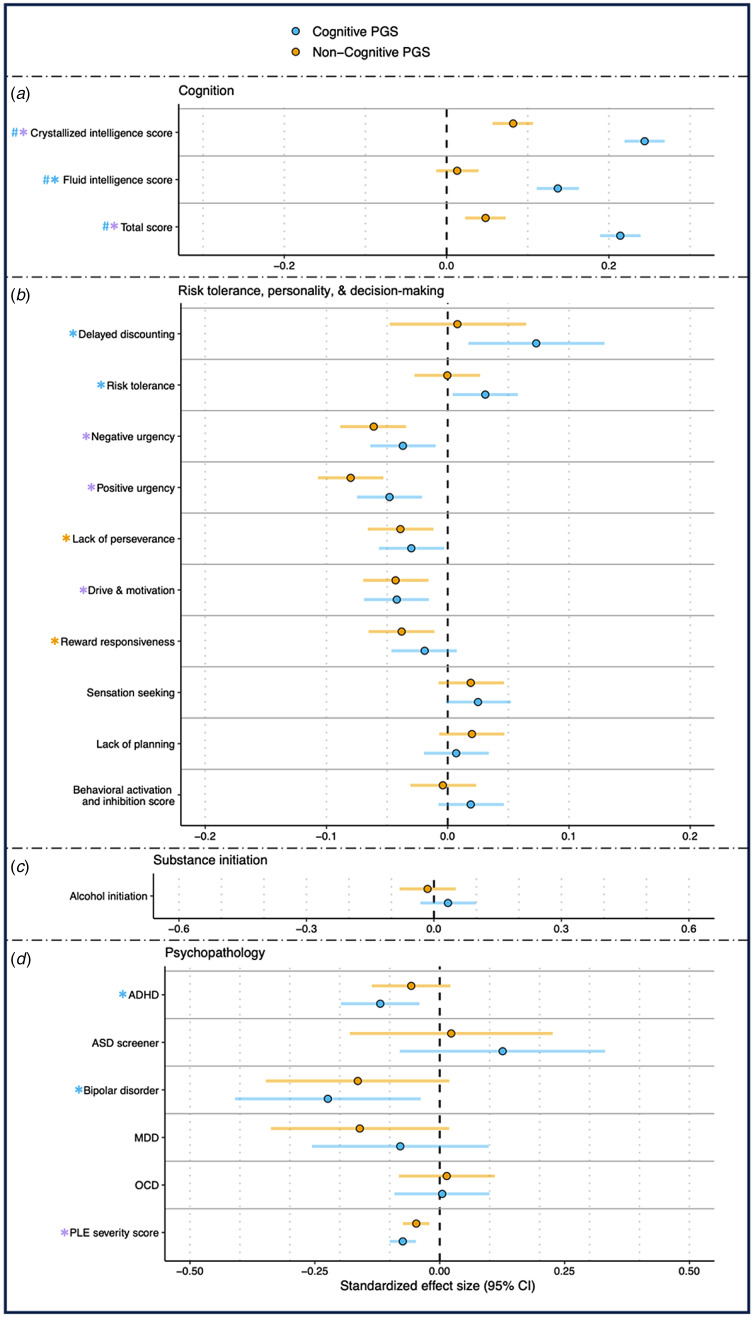
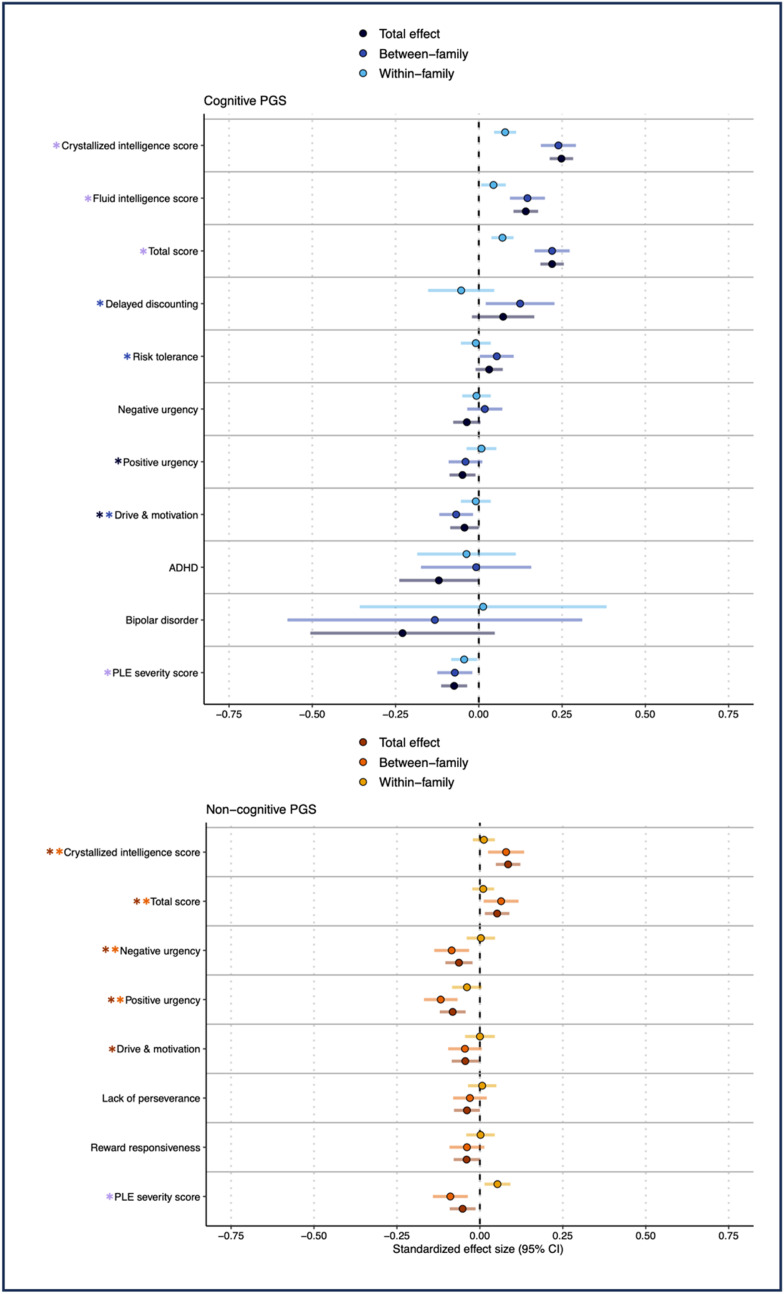
Using data from up to 5517 youth (ages 9-11) of European ancestry from the ongoing Adolescent Brain Cognitive Development Study, we examined associations between polygenic scores (PGS) for cognitive and non-cognitive factors and cognition, risk tolerance, decision-making & personality, substance initiation, psychopathology, and brain structure (e.g. volume, fractional anisotropy [FA]). Within-sibling analyses estimated whether observed genetic associations may be consistent with direct genetic effects.
Both PGSs were associated with greater cognition and lower impulsivity, drive, and severity of psychotic-like experiences. The cognitive PGS was also associated with greater risk tolerance, increased odds of choosing delayed reward, and decreased likelihood of ADHD and bipolar disorder; the non-cognitive PGS was associated with lack of perseverance and reward responsiveness. Cognitive PGS were more strongly associated with larger regional cortical volumes; non-cognitive PGS were more strongly associated with higher FA. All associations were characterized by small effects.
While the small sizes of these associations suggest that they are not effective for prediction within individuals, cognitive and non-cognitive PGS show unique associations with phenotypes in childhood at the population level.
教育程度(EduA)与生活结果相关,而EduA本身受到认知和非认知因素的影响。最近一项研究进行了一项“减法全基因组关联研究(GWAS)”,从教育程度GWAS中减去认知表现的遗传效应,以创建正交的“认知”和“非认知”因素。这些认知和非认知因素与成年人的行为健康结果相关;然而,这些相关性在儿童期是否存在尚不清楚。
利用来自正在进行的青少年大脑认知发展研究中多达5517名欧洲血统青少年(9至11岁)的数据,我们研究了认知和非认知因素的多基因评分(PGS)与认知、风险承受能力、决策和个性、物质使用起始、精神病理学以及脑结构(如体积、分数各向异性[FA])之间的关联。同胞内分析估计观察到的遗传关联是否可能与直接遗传效应一致。
两种PGS均与更高的认知能力以及更低的冲动性、驱动力和类精神病体验严重程度相关。认知PGS还与更高的风险承受能力、选择延迟奖励的几率增加以及注意力缺陷多动障碍(ADHD)和双相情感障碍的可能性降低相关;非认知PGS与缺乏毅力和奖励反应性相关。认知PGS与更大的区域皮质体积关联更强;非认知PGS与更高的FA关联更强。所有关联的效应都较小。
虽然这些关联效应较小表明它们对个体内部的预测无效,但认知和非认知PGS在人群水平上与儿童期的表型显示出独特的关联。