Vanderbilt Memory and Alzheimer's Center, Vanderbilt University Medical Center, Nashville, Tennessee, USA.
Department of Medicine, Vanderbilt University Medical Center, Nashville, Tennessee, USA.
Ann Clin Transl Neurol. 2024 Nov;11(11):2977-2986. doi: 10.1002/acn3.52209. Epub 2024 Oct 23.
This study examined the effect of cognitive status, education, and sex on the association between subjective cognitive decline (SCD) and Alzheimer's disease (AD) biomarkers in non-demented older adults.
Vanderbilt Memory and Aging Project participants (n = 129), dementia or stroke free, completed fasting lumbar puncture, SCD assessment, and cognitive assessment. Cerebrospinal fluid (CSF) biomarkers for AD were analyzed. Linear regression models related SCD to CSF AD biomarkers and follow-up models assessed interactions of SCD × cognitive status, sex, reading level, and education on AD biomarkers.
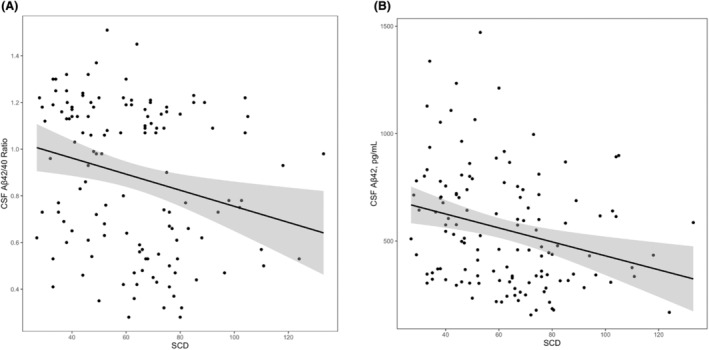
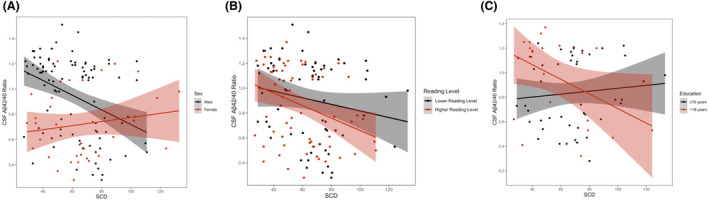
In main effect models, higher SCD was associated with more amyloidosis (p-values <0.004). SCD was not associated with tau, p-tau, or neurofilament light (NFL) levels (p-values >0.38). SCD score interacted with cognitive status (p < 0.02), sex (p = 0.03), and education (p-values <0.005) on amyloidosis. In stratified models, higher SCD was associated with more amyloid in cognitively unimpaired (p-values <0.003), men (p = 0.0003), and higher education. No SCD score × reading-level interaction was found (p-values >0.51) though SCD related to amyloid markers in the higher reading-level group (p-values <0.004).
Higher SCD was associated with greater cerebral amyloid accumulation, one of the earliest pathological AD changes. SCD appears most useful in detecting early AD-related brain changes prior to objective cognitive impairment, in men, and those with higher quantity and quality of education and highlight the importance of considering these factors.
本研究旨在探讨认知状态、教育程度和性别对主观认知下降(SCD)与非痴呆老年人阿尔茨海默病(AD)生物标志物之间关联的影响。
范德比尔特记忆与衰老项目参与者(n=129),无痴呆或中风,完成禁食腰椎穿刺、SCD 评估和认知评估。分析脑脊液(CSF)AD 生物标志物。线性回归模型将 SCD 与 CSF AD 生物标志物相关联,随访模型评估 SCD×认知状态、性别、阅读水平和教育对 AD 生物标志物的交互作用。
在主要效应模型中,较高的 SCD 与更多的淀粉样蛋白(p 值<0.004)相关。SCD 与 tau、p-tau 或神经丝轻链(NFL)水平无关(p 值>0.38)。SCD 评分与认知状态(p<0.02)、性别(p=0.03)和教育程度(p 值<0.005)在淀粉样蛋白上存在交互作用。在分层模型中,在认知正常(p 值<0.003)、男性(p=0.0003)和高教育程度的个体中,较高的 SCD 与更多的淀粉样蛋白相关。未发现 SCD 评分×阅读水平的交互作用(p 值>0.51),尽管 SCD 与较高阅读水平组的淀粉样蛋白标志物相关(p 值<0.004)。
较高的 SCD 与大脑淀粉样蛋白堆积增加有关,这是 AD 最早的病理变化之一。SCD 在检测认知功能障碍之前的早期 AD 相关脑变化方面似乎最有用,尤其是在男性和教育程度较高的人群中,这凸显了考虑这些因素的重要性。