Programa de Pós-graduação em Enfermagem, Universidade Federal de Pelotas, Pelotas, Brasil.
Programa de Pós-graduação em Epidemiologia, Universidade Federal de Pelotas, Pelotas, Brasil.
Cad Saude Publica. 2024 Oct 18;40(10):e00208022. doi: 10.1590/0102-311XEN208022. eCollection 2024.
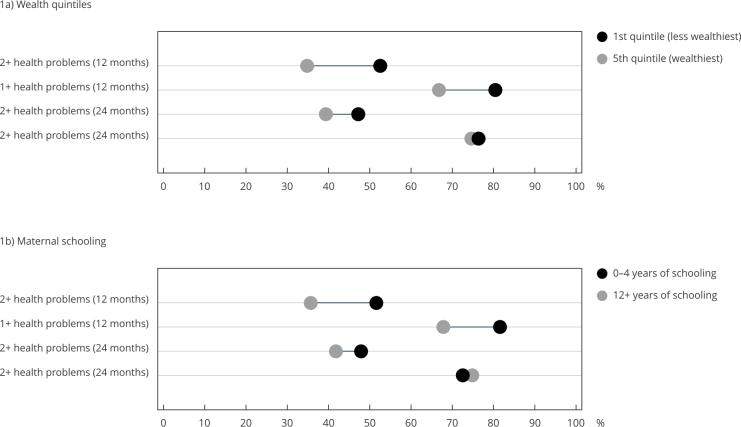
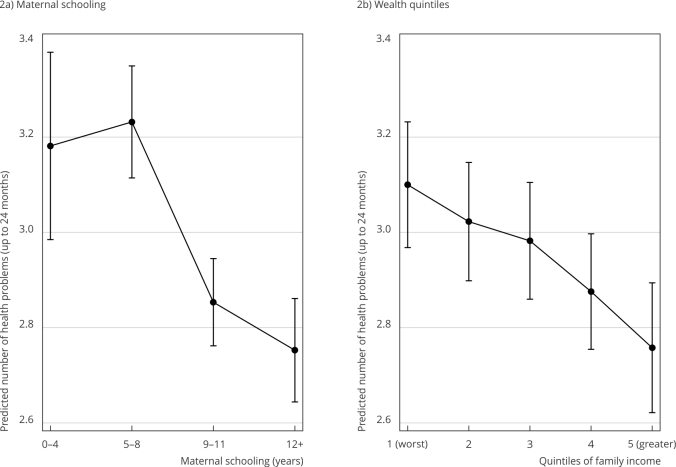
Brazil is characterized by an unfinished agenda of health inequalities, which impact health problems in the childhood. This study aimed to evaluate the socioeconomic inequalities of health problems in the early childhood. This is a prospective study, using data from the birth cohort carried out in the city of Pelotas (Rio Grande do Sul State, Brazil) in 2015. The outcomes were health problems presented at 12 and 24 months: cough, breathing difficulty, diarrhea, ear pain, pneumonia, urinary infection, hospitalization, and other health problems. Socioeconomic inequalities were measured applying the slope index of inequality (SII) and the concentration index (CIX), with wealth index and maternal schooling being the socioeconomic variables. The inequalities in the number of health problems were evaluated by Poisson regression. The perinatal sample comprised 4,275 children. At 12 months approximately 74% of the children presented 1 or more health problems, while at 24 months, approximately 44% presented 2 or more health problems. For all period, the mean number of health problems was 2.9 (standard deviation = 2.0). Higher frequencies were observed for children belonging to the poorest income quintile and with lower maternal education, except for 1 or more health problems at 24 months. The greatest absolute and relative inequality was observed for 2 or more health problems at 12 months (SII: -0.23, 95%CI: -0.29; -0.18 and CIX: -0.19, 95%CI: -0.25; -0.14). There is an opposite dose-response relation for the risk of accumulation of health problems according to maternal schooling (1.07, 95%CI: 1.04; 1.09) and wealth categories (1.03, 95%CI: 1.01; 1.04), in the full adjusted models. The study confirms inequalities due to health problems in Brazilian children, especially in the first year of life.
巴西的卫生不平等问题尚未得到解决,这对儿童时期的健康问题产生了影响。本研究旨在评估儿童早期健康问题的社会经济不平等状况。这是一项前瞻性研究,使用了 2015 年在巴西佩洛塔斯市进行的出生队列研究的数据。研究结果为 12 个月和 24 个月时出现的健康问题:咳嗽、呼吸困难、腹泻、耳痛、肺炎、尿路感染、住院和其他健康问题。使用不平等斜率指数(SII)和集中指数(CIX)来衡量社会经济不平等,财富指数和母亲教育程度是社会经济变量。通过泊松回归评估健康问题数量的不平等。围产期样本包括 4275 名儿童。12 个月时,约 74%的儿童出现 1 种或多种健康问题,而 24 个月时,约 44%的儿童出现 2 种或多种健康问题。在整个研究期间,儿童平均出现 2.9 种(标准差=2.0)健康问题。属于最贫困收入五分位组和受教育程度较低的儿童出现健康问题的频率更高,除了 24 个月时有 1 种或多种健康问题的情况。12 个月时出现 2 种或更多健康问题的绝对和相对不平等最大(SII:-0.23,95%CI:-0.29;-0.18 和 CIX:-0.19,95%CI:-0.25;-0.14)。在完全调整后的模型中,母亲教育程度(1.07,95%CI:1.04;1.09)和财富类别(1.03,95%CI:1.01;1.04)与健康问题积累风险之间存在相反的剂量反应关系。本研究证实了巴西儿童健康问题存在不平等现象,尤其是在生命的第一年。