Department of Horticulture, University of Georgia, 1111 Miller Plant Sciences, Athens, GA, 30602, USA.
U.S. Department of Agriculture, Agriculture Research Service, U.S. Horticultural Research Laboratory, 2001 South Rock Road, Fort Pierce, FL, 34945, USA.
Sci Rep. 2024 Oct 23;14(1):24964. doi: 10.1038/s41598-024-74929-w.
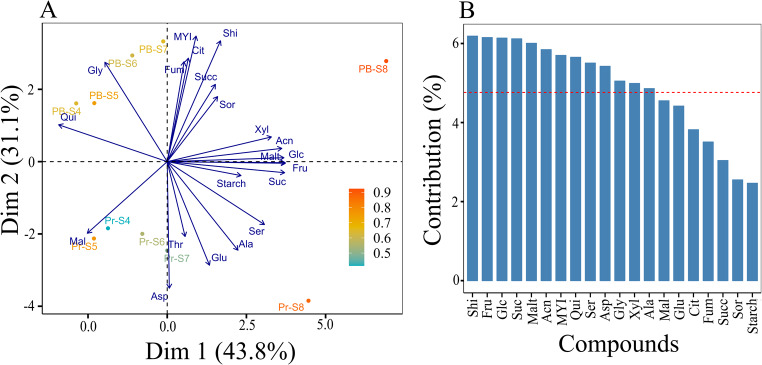
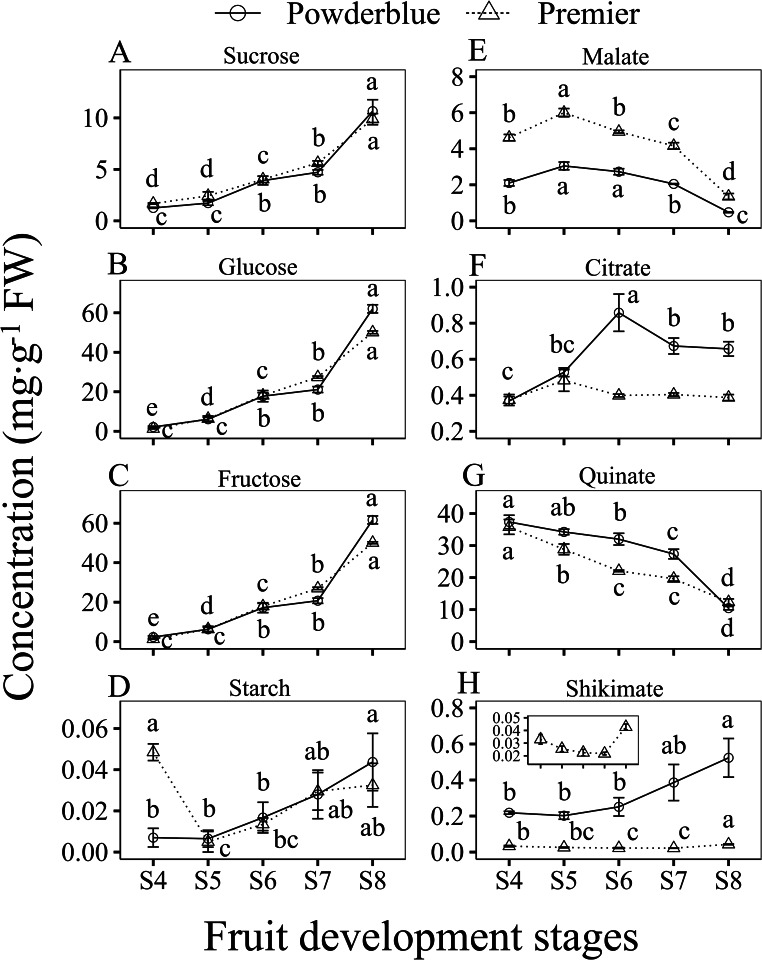
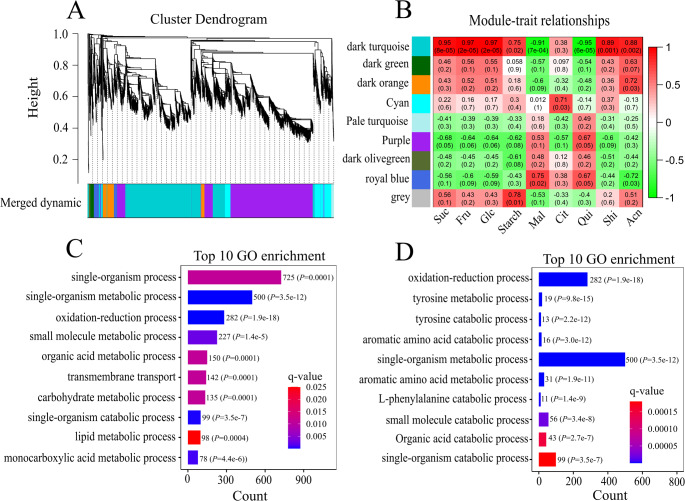
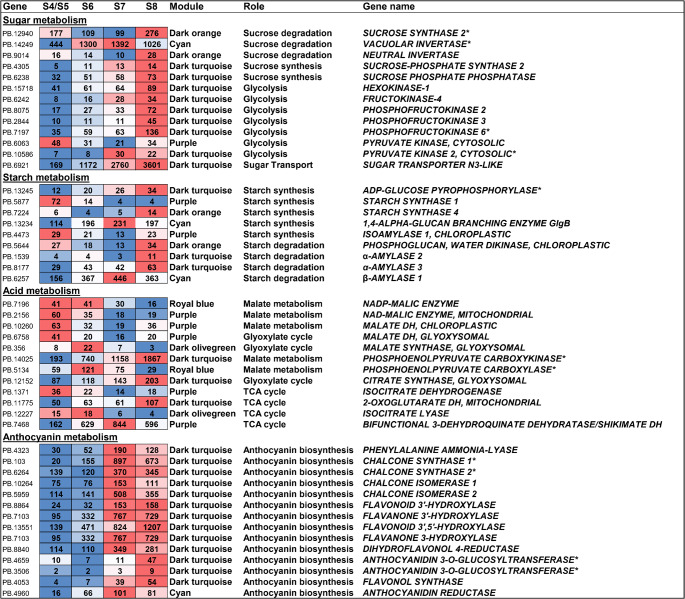
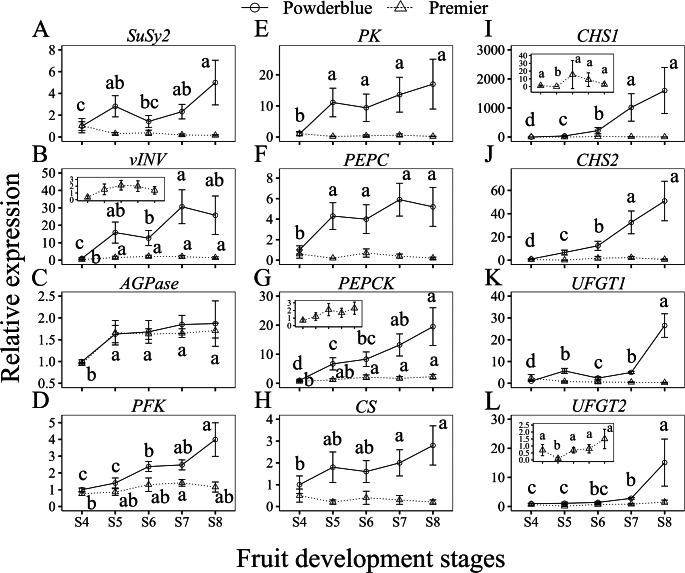
Fruit ripening is a highly coordinated process involving molecular and biochemical changes that collectively determine fruit quality. The underlying metabolic programs and their transitions leading to fruit ripening remain largely under-characterized in blueberry (Vaccinium sp.), which exhibits atypical climacteric behavior. In this study, we focused on sugar, acid and anthocyanin metabolism in two rabbiteye blueberry cultivars, Premier and Powderblue, during fruit development and ripening. Concentrations of the three major sugars, sucrose (Suc), glucose (Glc), and fructose (Fru) increased steadily during fruit development leading up to ripening, and increased dramatically by around 2-fold in 'Premier' and 2- to 3-fold in 'Powderblue' during the final stage of fruit ripening. Starch concentration was very low throughout fruit development in both cultivars indicating that it does not serve the role of a major transitory carbon (C) storage form in blueberry fruit. Together, these patterns indicate continued import of C, likely in the form of Suc, throughout blueberry fruit development. Concentrations of the predominant acids, malate and quinate, decreased during ripening, and may contribute to increased shikimate biosynthesis which, in-turn, allows for downstream phenylpropanoid metabolism leading to anthocyanin synthesis. Consistently, anthocyanin concentrations were highest in fully ripened blue fruit. Weighted gene co-expression network analysis (WGCNA) was performed using a 'Powderblue' fruit ripening transcriptome and targeted fruit metabolite concentration data. A 'dark turquoise' module positively correlated with sugars and anthocyanins, and negatively correlated with acids (malate, quinate), was identified. Gene Ontology (GO) enrichment analysis of this module identified transcripts related to sugar, acid, and phenylpropanoid metabolism pathways. Among these, increased transcript abundance of a VACUOLAR INVERTASE during ripening was consistent with sugar storage in the vacuole. In general, transcript abundance of the glycolysis pathway genes was upregulated during ripening. The transcript abundance of PHOSPHOENOLPYRUVATE (PEP) CARBOXYKINASE increased during fruit ripening and was negatively correlated with malate concentration, suggesting increased malate conversion to PEP, which supports anthocyanin production during fruit ripening. This was further supported by the co-upregulation of several anthocyanin biosynthesis-related genes. Together, this study provides insights into important metabolic programs, and their underlying gene expression patterns during fruit development and ripening in blueberry.
果实成熟是一个高度协调的过程,涉及分子和生化变化,这些变化共同决定了果实的品质。在蓝莓(Vaccinium sp.)中,果实成熟的潜在代谢途径及其转变仍然很大程度上没有得到描述,蓝莓表现出非典型的呼吸高峰行为。在这项研究中,我们专注于两个兔眼蓝莓品种 Premier 和 Powderblue 果实发育和成熟过程中糖、酸和花青素的代谢。在果实发育过程中,三种主要糖(蔗糖(Suc)、葡萄糖(Glc)和果糖(Fru)的浓度稳步上升,在果实成熟的最后阶段,Premier 中的浓度增加了约 2 倍,在 Powderblue 中增加了 2-3 倍。在两个品种的整个果实发育过程中,淀粉浓度都非常低,表明淀粉不是蓝莓果实中主要的暂态碳(C)储存形式。这些模式表明,在蓝莓果实发育过程中,持续有 C 的输入,可能是以 Suc 的形式。主要酸(苹果酸和奎宁酸)的浓度在成熟过程中下降,可能有助于增加莽草酸的生物合成,从而允许下游苯丙素代谢途径导致花青素的合成。一致地,完全成熟的蓝色果实中花青素浓度最高。使用兔眼蓝莓果实成熟转录组和靶向果实代谢物浓度数据进行加权基因共表达网络分析(WGCNA)。鉴定到一个与糖和花青素呈正相关,与酸(苹果酸、奎宁酸)呈负相关的“深蓝色”模块。该模块的基因本体论(GO)富集分析确定了与糖、酸和苯丙素代谢途径相关的转录本。其中,在成熟过程中,液泡型 invertase 的转录本丰度增加,这与糖在液泡中的储存相一致。一般来说,糖酵解途径基因的转录本丰度在成熟过程中上调。磷酸烯醇丙酮酸(PEP)羧激酶的转录本丰度在果实成熟过程中增加,与苹果酸浓度呈负相关,表明苹果酸向 PEP 的转化率增加,这支持了果实成熟过程中花青素的产生。这进一步得到了几个花青素生物合成相关基因的共同上调的支持。总的来说,这项研究提供了在蓝莓果实发育和成熟过程中重要代谢途径及其潜在基因表达模式的见解。