Cominetti Fabrizio, Vaucher Julien, Marques-Vidal Pedro, Kraege Vanessa
Internal Medicine Division, Department of Medicine, Lausanne University Hospital and University of Lausanne, Lausanne, Switzerland.
Division of Internal Medicine, Department of Internal Medicine and Specialties, Hospital and University of Fribourg, Fribourg, Switzerland.
JACC Adv. 2024 Oct 9;3(11):101324. doi: 10.1016/j.jacadv.2024.101324. eCollection 2024 Nov.
Moderate-intensity physical activity (PA) is recommended for health benefits, but optimal PA timing regarding cardiovascular disease (CVD) is debated.
The authors assessed the impact of differing PA patterns on CVD risk factors and outcomes.
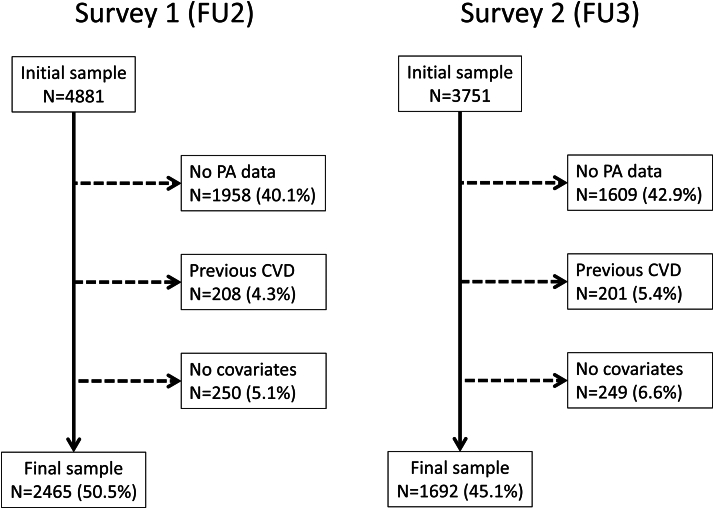
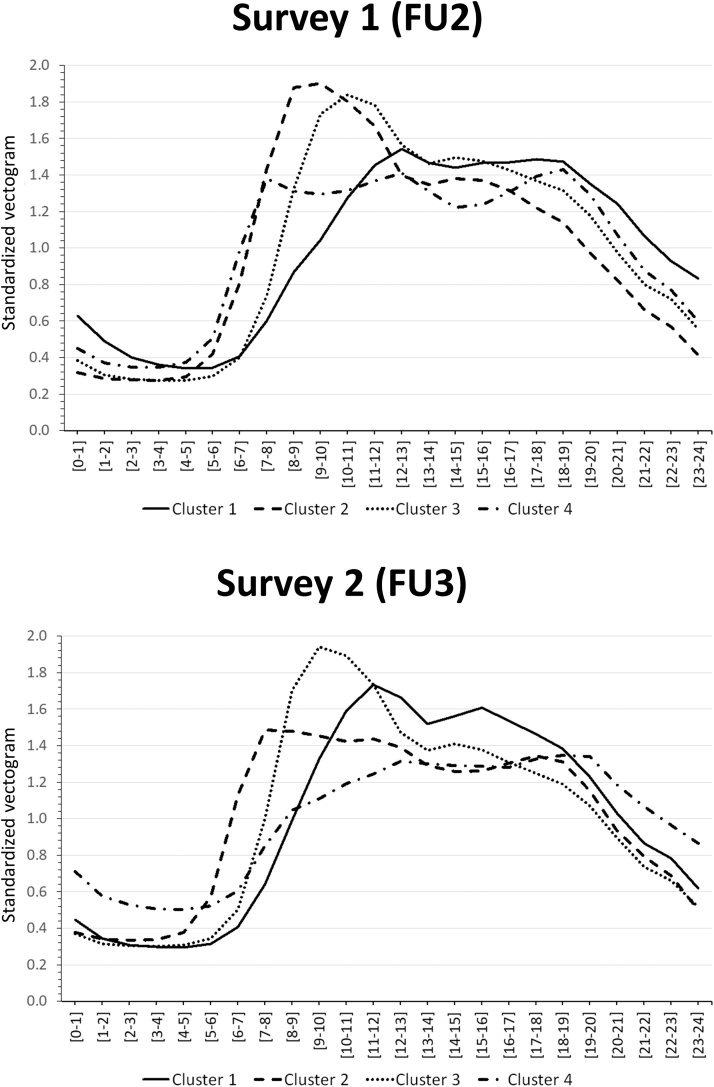
Data from 2 surveys (S1 and S2) of the CoLaus-PsyCoLaus study (2,465 and 1,692 participants, respectively; 55.3% [54.3%] females; mean age 61.2 ± 9.7 years [64.4 ± 9.5]), conducted in Lausanne, Switzerland. PA was assessed using a wrist-worn accelerometer, and PA patterns were assessed using K-means clustering.
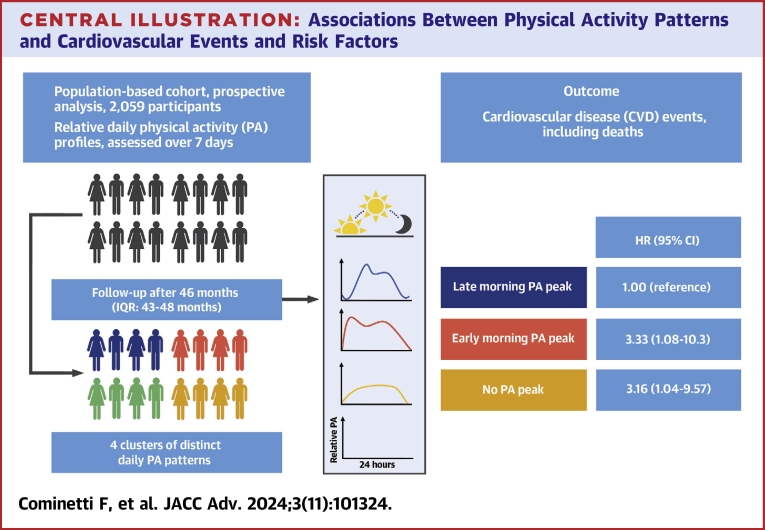
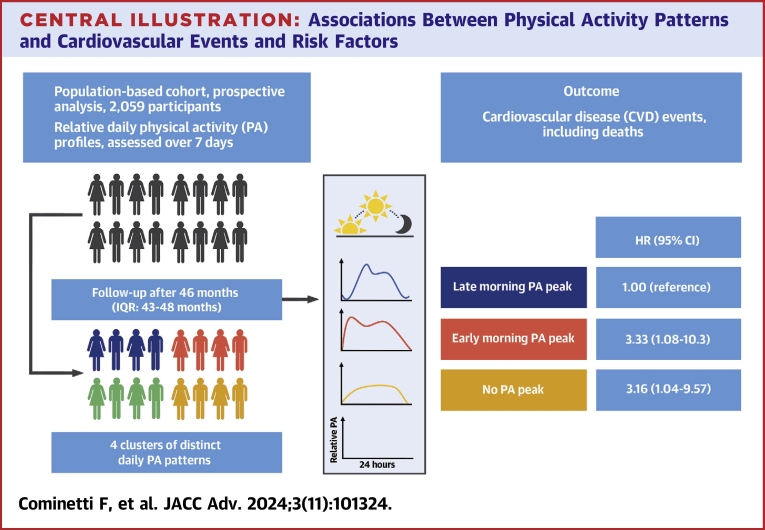
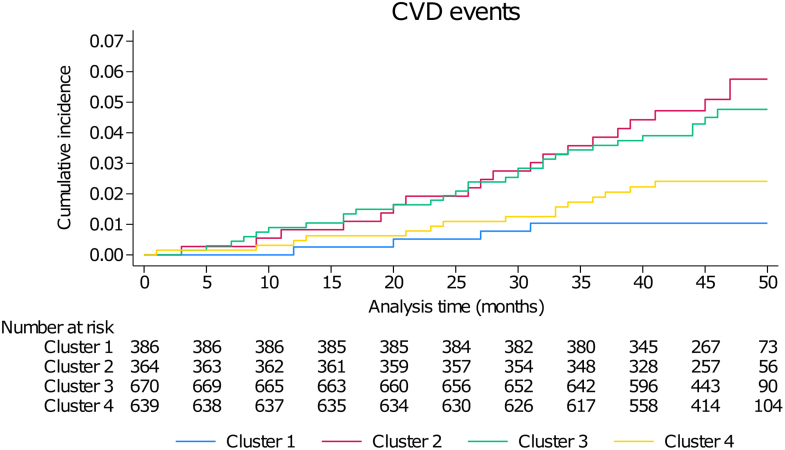
Morning PA was positively associated with hypertension (multivariable-adjusted OR: 1.36 [95% CI: 1.00-1.84]) in S1, similar trend in S2. No significant association was found between PA clusters and total, HDL-, and LDL-cholesterol or triglycerides. Morning PA was positively associated with hypolipidemic drug treatment: 1.88 (1.07-3.30) in S2. Evenly distributed daily PA was positively associated with diabetes: 1.82 (95% CI: 1.06-3.12) in S2, with a similar trend in S1. In the outcome analysis, the early morning PA cluster (7 am-12 am) and the evenly distributed daily PA cluster led to a higher risk of CVD events (HR: 3.33 [95% CI: 1.08-10.3] and 3.16 [95% CI: 1.04-9.57], respectively).
In a population-based study, we observed a higher risk for cardiovascular events in participants whose daily PA occurred predominantly in the early morning (7 am-12 am) or was evenly distributed throughout the day. No PA pattern was consistently associated with hypertension, blood lipids, or diabetes markers.
推荐进行中等强度的体育活动(PA)以促进健康,但关于心血管疾病(CVD)的最佳PA时间存在争议。
作者评估了不同PA模式对CVD危险因素和结局的影响。
来自瑞士洛桑的CoLaus-PsyCoLaus研究的两项调查(S1和S2)的数据(分别有2465名和1692名参与者;女性占55.3%[54.3%];平均年龄61.2±9.7岁[64.4±9.5])。使用腕部佩戴的加速度计评估PA,并使用K均值聚类评估PA模式。
在S1中,早晨PA与高血压呈正相关(多变量调整后的OR:1.36[95%CI:1.00-1.84]),S2中有类似趋势。未发现PA聚类与总胆固醇、高密度脂蛋白胆固醇、低密度脂蛋白胆固醇或甘油三酯之间存在显著关联。早晨PA与降血脂药物治疗呈正相关:S2中为1.88(1.07-3.30)。全天均匀分布的PA与糖尿病呈正相关:S2中为1.82(95%CI:1.06-3.12),S1中有类似趋势。在结局分析中,清晨PA聚类(上午7点至中午12点)和全天均匀分布的PA聚类导致CVD事件风险更高(HR分别为:3.33[95%CI:1.08-10.3]和3.16[95%CI:1.04-9.57])。
在一项基于人群的研究中,我们观察到每日PA主要发生在清晨(上午7点至中午12点)或全天均匀分布的参与者发生心血管事件的风险更高。没有一种PA模式与高血压、血脂或糖尿病标志物始终相关。