Institute of Social and Preventive Medicine, University of Bern, Bern, Switzerland.
Department of Medicine, Internal Medicine, Lausanne University Hospital (CHUV) and University of Lausanne, Office BH10-642, Rue du Bugnon 46, 1011, Lausanne, Switzerland.
Sci Rep. 2023 Feb 18;13(1):2879. doi: 10.1038/s41598-023-29872-7.
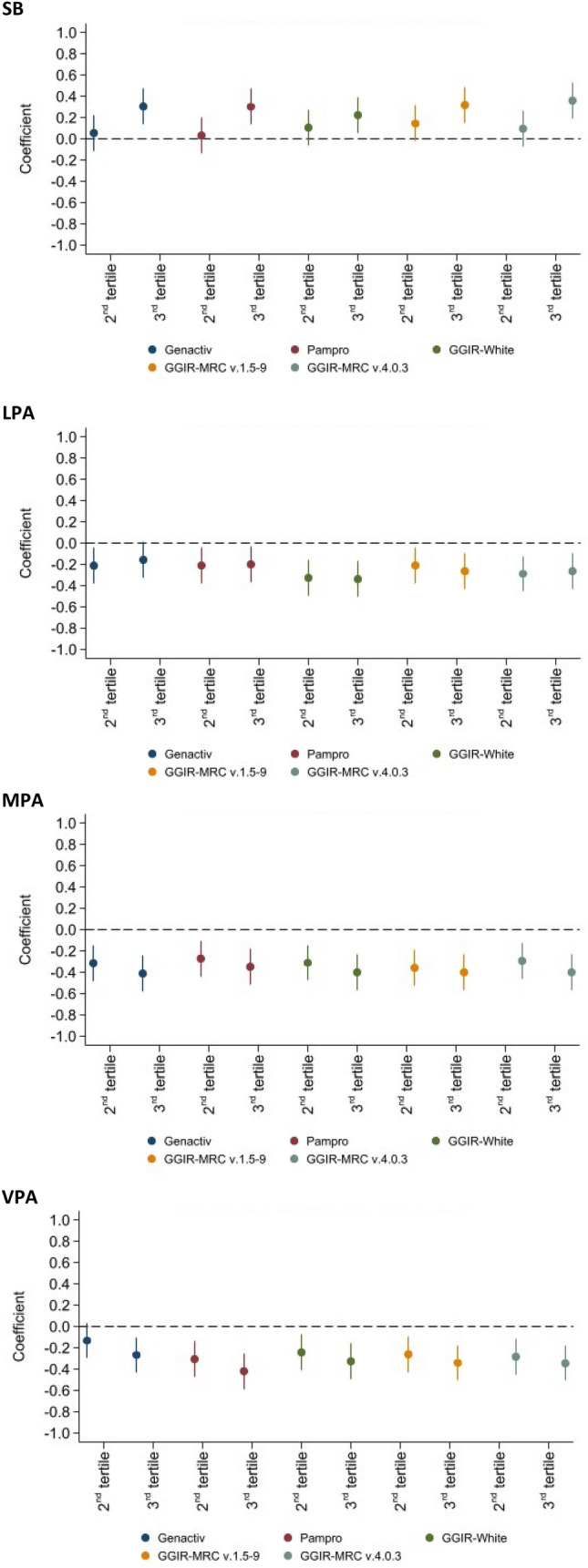
Several raw-data processing software for accelerometer-measured physical activity (PA) exist, but whether results agree has not been assessed. We examined the agreement between three different software for raw accelerometer data, and associated their results with cardiovascular risk. A cross-sectional analysis conducted between 2014 and 2017 in 2693 adults (53.4% female, 45-86 years) living in Lausanne, Switzerland was used. Participants wore the wrist-worn GENEActive accelerometer for 14 days. Data was processed with the GENEActiv manufacturer software, the Pampro package in Python and the GGIR package in R. For the latter, two sets of thresholds "White" and "MRC" defining levels of PA and two versions (1.5-9 and 1.11-1) for the "MRC" threshold were used. Cardiovascular risk was assessed using the SCORE risk score. Time spent (mins/day) in stationary, light, moderate and vigorous PA ranged from 633 (GGIR-MRC) to 1147 (Pampro); 93 (GGIR-White) to 196 (GGIR-MRC); 19 (GGIR-White) to 161 (GENEActiv) and 1 (GENEActiv) to 26 (Pampro), respectively. Spearman correlations between results ranged between 0.317 and 0.995, while concordance coefficients ranged between 0.035 and 0.968. With some exceptions, the line of perfect agreement was not in the 95% confidence interval of the Bland-Altman plots. Compliance to PA guidelines varied considerably: 99.8%, 98.7%, 76.3%, 72.6% and 50.2% for Pampro, GENEActiv, GGIR-MRC v.1.11-1, GGIR-MRC v.1.4-9 and GGIR-White, respectively. Cardiovascular risk decreased with increasing time spent in PA across most software packages. We found large differences in PA estimation between software and thresholds used, which makes comparability between studies challenging.
目前存在几种用于处理加速度计测量的身体活动(PA)原始数据的软件,但尚未评估其结果是否一致。我们检验了三种不同的原始加速度计数据处理软件之间的一致性,并将其结果与心血管风险相关联。本研究为 2014 年至 2017 年期间在瑞士洛桑居住的 2693 名成年人(53.4%为女性,年龄 45-86 岁)进行的横断面分析。参与者佩戴腕戴式 GENEActive 加速度计 14 天。数据分别使用 GENEActiv 制造商软件、Python 中的 Pampro 包和 R 中的 GGIR 包进行处理。对于后者,使用了定义 PA 水平的“White”和“MRC”两套阈值,以及“MRC”阈值的两个版本(1.5-9 和 1.11-1)。心血管风险使用 SCORE 风险评分进行评估。静止、轻度、中度和剧烈 PA 时间(分钟/天)范围分别为 633(GGIR-MRC)至 1147(Pampro);93(GGIR-White)至 196(GGIR-MRC);19(GGIR-White)至 161(GENEActiv)和 1(GENEActiv)至 26(Pampro)。结果之间的 Spearman 相关系数范围在 0.317 到 0.995 之间,而一致性系数范围在 0.035 到 0.968 之间。除了一些例外,完美一致性线不在 Bland-Altman 图的 95%置信区间内。对 PA 指南的依从性差异很大:Pampro、GENEActiv、GGIR-MRC v.1.11-1、GGIR-MRC v.1.4-9 和 GGIR-White 的依从率分别为 99.8%、98.7%、76.3%、72.6%和 50.2%。在大多数软件包中,随着 PA 时间的增加,心血管风险降低。我们发现软件和使用的阈值之间在 PA 估计方面存在很大差异,这使得研究之间的可比性具有挑战性。