Centre for Advanced Material Application, Slovak Academy of Sciences, Bratislava, Slovakia.
Department of Nanobiology, Cancer Research Institute, Biomedical Research Center, Slovak Academy of Sciences, Bratislava, Slovakia.
Drug Des Devel Ther. 2024 Oct 19;18:4629-4659. doi: 10.2147/DDDT.S483140. eCollection 2024.
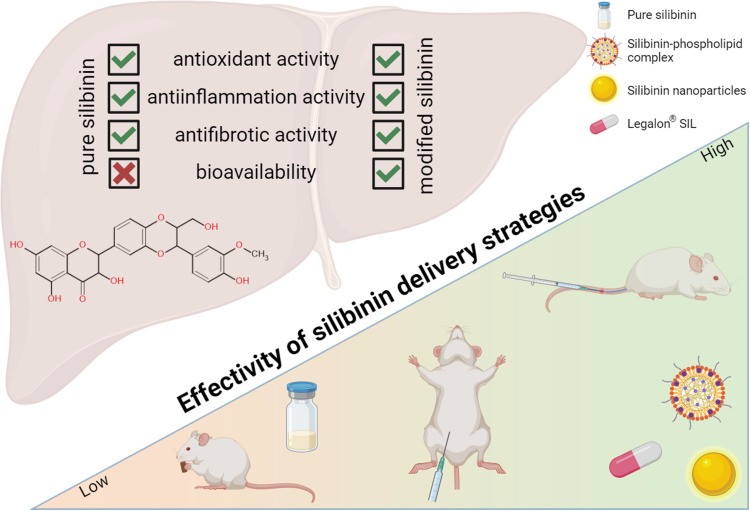
Silibinin, a bioactive component found in milk thistle extract (), is known to have significant therapeutic potential in the treatment of various liver diseases. It is considered a key element of silymarin, which is traditionally used to support liver function. The main mechanisms of action of silibinin are attributed to its antioxidant properties protecting liver cells from damage caused by free radicals. Experimental studies conducted in vitro and in vivo have confirmed its ability to inhibit inflammatory and fibrotic processes, as well as promote the regeneration of damaged liver tissue. Therefore, silibinin represents a promising tool for the treatment of liver diseases. Since the silibinin molecule is insoluble in water and has poor bioavailability in vivo, new perspectives on solving this problem are being sought. The two most promising approaches are the water-soluble derivative silibinin-C-2',3-dihydrogen succinate, disodium salt, and the silibinin-phosphatidylcholine complex. Both drugs are currently under evaluation in liver disease clinical trials. Nevertheless, the mechanism underlying silibinin biological activity is still elusive and its more detailed understanding would undoubtedly increase its potential in the development of effective therapeutic strategies against liver diseases. This review is focused on the therapeutic potential of silibinin and its derivates, approaches to increase the bioavailability and the benefits in the treatment of liver diseases that have been achieved so far. The review discusses the relevant in vitro and in vivo studies that investigated the protective effects of silibinin in various forms of liver damage.
水飞蓟宾,一种从水飞蓟提取物()中发现的生物活性成分,在治疗各种肝脏疾病方面具有显著的治疗潜力。它被认为是水飞蓟素的关键成分,传统上用于支持肝功能。水飞蓟宾的主要作用机制归因于其抗氧化特性,可保护肝细胞免受自由基损伤。体外和体内的实验研究证实了它抑制炎症和纤维化过程以及促进受损肝组织再生的能力。因此,水飞蓟宾是治疗肝脏疾病的有前途的工具。由于水飞蓟宾分子不溶于水,体内生物利用度差,因此正在寻求解决这个问题的新方法。最有前途的两种方法是水溶性衍生物水飞蓟宾 C-2',3-二氢琥珀酸,二钠盐和水飞蓟宾-磷脂酰胆碱复合物。这两种药物目前都在肝脏疾病临床试验中进行评估。然而,水飞蓟宾生物活性的机制仍然难以捉摸,更详细地了解这一机制无疑将增加其在开发针对肝脏疾病的有效治疗策略方面的潜力。这篇综述重点介绍了水飞蓟宾及其衍生物的治疗潜力、提高生物利用度的方法以及迄今为止在治疗肝脏疾病方面取得的益处。综述讨论了研究水飞蓟宾在各种形式肝损伤中的保护作用的相关体外和体内研究。