Fan Shipei, Shi Xing-Yu, Li Xia, Li Jun, Yu Song-Ping
Department of Ophthalmology, Lishui Municipal Central Hospital, The Fifth Affiliated Hospital of Wenzhou Medical University, Zhejiang, China.
Department of Nephrology, Lishui Municipal Central Hospital, The Fifth Affiliated Hospital of Wenzhou Medical University, Zhejiang, China.
Front Med (Lausanne). 2024 Oct 9;11:1431170. doi: 10.3389/fmed.2024.1431170. eCollection 2024.
This study aimed to assess the causal relationships between vitamin D levels and ocular disorders.
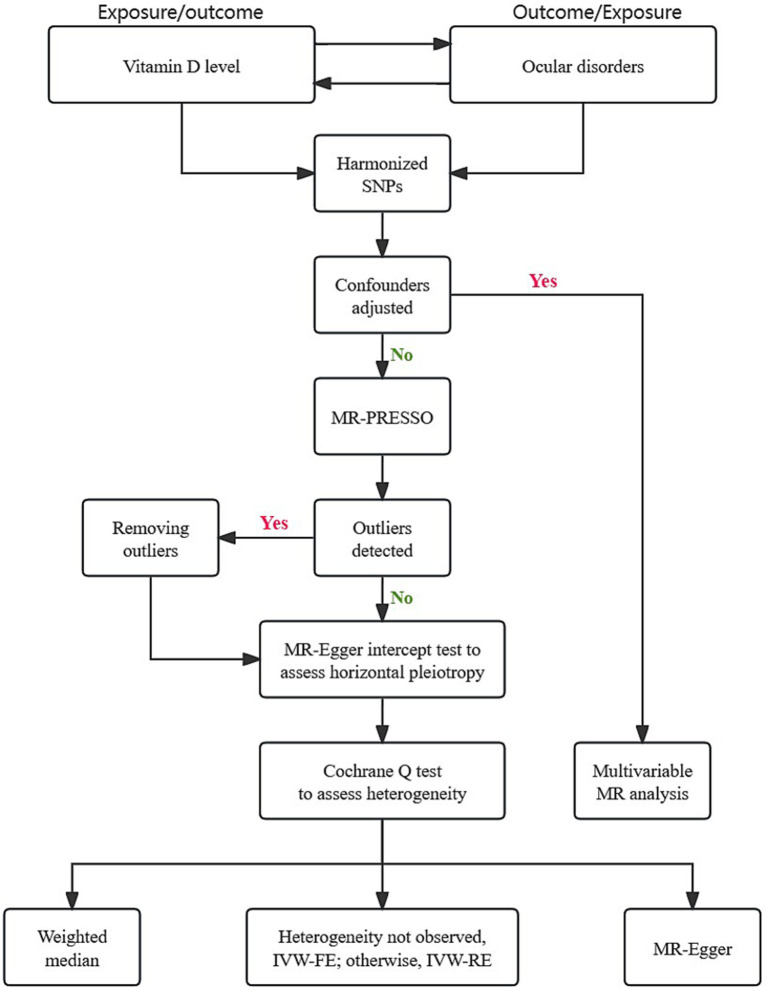
Independent genetic variables were obtained from genome-wide association studies (GWAS) and publicly available databases. The summary statistics for 25-hydroxyvitamin D (25(OH)D) were obtained from two large-scale GWAS studies, with sample sizes of 324,105 and 417,580 European individuals. The genetic variants of myopia, primary open angle glaucoma (POAG), anterior iridocyclitis, senile cataract, diabetic retinopathy (DR), retinal vein occlusion (RVO), wet age-related macular degeneration (WAMD) and optic neuritis were extracted from the latest release of FinnGen consortium, which contains genome data from Finnish participants. Subsequently, Mendelian randomization (MR) analyses were conducted to obtain effect estimates. Additionally, we performed multivariable MR analysis and mediation analysis to validate the results.
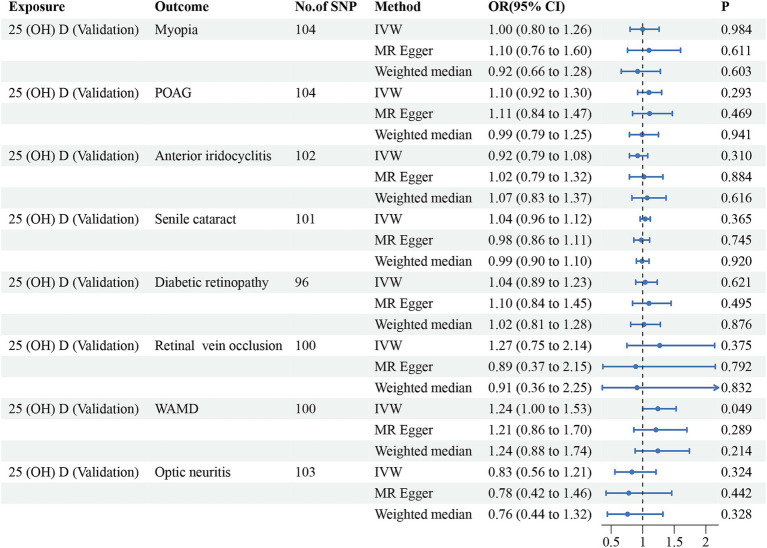
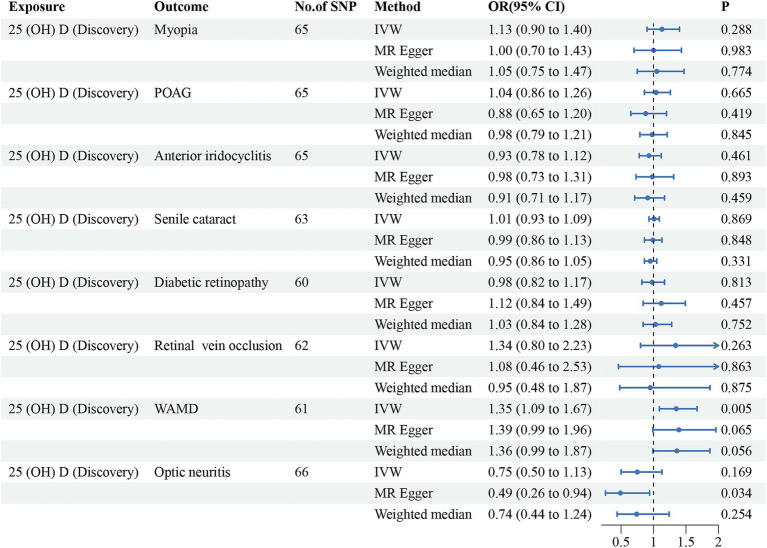
In the discovery dataset, genetically predicted vitamin D concentration was found to be causally associated with an increased risk of WAMD, (odd ratio (OR) = 1.35, 95% confidence interval (CI) = 1.09-1.67, = 0.005). However, no causal effects of genetically predisposed vitamin D levels on the risk of most types of ocular disorders were observed. Reverse MR revealed no causal relationships between the ocular diseases and vitamin D concentrations. The MR analyses of the validation dataset yielded consistent results. Additionally, the causal effect of vitamin D levels on the risk of WAMD remained significant after adjusting for potential confounders in the multivariable MR analysis (OR = 1.86, 95% CI = 1.26-2.73, = 0.002).
Our MR analysis results provide robust evidence of a causal relationship between genetically predicted 25(OH)D levels and an increased risk of WAMD in European population. These findings offer important insights into the management and control of ocular disorders.
本研究旨在评估维生素D水平与眼部疾病之间的因果关系。
从全基因组关联研究(GWAS)和公开可用数据库中获取独立的遗传变量。25-羟基维生素D(25(OH)D)的汇总统计数据来自两项大规模GWAS研究,样本量分别为324105名和417580名欧洲个体。近视、原发性开角型青光眼(POAG)、前葡萄膜炎、老年性白内障、糖尿病视网膜病变(DR)、视网膜静脉阻塞(RVO)、湿性年龄相关性黄斑变性(WAMD)和视神经炎的基因变异从芬兰基因组联盟的最新版本中提取,该联盟包含来自芬兰参与者的基因组数据。随后,进行孟德尔随机化(MR)分析以获得效应估计值。此外,我们进行了多变量MR分析和中介分析以验证结果。
在发现数据集中,发现基因预测的维生素D浓度与WAMD风险增加存在因果关系(优势比(OR)=1.35,95%置信区间(CI)=1.09-1.67,P=0.005)。然而,未观察到基因易感性维生素D水平对大多数类型眼部疾病风险的因果效应。反向MR显示眼部疾病与维生素D浓度之间无因果关系。验证数据集的MR分析得出了一致的结果。此外,在多变量MR分析中调整潜在混杂因素后,维生素D水平对WAMD风险的因果效应仍然显著(OR=1.86,95%CI=1.26-2.73,P=0.002)。
我们的MR分析结果提供了有力证据,证明在欧洲人群中,基因预测的25(OH)D水平与WAMD风险增加之间存在因果关系。这些发现为眼部疾病的管理和控制提供了重要见解。