School of Management, Shandong Second Medical University, Weifang, China.
Front Public Health. 2024 Oct 9;12:1466700. doi: 10.3389/fpubh.2024.1466700. eCollection 2024.
The expansion of higher education and the growing number of college students have led to increased awareness of mental health issues such as stress, anxiety, and eating disorders. In China, the educational system and cultural expectations contribute to the stress experienced by college students. This study aims to clarify the role of anxiety as a mediator in the relationship between stress and eating behaviors among Chinese college students.
This study utilized data from the 2021 Psychology and Behavior Investigation of Chinese Residents, which included 1,672 college students under the age of 25. The analysis methods comprised descriptive statistics, -tests, Pearson correlation analyses, and mediation effect analysis.
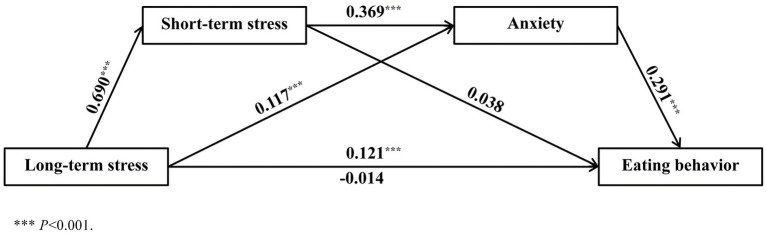
The findings indicate that Chinese college students experience high levels of stress, with long-term stress slightly exceeding short-term stress. Both types of stress were positively correlated with increased anxiety and the adoption of unhealthy eating behaviors. Anxiety was identified as a significant mediator, accounting for 28.3% of the relationship between long-term stress and eating behavior (95% = 0.058-0.183). The mediation effect of short-term stress on eating behavior through anxiety was also significant, explaining 61.4% of the total effect (95% = 0.185-0.327).
The study underscores the importance of stress management and mental health services for college students. It recommends a comprehensive approach to reducing external pressures, managing anxiety, and promoting healthy eating behaviors among college students. Suggestions include expanding employment opportunities, providing career guidance, enhancing campus and societal support for holistic development, strengthening mental health services, leveraging artificial intelligence technologies, educating on healthy lifestyles, and implementing targeted health promotion programs.
高等教育的扩张和大学生人数的增加,使得人们越来越关注压力、焦虑和饮食失调等心理健康问题。在中国,教育系统和文化期望导致大学生承受压力。本研究旨在阐明焦虑作为中介变量在大学生压力与饮食行为之间的关系中的作用。
本研究利用 2021 年中国居民心理学和行为调查的数据,该数据包括 1672 名 25 岁以下的大学生。分析方法包括描述性统计、t 检验、皮尔逊相关分析和中介效应分析。
研究结果表明,中国大学生承受着较高的压力,长期压力略高于短期压力。两种类型的压力都与焦虑增加和不健康的饮食行为呈正相关。焦虑被确定为一个重要的中介变量,占长期压力与饮食行为关系的 28.3%(95%置信区间为 0.058-0.183)。短期压力通过焦虑对饮食行为的中介效应也具有统计学意义,解释了总效应的 61.4%(95%置信区间为 0.185-0.327)。
该研究强调了对大学生进行压力管理和心理健康服务的重要性。建议采取综合方法减少大学生的外部压力、管理焦虑并促进健康的饮食行为。建议包括扩大就业机会、提供职业指导、增强校园和社会对全面发展的支持、加强心理健康服务、利用人工智能技术、教育健康生活方式以及实施有针对性的健康促进计划。