Jhpiego, Addis Ababa, Ethiopia.
Department of Emergency Medicine, Johns Hopkins University School of Medicine, Baltimore, MD, United States.
Front Public Health. 2024 Oct 9;12:1448655. doi: 10.3389/fpubh.2024.1448655. eCollection 2024.
Effective infection prevention and control (IPC) was central to keeping healthcare workers (HCWs) safe during the COVID-19 pandemic. However, as the pandemic continued, the maintenance of high-quality IPC practices waned, placing HCWs at increased risk of infection. A COVID-19 Safety Officer (SO) program was piloted by the United States Agency for International Development (USAID)-funded Reaching Impact, Saturation and Epidemic Control (RISE) project across two health facilities in Ethiopia, which trained clinical and non-clinical HCWs on IPC protocols to promote safe practices in patient care areas. We sought to evaluate the implementation and effectiveness of the SO program in improving IPC practices within the clinical setting.
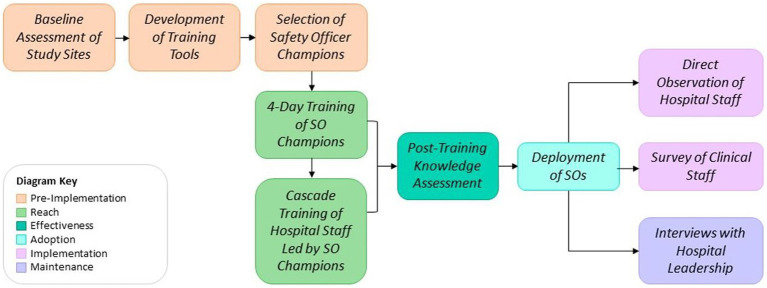
This is a post-implementation evaluation of the SO program, implemented in two hospitals in Ethiopia between May 2022 and December 2022. Participants completed a 4-day course on COVID-19 epidemiology, IPC, safety communication, and learning theory as a part of the Training of Trainers component ( = 23), and were posted in clinical wards to provide staff training and support to maintain IPC protocols. The program was evaluated at 6 months using the Reach, Effectiveness, Adoption, Implementation, and Maintenance (RE-AIM) framework. Effectiveness was measured using direct observation of IPC practices across intervention sites. Implementation outcomes were measured using surveys and qualitative interviews to capture training cascade, knowledge, comfort, acceptability, and maintenance.
Participants were able to cascade training to an additional 167 clinical (67.6%) and 80 non-clinical (32.3%) staff across both sites. Direct observation of clinical staff at 6 months showed that 95% (59/62) wore at least a surgical mask with patients and were compliant with masking and/or distancing protocol. Clinical interviews revealed that SOs contributed to increased perceived comfort with screening and isolation procedures and environmental cleaning procedures.
The SO training program was widely adopted, and effective in improving the implementation and comfort of maintaining IPC practices in clinical settings.
在 COVID-19 大流行期间,有效的感染预防和控制(IPC)对于保护医护人员(HCWs)的安全至关重要。然而,随着大流行的持续,高质量 IPC 实践的维护逐渐减弱,使 HCWs 面临更大的感染风险。美国国际开发署(USAID)资助的“接触影响、饱和和流行控制”(RISE)项目在埃塞俄比亚的两家卫生机构试点了 COVID-19 安全官员(SO)计划,该计划培训临床和非临床 HCWs 有关 IPC 协议的知识,以促进在患者护理区域内采取安全措施。我们旨在评估 SO 计划在改善临床环境中的 IPC 实践方面的实施和效果。
这是对 SO 计划的实施后评估,该计划于 2022 年 5 月至 2022 年 12 月在埃塞俄比亚的两家医院实施。参与者完成了为期 4 天的 COVID-19 流行病学、IPC、安全沟通和学习理论培训课程,作为培训师培训的一部分(=23),并被派往临床病房为员工提供培训和支持,以维持 IPC 协议。该计划使用 Reach、Effectiveness、Adoption、Implementation 和 Maintenance(RE-AIM)框架在 6 个月时进行评估。效果通过干预点的 IPC 实践直接观察来衡量。通过调查和定性访谈来衡量实施结果,以了解培训的级联、知识、舒适度、可接受性和维护情况。
参与者能够在两个地点将培训级联到另外 167 名临床(67.6%)和 80 名非临床(32.3%)工作人员。在 6 个月时对临床工作人员的直接观察表明,95%(59/62)在与患者接触时至少佩戴了外科口罩,并且遵守了戴口罩和/或保持距离的规定。临床访谈显示,SO 有助于提高对筛查和隔离程序以及环境清洁程序的舒适度。
SO 培训计划得到了广泛采用,并且有效地提高了临床环境中 IPC 实践的实施和舒适度。