Okesanya Olalekan John, Olatunji Gbolahan, Olaleke Noah Olabode, Mercy Mba Oluebube, Ilesanmi Ayodele O, Kayode Hassan Hakeem, Manirambona Emery, Ahmed Mohamed Mustaf, Ukoaka Bonaventure Michael, Lucero-Prisno Iii Don Eliseo
Department of Public Health and Maritime Transport, University of Thessaly, Volos, Greece.
Department of Medicine and Surgery, University of Ilorin, Kwara, Nigeria.
Adolesc Health Med Ther. 2024 Oct 19;15:83-91. doi: 10.2147/AHMT.S494099. eCollection 2024.
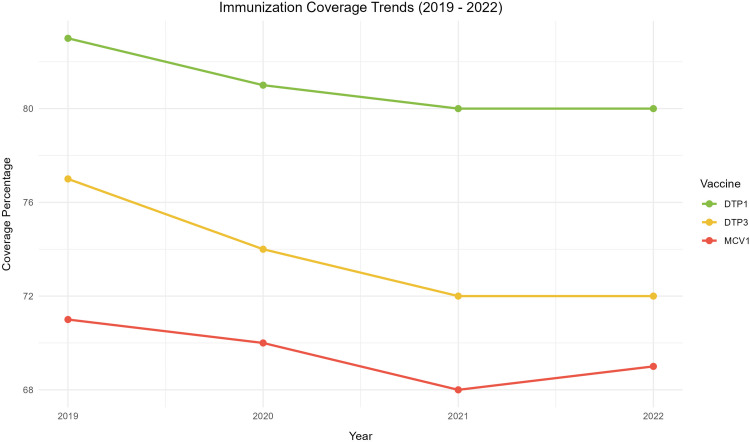
African immunization programs are crucial in reducing the prevalence of infectious diseases and improving public health outcomes. This review provides an overview of the current status of immunization efforts in Africa, highlights key challenges, and offers recommendations to help the continent achieve the 2030 Global Immunization Goals. While progress has been made, significant challenges remain. For instance, the WHO African Region reports full immunization coverage at 56.5%, partial coverage at 35.1%, and zero immunization coverage at 8.4%. Between 2019 and 2021, approximately 67 million children in Africa did not receive routine vaccinations, with West and Central Africa particularly affected. DTP1 coverage remained stable at 80%, but DTP3 coverage saw a slight drop to 72% between 2021 and 2022. As of 2022, MCV1 coverage reached 69%, reflecting ongoing efforts against measles. Key barriers to vaccination include limited parental education, religious beliefs, inadequate healthcare systems, and vaccine hesitancy. Addressing these barriers requires community-driven approaches like door-to-door campaigns and mobile clinics. To reach the 2030 immunization targets, health systems must be strengthened, vaccine supply chains optimized, and financial resources-both domestic and international-expanded. The Immunization Agenda 2030 (IA2030) emphasizes data-driven decision-making, nation-ownership, and tailored strategies to overcome obstacles and raise immunization coverage among several demographic groups. Achieving these 2030 goals in Africa requires collaborative efforts to ensure equitable access to vaccines, address sociocultural challenges, and strengthen health system infrastructure.
非洲的免疫规划对于降低传染病流行率和改善公共卫生成果至关重要。本综述概述了非洲免疫工作的现状,突出了关键挑战,并提出了建议,以帮助该大陆实现2030年全球免疫目标。尽管已取得进展,但重大挑战依然存在。例如,世卫组织非洲区域报告称,全程免疫覆盖率为56.5%,部分免疫覆盖率为35.1%,未接种疫苗率为8.4%。2019年至2021年期间,非洲约6700万儿童未接受常规疫苗接种,西非和中非受影响尤为严重。白喉、破伤风、百日咳三联疫苗第一剂(DTP1)覆盖率稳定在80%,但2021年至2022年期间,白喉、破伤风、百日咳三联疫苗第三剂(DTP3)覆盖率略有下降,降至72%。截至2022年,麻疹疫苗第一剂(MCV1)覆盖率达到69%,反映出在抗击麻疹方面持续做出的努力。疫苗接种的主要障碍包括家长教育程度有限、宗教信仰、医疗保健系统不完善以及疫苗犹豫。解决这些障碍需要采取社区驱动的方法,如挨家挨户宣传活动和流动诊所。为实现2030年免疫目标,必须加强卫生系统,优化疫苗供应链,并扩大国内和国际财政资源。《2030年免疫议程》(IA2030)强调数据驱动的决策、国家自主以及量身定制的战略,以克服障碍并提高几类人群的免疫覆盖率。要在非洲实现这些2030年目标,需要共同努力,以确保公平获得疫苗、应对社会文化挑战并加强卫生系统基础设施。