Department of Infectious Diseases and Tropical Medicine, Center for Infectious Diseases, Heidelberg University Hospital, Heidelberg, Germany.
Division of Immunology, Department of Biomedical Sciences, Faculty of Medicine and Health Sciences, South African Medical Research Council Centre for Tuberculosis Research, Stellenbosch University, Cape Town, South Africa.
J Clin Microbiol. 2024 Nov 13;62(11):e0078624. doi: 10.1128/jcm.00786-24. Epub 2024 Oct 24.
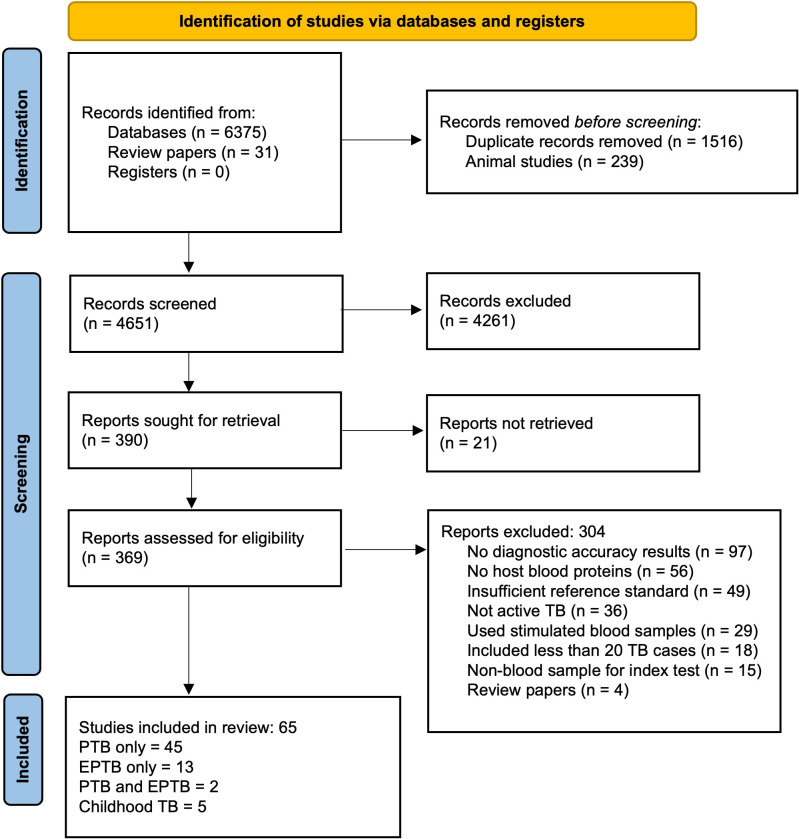
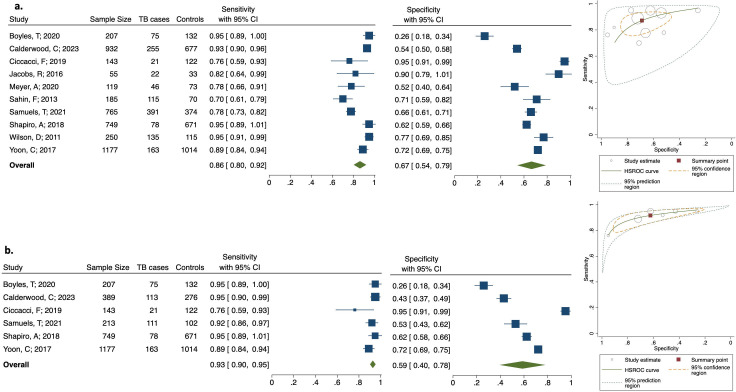
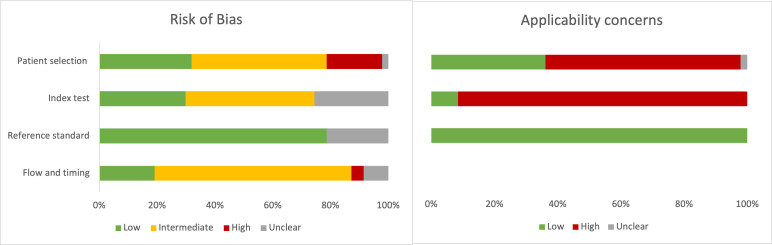
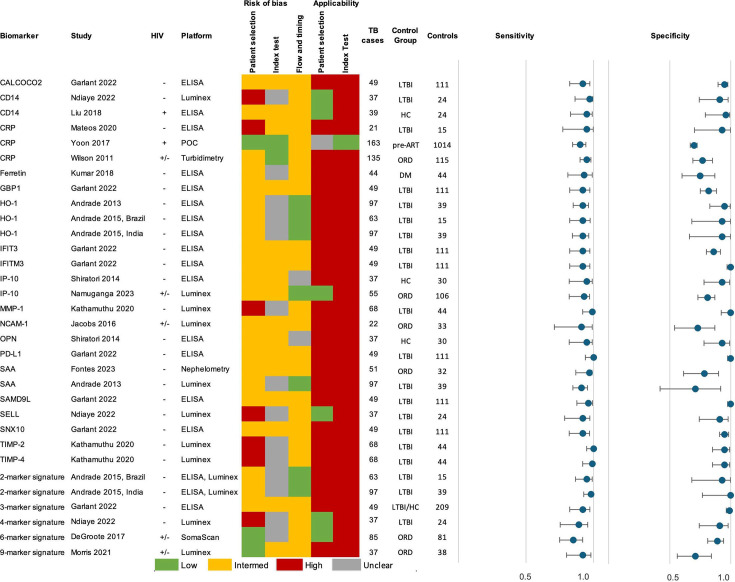
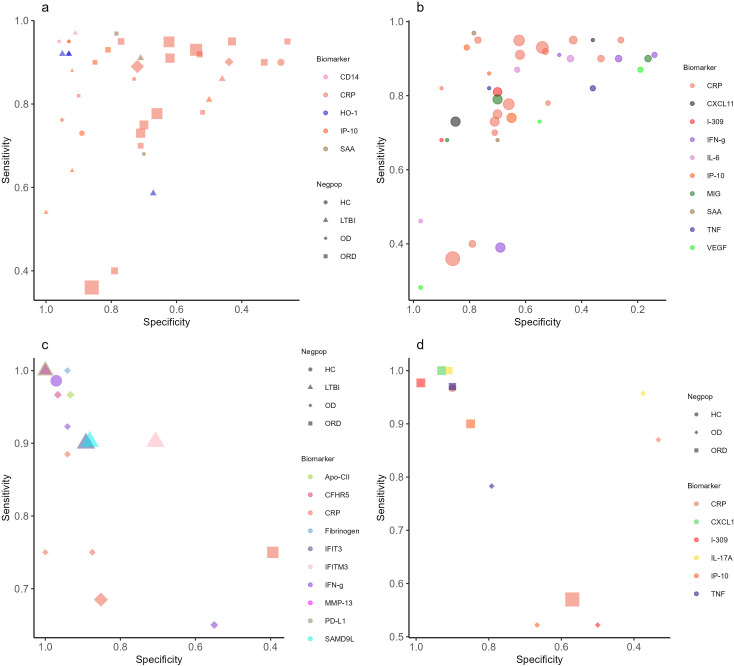
Non-sputum tests are needed to improve tuberculosis (TB) diagnosis and close the diagnostic gap. The World Health Organization's target product profile (TPP) for point-of-care (POC) screening tests requires a minimum sensitivity of 90% and a specificity of 70%. Our objective was to identify host blood protein biomarkers meeting TPP criteria. A systematic review was conducted and reported following PRISMA guidelines. Data extraction and quality assessment with Quality Assessment of Diagnostic Accuracy Studies-2 (QUADAS-2) were completed for the included studies. Heterogeneity was assessed. For biomarkers reporting sensitivity and specificity in at least four studies, a random-effects meta-analysis was performed for biomarkers with similar cut-offs. We screened 4,651 citations and included 65 studies that enrolled 16,010 participants and evaluated 156 host proteins. Most (47/65) studies enrolled adult pulmonary TB (PTB), with 15 studies in adult extra-pulmonary TB and 5 in children. Small early-stage discovery studies with case-control design were common (24/65) and had a high risk of bias. For adult PTB, CRP, IP-10, NCAM-1, and SAA met TPP criteria in high-quality studies. There was a high degree of heterogeneity in biomarker cut-offs and study design. CRP at 10 mg/L cut-off was meta-analyzed from 10 studies; pooled sensitivity 86% [95% confidence interval (CI): 80-95] and pooled specificity 67% (95% CI: 54-79). In people living with HIV (six studies), CRP pooled sensitivity was 93% (95% CI: 90-95), and pooled specificity was 59% (95% CI: 40-78). We identified promising biomarkers that performed well in high-quality studies. Data overall are limited and highly heterogenous. Further standardized validation across subgroups in prospective studies is needed before translating into POC assays.
To our knowledge, this is the first comprehensive systematic review of host blood protein biomarkers for tuberculosis (TB), and we identified promising biomarkers for a TB screening test.
为了提高结核病(TB)诊断水平并缩小诊断差距,需要进行非痰检。世界卫生组织(WHO)的即时检测(POC)筛查检测目标产品特性(TPP)要求敏感性至少为 90%,特异性为 70%。我们的目标是确定符合 TPP 标准的宿主血液蛋白生物标志物。我们进行了一项系统综述,并按照 PRISMA 指南进行了报告。对纳入的研究进行了数据提取和质量评估(QUADAS-2)。对报告至少有 4 项研究敏感性和特异性的生物标志物进行了具有相似截止值的随机效应荟萃分析。我们筛选了 4651 条引用文献,并纳入了 65 项研究,这些研究共纳入了 16010 名参与者,评估了 156 种宿主蛋白。大多数(47/65)研究纳入了成人肺结核(PTB),15 项研究纳入了成人肺外结核,5 项研究纳入了儿童。常见的是采用病例对照设计的早期小型发现研究(24/65),这些研究存在较高的偏倚风险。对于成人 PTB,CRP、IP-10、NCAM-1 和 SAA 在高质量研究中符合 TPP 标准。生物标志物截止值和研究设计存在高度异质性。10 项研究中以 10 mg/L 截止值进行 CRP 的荟萃分析,汇总敏感性为 86%[95%置信区间(CI):80-95],汇总特异性为 67%(95% CI:54-79)。在 HIV 感染者(6 项研究)中,CRP 的汇总敏感性为 93%(95% CI:90-95),汇总特异性为 59%(95% CI:40-78)。我们确定了一些有前途的生物标志物,这些标志物在高质量研究中表现良好。但总体数据有限且高度异质。需要在前瞻性研究中针对亚组进行进一步的标准化验证,然后才能转化为 POC 检测。
据我们所知,这是第一项针对宿主血液蛋白生物标志物用于结核病(TB)的全面系统综述,我们确定了有前途的 TB 筛查检测生物标志物。