Engvig Andreas, Kalleberg Karl Trygve, Westlye Lars T, Leonardsen Esten Høyland
Department of Endocrinology, Obesity and Preventive Medicine, Section of Preventive Cardiology, Oslo University Hospital, Oslo, Norway.
Age Labs AS, Oslo, Norway.
Geroscience. 2025 Apr;47(2):2099-2118. doi: 10.1007/s11357-024-01376-w. Epub 2024 Oct 24.
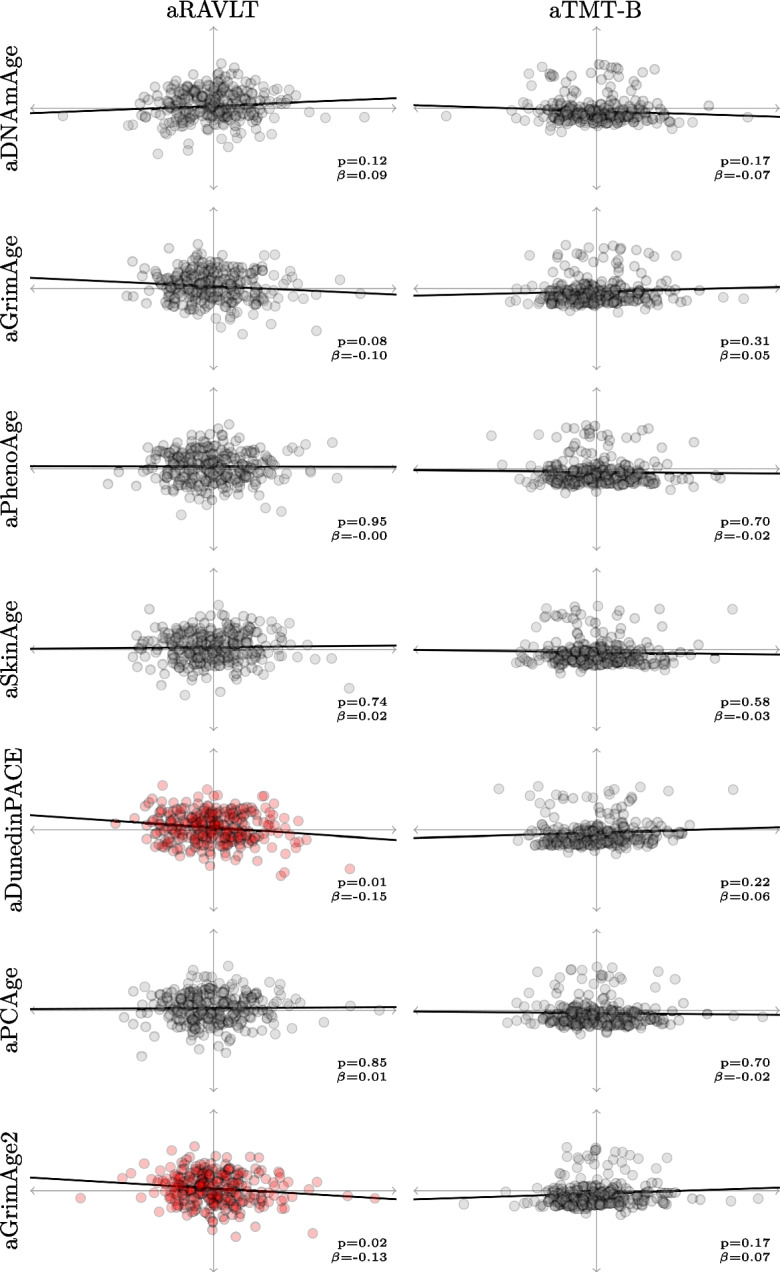
DNA methylation age (MA), brain age (BA), and frailty index (FI) are putative aging biomarkers linked to dementia risk. We investigated their relationship and combined potential for prediction of cognitive impairment and future dementia risk using the ADNI database. Of several MA algorithms, DunedinPACE and GrimAge2, associated with memory, were combined in a composite MA alongside BA and a data-driven FI in predictive analyses. Pairwise correlations between age- and sex-adjusted measures for MA (aMA), aBA, and aFI were low. FI outperformed BA and MA in all diagnostic tasks. A model including age, sex, and aFI achieved an area under the curve (AUC) of 0.94 for differentiating cognitively normal controls (CN) from dementia patients in a held-out test set. When combined with clinical biomarkers (apolipoprotein E ε4 allele count, memory, executive function), a model including aBA and aFI predicted 5-year dementia risk among MCI patients with an out-of-sample AUC of 0.88. In the prognostic model, BA and FI offered complementary value (both βs 0.50). The tested MAs did not improve predictions. Results were consistent across FI algorithms, with data-driven health deficit selection yielding the best performance. FI had a stronger adverse effect on prognosis in males, while BA's impact was greater in females. Our findings highlight the complementary value of BA and FI in dementia prediction. The results support a multidimensional view of dementia, including an intertwined relationship between the biomarkers, sex, and prognosis. The tested MA's limited contribution suggests caution in their use for individual risk assessment of dementia.
DNA甲基化年龄(MA)、脑年龄(BA)和衰弱指数(FI)是与痴呆风险相关的假定衰老生物标志物。我们利用阿尔茨海默病神经影像学倡议(ADNI)数据库研究了它们之间的关系以及联合预测认知障碍和未来痴呆风险的潜力。在几种与记忆相关的MA算法中,达尼丁PACE和GrimAge2被纳入一个综合MA中,与BA和一个数据驱动的FI一起进行预测分析。经年龄和性别调整后的MA(aMA)、aBA和aFI测量值之间的成对相关性较低。在所有诊断任务中,FI的表现优于BA和MA。在一个保留测试集中,一个包含年龄、性别和aFI的模型区分认知正常对照(CN)和痴呆患者的曲线下面积(AUC)为0.94。当与临床生物标志物(载脂蛋白E ε4等位基因计数、记忆、执行功能)相结合时,一个包含aBA和aFI的模型预测轻度认知障碍(MCI)患者5年痴呆风险的样本外AUC为0.88。在预后模型中,BA和FI具有互补价值(两者的β值均为0.50)。所测试的MA并未改善预测效果。FI算法的结果一致,数据驱动的健康缺陷选择表现最佳。FI对男性预后的不良影响更强,而BA对女性的影响更大。我们的研究结果突出了BA和FI在痴呆预测中的互补价值。这些结果支持了对痴呆的多维观点,包括生物标志物、性别和预后之间的相互交织关系。所测试的MA贡献有限,这表明在将其用于痴呆个体风险评估时应谨慎。