
利用患者来源的诱导多能干细胞研究与肥厚型心肌病相关的非经典剪接变体。
Patient-derived induced pluripotent stem cells to study non-canonical splicing variants associated with Hypertrophic Cardiomyopathy.
作者信息
Jager Joanna, Ribeiro Marta, Furtado Marta, Carvalho Teresa, Syrris Petros, Lopes Luis R, Elliott Perry M, Cabral Joaquim M S, Carmo-Fonseca Maria, da Rocha Simão Teixeira, Martins Sandra
机构信息
University College London Institute of Cardiovascular Science, Rayne Institute, 5 University Street, London WC1E 6JF, United Kingdom.
iBB - Institute for Bioengineering and Biosciences and Department of Bioengineering, Instituto Superior Técnico, Universidade de Lisboa, Av. Rovisco Pais, 1049-001 Lisboa, Portugal; Associate Laboratory i4HB Institute for Health and Bioeconomy, Instituto Superior Técnico, Universidade de Lisboa, Av. Rovisco Pais, 1049-001 Lisboa, Portugal.
出版信息
Stem Cell Res. 2024 Dec;81:103582. doi: 10.1016/j.scr.2024.103582. Epub 2024 Oct 16.
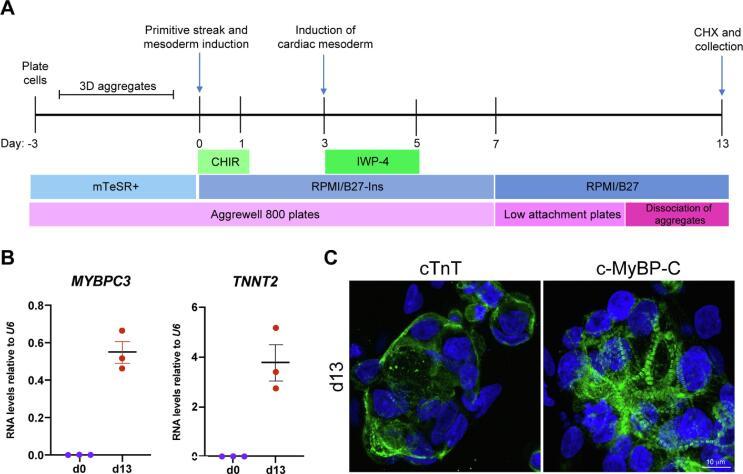
Hypertrophic cardiomyopathy (HCM) is the most prevalent inherited cardiomyopathy and a leading cause of sudden death. Genetic testing and familial cascade screening play a pivotal role in the clinical management of HCM patients. However, conventional genetic tests primarily focus on the detection of exonic and canonical splice site variation. Oversighting intronic non-canonical splicing variants potentially contributes to a proportion of HCM patients remaining genetically undiagnosed. Here, using a non-integrative reprogramming strategy, we generated induced pluripotent stem cell (iPSC) lines from four individuals carrying one of two variants within intronic regions of MYBPC3: c.1224-52G > A and c.1898-23A > G. Upon differentiation to iPSC-derived cardiomyocytes (iPSC-CMs), mis-spliced mRNAs were identified in cells harbouring these variants. Both abnormal mRNAs contained a premature termination codon (PTC), fitting the criteria for activation of nonsense mediated decay (NMD). However, the c.1898-23A > G transcripts escaped this mRNA quality control mechanism, while the c.1224-52G > A transcripts were degraded. The newly generated iPSC lines represent valuable tools for studying the functional consequences of intronic variation and for translational research aimed at reversing splicing abnormalities to prevent disease progression.
肥厚型心肌病(HCM)是最常见的遗传性心肌病,也是猝死的主要原因。基因检测和家族性级联筛查在HCM患者的临床管理中起着关键作用。然而,传统的基因检测主要集中在外显子和典型剪接位点变异的检测上。忽视内含子非典型剪接变异可能导致一部分HCM患者在基因上仍未得到诊断。在这里,我们使用一种非整合重编程策略,从四名携带MYBPC3内含子区域两个变异之一(c.1224-52G>A和c.1898-23A>G)的个体中生成了诱导多能干细胞(iPSC)系。在分化为iPSC衍生的心肌细胞(iPSC-CM)后,在携带这些变异的细胞中鉴定出了剪接错误的mRNA。两种异常mRNA都包含一个提前终止密码子(PTC),符合无义介导衰变(NMD)激活的标准。然而,c.1898-23A>G转录本逃脱了这种mRNA质量控制机制,而c.1224-52G>A转录本则被降解。新生成的iPSC系是研究内含子变异功能后果以及旨在逆转剪接异常以预防疾病进展的转化研究的宝贵工具。




 Zotero 插件