Visca Dina, Ardesi Francesco, Zappa Martina, Pignatti Patrizia, Grossi Sarah, Vanetti Marco, Migliori Giovanni Battista, Centis Rosella, Angeli Fabio, Spanevello Antonio
Department of Pulmonary Rehabilitation, Istituti Clinici Scientifici Maugeri IRCCS, Tradate, Italy.
Department of Medicine and Surgery, University of Insubria, Varese, Italy.
Front Med (Lausanne). 2024 Oct 10;11:1451625. doi: 10.3389/fmed.2024.1451625. eCollection 2024.
Asthma is a chronic inflammatory respiratory disease often associated with comorbidities. Among cardiovascular comorbidities, arterial hypertension seems to create an additional health burden in asthmatics. However, evidence on this relationship is lacking.
Our study aims to evaluate the characteristics of hypertensive asthmatics, focusing on the role of inflammation as a possible link between these diseases.
We conducted a monocentric retrospective analysis consecutively including asthmatics who underwent induced sputum (IS) at our asthma referral center. Patients were divided in two groups according to presence or absence of history of hypertension. Clinical, functional, and inflammatory (airway and systemic) data were collected.
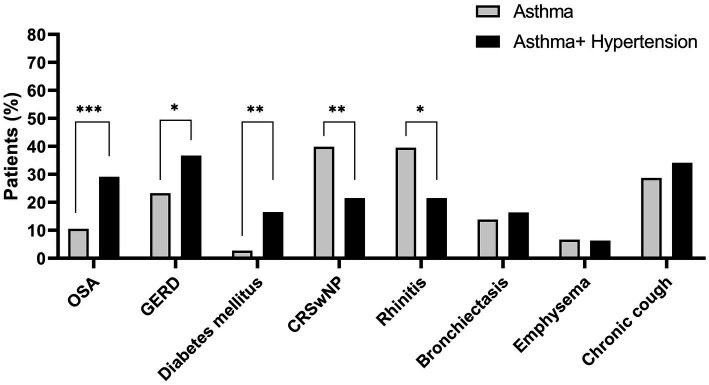
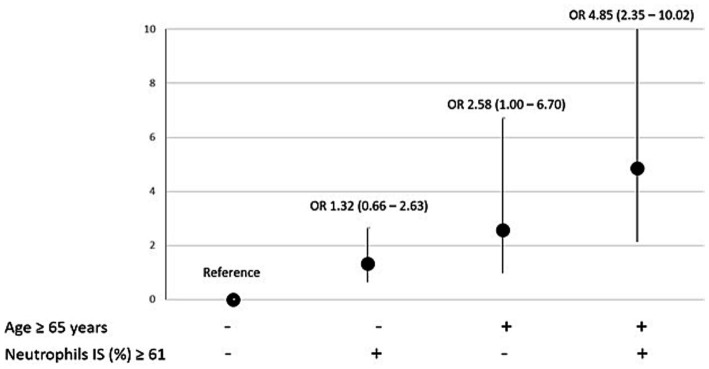
Data on two hundred and sixty asthmatic patients were analyzed. Seventy-nine (30.4%) of them had a diagnosis of hypertension requiring a specific pharmacological treatment. Asthmatics with hypertension were more frequently male ( = 0.047), older ( < 0.001), and with higher body max index (BMI) (p < 0.001) when compared to normotensive patients. No difference concerning asthma control, severity and pharmacological treatment was observed between the two groups (all > 0.05); distribution of comorbidities and lung function impairment (forced expiratory volume in the first second (FEV1) and forced vital capacity (FVC); all < 0.05) were statistically different between groups. Mixed granulocytic airway inflammation was prevalent in the hypertensive asthmatics ( = 0.014). Interestingly, a multivariable analysis revealed that age ≥ 65 years and an increased percentage of sputum neutrophils (≥61%) were independent predictors of hypertensive status ( < 0.001).
Our data suggest that neutrophilic airway inflammation (as evaluated by induced sputum) is strictly associated with hypertension. In clinical practice, phenotyping asthmatic patients with comorbidities like hypertension could be useful also from a therapeutic point of view. Additional studies are mandatory to further elucidate the role of neutrophilic airway inflammation in asthma with cardiovascular diseases.
哮喘是一种慢性炎症性呼吸道疾病,常伴有合并症。在心血管合并症中,动脉高血压似乎给哮喘患者带来了额外的健康负担。然而,关于这种关系的证据尚缺。
我们的研究旨在评估高血压哮喘患者的特征,重点关注炎症作为这些疾病之间可能联系的作用。
我们进行了一项单中心回顾性分析,连续纳入在我们哮喘转诊中心接受诱导痰检查的哮喘患者。根据有无高血压病史将患者分为两组。收集临床、功能和炎症(气道和全身)数据。
分析了260例哮喘患者的数据。其中79例(30.4%)被诊断为高血压,需要进行特定的药物治疗。与血压正常的患者相比,高血压哮喘患者男性更常见(P = 0.047)、年龄更大(P < 0.001)、体重指数(BMI)更高(P < 0.001)。两组之间在哮喘控制、严重程度和药物治疗方面未观察到差异(均P > 0.05);合并症分布和肺功能损害(第一秒用力呼气量(FEV1)和用力肺活量(FVC);均P < 0.05)在两组之间有统计学差异。混合性粒细胞气道炎症在高血压哮喘患者中普遍存在(P = 0.014)。有趣的是,多变量分析显示年龄≥65岁和痰液中性粒细胞百分比增加(≥61%)是高血压状态的独立预测因素(P < 0.001)。
我们的数据表明,中性粒细胞气道炎症(通过诱导痰评估)与高血压密切相关。在临床实践中,对合并高血压等合并症的哮喘患者进行表型分析从治疗角度来看也可能是有用的。需要进一步的研究来阐明中性粒细胞气道炎症在伴有心血管疾病的哮喘中的作用。