School of Physiotherapy and Exercise Science, Curtin University, Kent St, Bentley, Perth, WA 6102, Australia.
Department of Sports Science and Clinical Biomechanics, University of Southern Denmark, Odense, Denmark.
BMC Med Res Methodol. 2020 Jun 29;20(1):172. doi: 10.1186/s12874-020-01050-7.
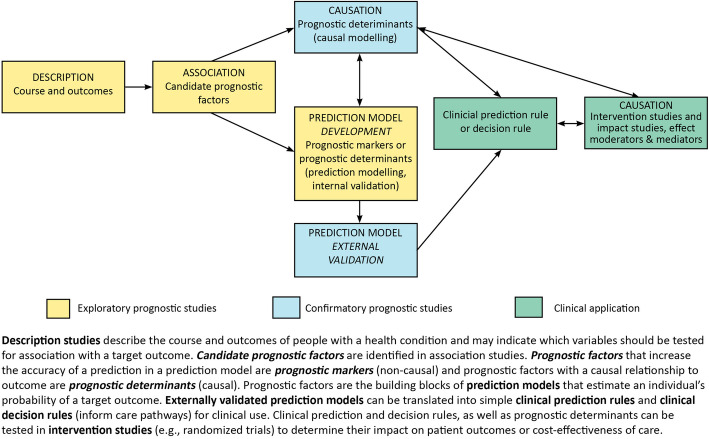
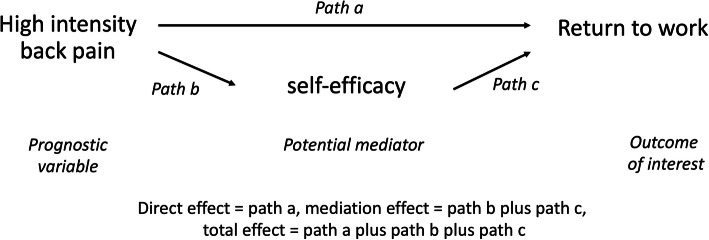
Prognostic research has many important purposes, including (i) describing the natural history and clinical course of health conditions, (ii) investigating variables associated with health outcomes of interest, (iii) estimating an individual's probability of developing different outcomes, (iv) investigating the clinical application of prediction models, and (v) investigating determinants of recovery that can inform the development of interventions to improve patient outcomes. But much prognostic research has been poorly conducted and interpreted, indicating that a number of conceptual areas are often misunderstood. Recent initiatives to improve this include the Prognosis Research Strategy (PROGRESS) and the Transparent Reporting of a multivariable prediction model for Individual Prognosis or Diagnosis (TRIPOD) Statement. In this paper, we aim to show how different categories of prognostic research relate to each other, to differentiate exploratory and confirmatory studies, discuss moderators and mediators, and to show how important it is to understand study designs and the differences between prediction and causation.
We propose that there are four main objectives of prognostic studies - description, association, prediction and causation. By causation, we mean the effect of prediction and decision rules on outcomes as determined by intervention studies and the investigation of whether a prognostic factor is a determinant of outcome (on the causal pathway). These either fall under the umbrella of exploratory (description, association, and prediction model development) or confirmatory (prediction model external validation and investigation of causation). Including considerations of causation within a prognostic framework provides a more comprehensive roadmap of how different types of studies conceptually relate to each other, and better clarity about appropriate model performance measures and the inferences that can be drawn from different types of prognostic studies. We also propose definitions of 'candidate prognostic factors', 'prognostic factors', 'prognostic determinants (causal)' and 'prognostic markers (non-causal)'. Furthermore, we address common conceptual misunderstandings related to study design, analysis, and interpretation of multivariable models from the perspectives of association, prediction and causation.
This paper uses a framework to clarify some concepts in prognostic research that remain poorly understood and implemented, to stimulate discussion about how prognostic studies can be strengthened and appropriately interpreted.
预后研究有许多重要的目的,包括(i)描述健康状况的自然史和临床过程,(ii)研究与感兴趣的健康结果相关的变量,(iii)估计个体发生不同结果的概率,(iv)研究预测模型的临床应用,以及(v)研究可用于改善患者预后的干预措施的恢复决定因素。但是,许多预后研究的实施和解释都很差,这表明许多概念领域经常被误解。最近的一些举措旨在改善这种情况,包括预后研究策略(PROGRESS)和用于个体预后或诊断的多变量预测模型的透明报告(TRIPOD)声明。在本文中,我们旨在展示不同类别的预后研究如何相互关联,区分探索性和验证性研究,讨论调节因素和中介因素,并展示理解研究设计以及预测和因果之间差异的重要性。
我们提出,预后研究有四个主要目标-描述、关联、预测和因果关系。通过因果关系,我们指的是预测和决策规则对干预研究确定的结果的影响,以及调查预后因素是否是结果的决定因素(在因果途径上)。这些要么属于探索性(描述、关联和预测模型开发),要么属于验证性(预测模型外部验证和因果关系研究)。在预后框架内纳入因果关系的考虑因素提供了一个更全面的路线图,说明不同类型的研究在概念上如何相互关联,以及更好地了解适当的模型性能指标以及不同类型的预后研究可以得出的推断。我们还提出了“候选预后因素”、“预后因素”、“预后决定因素(因果关系)”和“预后标志物(非因果关系)”的定义。此外,我们从关联、预测和因果关系的角度解决了与设计、分析和解释多变量模型相关的常见概念误解。
本文使用框架来澄清预后研究中一些理解和实施较差的概念,以激发关于如何加强和适当解释预后研究的讨论。