Cowley Laura E, Farewell Daniel M, Maguire Sabine, Kemp Alison M
Division of Population Medicine, School of Medicine, Neuadd Meirionnydd, Heath Park, Cardiff University, Wales, CF14 4YS UK.
Diagn Progn Res. 2019 Aug 22;3:16. doi: 10.1186/s41512-019-0060-y. eCollection 2019.
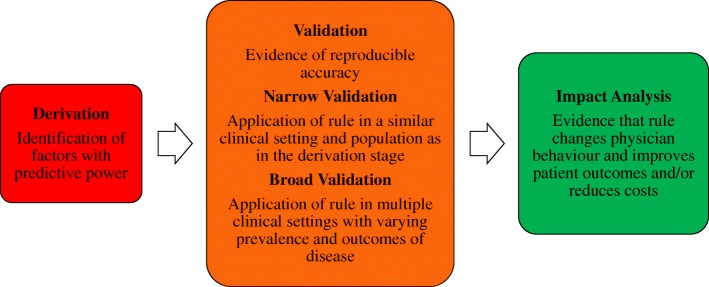
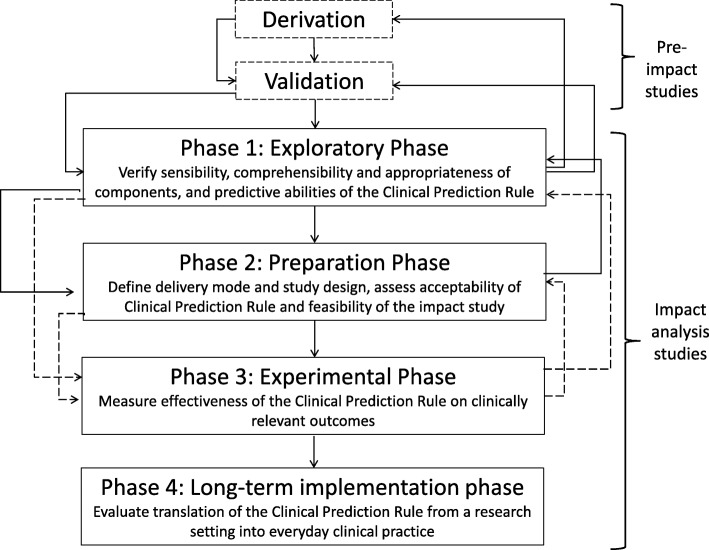
Clinical prediction rules (CPRs) that predict the absolute risk of a clinical condition or future outcome for individual patients are abundant in the medical literature; however, systematic reviews have demonstrated shortcomings in the methodological quality and reporting of prediction studies. To maximise the potential and clinical usefulness of CPRs, they must be rigorously developed and validated, and their impact on clinical practice and patient outcomes must be evaluated. This review aims to present a comprehensive overview of the stages involved in the development, validation and evaluation of CPRs, and to describe in detail the methodological standards required at each stage, illustrated with examples where appropriate. Important features of the study design, statistical analysis, modelling strategy, data collection, performance assessment, CPR presentation and reporting are discussed, in addition to other, often overlooked aspects such as the acceptability, cost-effectiveness and longer-term implementation of CPRs, and their comparison with clinical judgement. Although the development and evaluation of a robust, clinically useful CPR is anything but straightforward, adherence to the plethora of methodological standards, recommendations and frameworks at each stage will assist in the development of a rigorous CPR that has the potential to contribute usefully to clinical practice and decision-making and have a positive impact on patient care.
预测个体患者临床状况或未来结局绝对风险的临床预测规则(CPRs)在医学文献中大量存在;然而,系统评价已表明预测研究在方法学质量和报告方面存在缺陷。为了最大限度地发挥CPRs的潜力和临床实用性,必须对其进行严格开发和验证,并且必须评估它们对临床实践和患者结局的影响。本综述旨在全面概述CPRs开发、验证和评估所涉及的阶段,并详细描述每个阶段所需的方法学标准,并在适当的地方举例说明。除了其他经常被忽视的方面,如CPRs的可接受性、成本效益和长期实施,以及它们与临床判断的比较外,还讨论了研究设计、统计分析、建模策略、数据收集、性能评估、CPR呈现和报告的重要特征。尽管开发和评估一个强大的、临床有用的CPR绝非易事,但在每个阶段遵循大量的方法学标准、建议和框架将有助于开发一个严谨的CPR,它有可能对临床实践和决策做出有益贡献,并对患者护理产生积极影响。