Department of Pediatric Diabetes, Auxology and Obesity, Poznan University of Medical Sciences, Poland.
Department of Human Nutrition and Dietetics, Faculty of Food Technology, University of Agriculture, Krakow, Poland.
Pediatr Endocrinol Diabetes Metab. 2024;30(3):125-131. doi: 10.5114/pedm.2024.142589.
The latest evidence highlights that an unhealthy diet and poor nutrition status are some of the modifiable behavioural risk factors responsible for the development of non-communicable diseases (NCDs). Anti-inflammatory diets are important in both the treatment and prevention of disease (e.g. hypertension, obesity, Hashimoto's thyroiditis). The concept of these diets has common core foundations and recommendations. The family environment from early childhood plays a particularly important role in shaping healthy eating patterns of children and youths. Thus, parents' nutritional knowledge, attitudes, and dietary practices are essential in preventing NCD development and improving their children's health as their primary guardians. This study aims to assess parents' awareness of an anti-inflammatory diet.
A total of 325 parents participated in the study. Data for the study were collected anonymously using the CAWI method. The research tool was an original questionnaire about parents' awareness of anti-inflammatory diets.
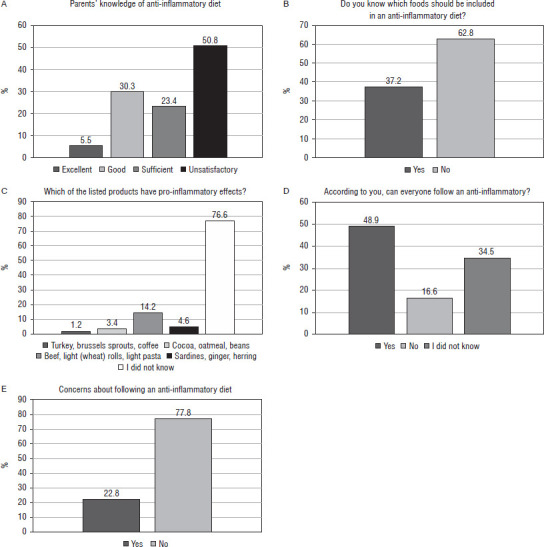
Of the 325 parents participating in the study, 204 (62.8%) admitted that they did not know which products to use in an anti-inflammatory diet. About half of them (165; 50.8%) had unsatisfactory knowledge of the anti-inflammatory diet, 66 (30.3%) had a good level of knowledge, and only 16 (5.5%) respondents had an excellent level of knowledge.
Parental awareness of the use of the anti-inflammatory diet was insufficient in the study group. It seems important to implement appropriate educational activities on the anti-inflammatory diet to expand parents' knowledge of the impact of nutrition on children's development.
最新证据表明,不健康的饮食和营养状况不佳是导致非传染性疾病(NCD)发展的一些可改变的行为风险因素。抗炎饮食在疾病的治疗和预防中都很重要(例如,高血压、肥胖、桥本甲状腺炎)。这些饮食的概念有共同的核心基础和建议。儿童早期的家庭环境在塑造儿童和青少年的健康饮食习惯方面起着特别重要的作用。因此,父母的营养知识、态度和饮食实践对于预防 NCD 的发展和改善其子女的健康至关重要,因为他们是子女的主要监护人。本研究旨在评估父母对抗炎饮食的认识。
共有 325 名家长参与了这项研究。研究数据通过 CAWI 方法匿名收集。研究工具是一份关于父母对抗炎饮食认识的原始问卷。
在参与研究的 325 名家长中,有 204 名(62.8%)承认他们不知道抗炎饮食中应该使用哪些产品。他们中的近一半(165 人;50.8%)对抗炎饮食的知识不满意,66 人(30.3%)有良好的知识水平,只有 16 人(5.5%)受访者有优秀的知识水平。
研究组中父母对抗炎饮食的使用意识不足。似乎有必要开展适当的抗炎饮食教育活动,以扩大父母对营养对儿童发展影响的认识。