Shimizu Eisuke, Tanaka Kenta, Nishimura Hiroki, Agata Naomichi, Tanji Makoto, Nakayama Shintato, Khemlani Rohan Jeetendra, Yokoiwa Ryota, Sato Shinri, Shiba Daisuke, Sato Yasunori
OUI Inc., Tokyo 107-0062, Japan.
Yokohama Keiai Eye Clinic, Kanagawa 240-0065, Japan.
Bioengineering (Basel). 2024 Oct 9;11(10):1005. doi: 10.3390/bioengineering11101005.
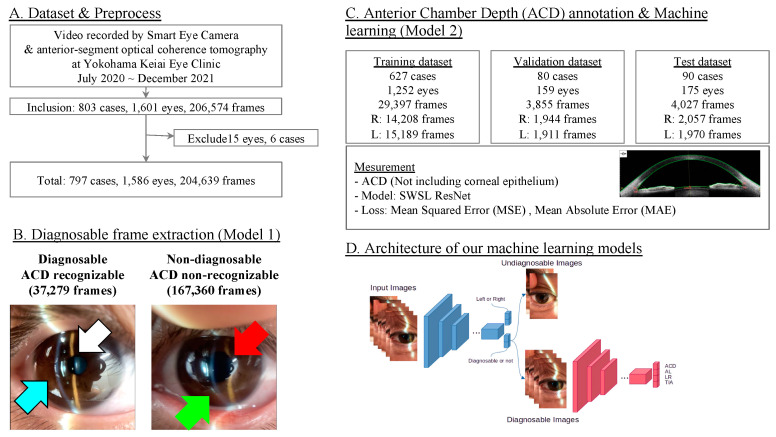
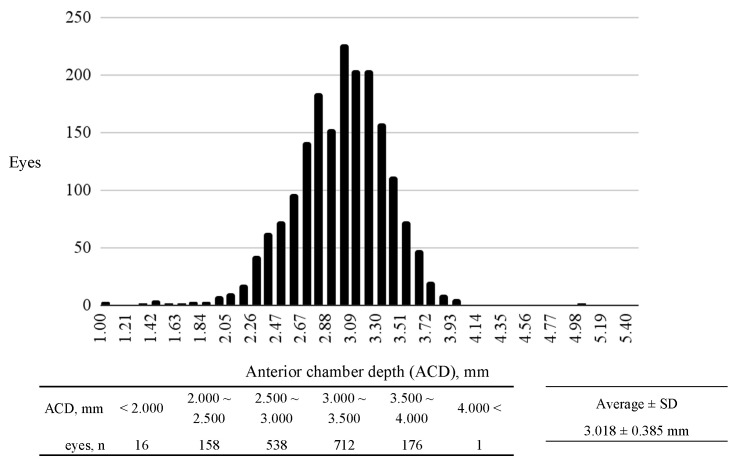
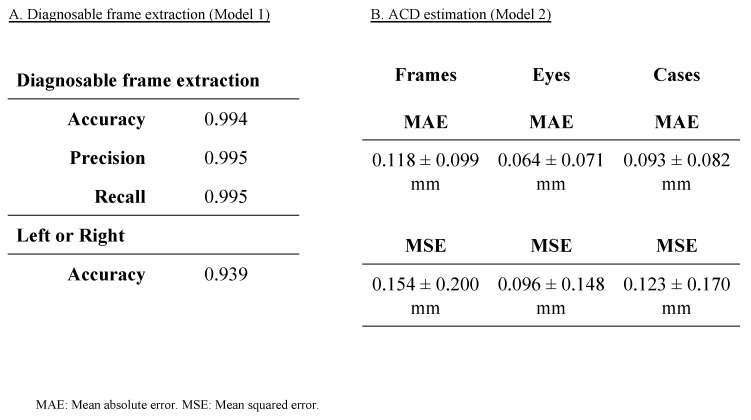
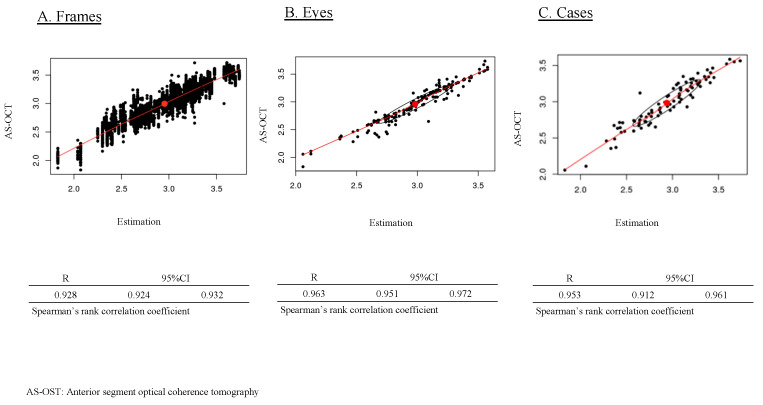
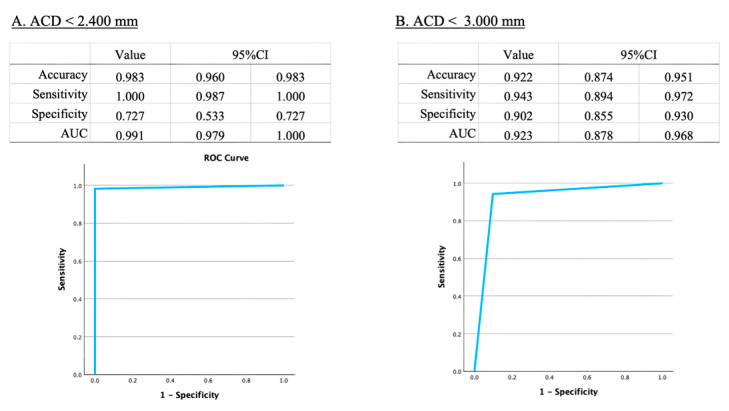
Primary angle closure glaucoma (PACG) is a major cause of visual impairment, particularly in Asia. Although effective screening tools are necessary, the current gold standard is complex and time-consuming, requiring extensive expertise. Artificial intelligence has introduced new opportunities for innovation in ophthalmic imaging. Anterior chamber depth (ACD) is a key risk factor for angle closure and has been suggested as a quick screening parameter for PACG. This study aims to develop an AI algorithm to quantitatively predict ACD from anterior segment photographs captured using a portable smartphone slit-lamp microscope. We retrospectively collected 204,639 frames from 1586 eyes, with ACD values obtained by anterior-segment OCT. We developed two models, (Model 1) diagnosable frame extraction and (Model 2) ACD estimation, using SWSL ResNet as the machine learning model. Model 1 achieved an accuracy of 0.994. Model 2 achieved an MAE of 0.093 ± 0.082 mm, an MSE of 0.123 ± 0.170 mm, and a correlation of R = 0.953. Furthermore, our model's estimation of the risk for angle closure showed a sensitivity of 0.943, specificity of 0.902, and an area under the curve (AUC) of 0.923 (95%CI: 0.878-0.968). We successfully developed a high-performance ACD estimation model, laying the groundwork for predicting other quantitative measurements relevant to PACG screening.
原发性闭角型青光眼(PACG)是导致视力损害的主要原因,在亚洲尤为如此。尽管有效的筛查工具必不可少,但目前的金标准复杂且耗时,需要广泛的专业知识。人工智能为眼科成像创新带来了新机遇。前房深度(ACD)是闭角的关键危险因素,已被提议作为PACG的快速筛查参数。本研究旨在开发一种人工智能算法,用于从使用便携式智能手机裂隙灯显微镜拍摄的眼前节照片中定量预测ACD。我们回顾性收集了来自1586只眼睛的204,639帧图像,通过眼前节OCT获得ACD值。我们使用SWSL ResNet作为机器学习模型开发了两个模型,(模型1)可诊断帧提取和(模型2)ACD估计。模型1的准确率达到0.994。模型2的平均绝对误差(MAE)为0.093±0.082毫米,均方误差(MSE)为0.123±0.170毫米,相关系数R = 0.953。此外,我们的模型对闭角风险的估计显示敏感性为0.943,特异性为0.902,曲线下面积(AUC)为0.923(95%CI:0.878 - 0.968)。我们成功开发了一个高性能的ACD估计模型,为预测与PACG筛查相关的其他定量测量奠定了基础。