Kim Hyun-Ryun, Woo Seung-Hwan, Seo Jae-Pil, So Wi-Young, Bae Jun-Su
Department of Physical Education, Woosuk University, Wanju-gun 55338, Jeollabuk-do, Republic of Korea.
College of Convergence in Culture, U1 University, Yeongdong-eup 29131, Chungcheongbuk-do, Republic of Korea.
Healthcare (Basel). 2024 Oct 16;12(20):2054. doi: 10.3390/healthcare12202054.
As the Republic of Korea transitions towards a super-aged society, the health and mental well-being of older adults are emerging as critical issues. While many researchers are focusing on successful aging among older adults who participate in exercise, there is a research gap in the Korean literature regarding the preconditions that foster this outcome. Therefore, this study analyzed the relationship between satisfaction and exercise, physical self-efficacy (PSE), exercise adherence, and successful aging among Korean older adults who exercise regularly.
The participants were 369 (234 male and 135 female) older adults aged 65 or older living in the Republic of Korea, with an average age of 69.91 years. Data were collected from March 2024 to June 2024 and analyzed using descriptive statistics, correlation analysis, and structural equation modeling.
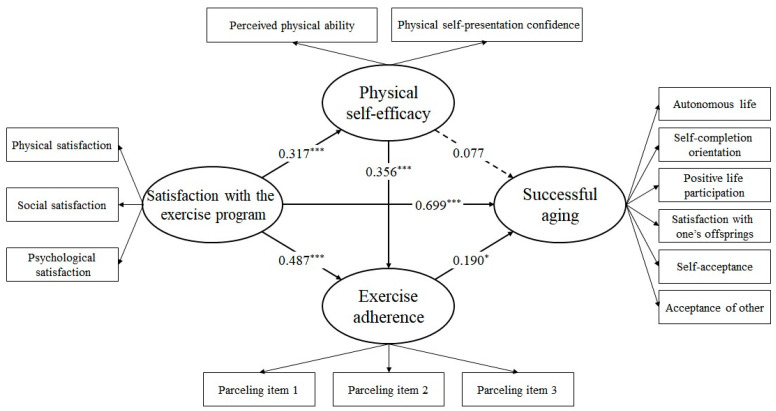
There was no problem with the model fit. Satisfaction with exercise positively affected PSE (β = 0.317, < 0.001), exercise adherence (β = 0.487, < 0.001), and successful aging (β = 0.669, < 0.001). PSE positively affected exercise adherence (β = 0.356, < 0.001), and exercise adherence positively affected successful aging (β = 0.190, < 0.05). Furthermore, PSE (β = 0.019, < 0.01) and exercise adherence (β = 0.081, < 0.05) mediated the relationship between satisfaction with exercise and successful aging.
Satisfaction with exercise is important for promoting successful aging among Korean older adults who exercise. Satisfaction with exercise can increase their efficacy for performing physical activities and encourage them to continue exercising. This can ultimately lead to a happy life in old age.
随着韩国向超老龄化社会转变,老年人的健康和心理健康正成为关键问题。虽然许多研究人员关注参与锻炼的老年人的成功老龄化,但韩国文献中关于促成这一结果的前提条件存在研究空白。因此,本研究分析了韩国定期锻炼的老年人的满意度与锻炼、身体自我效能感(PSE)、锻炼坚持性和成功老龄化之间的关系。
参与者为369名(234名男性和135名女性)65岁及以上居住在韩国的老年人,平均年龄为69.91岁。数据于2024年3月至2024年6月收集,并使用描述性统计、相关性分析和结构方程模型进行分析。
模型拟合没有问题。锻炼满意度对身体自我效能感(β = 0.317,<0.001)、锻炼坚持性(β = 0.487,<0.001)和成功老龄化(β = 0.669,<0.001)有积极影响。身体自我效能感对锻炼坚持性有积极影响(β = 0.356,<0.001),锻炼坚持性对成功老龄化有积极影响(β = 0.190,<0.05)。此外,身体自我效能感(β = 0.019,<0.01)和锻炼坚持性(β = 0.081,<0.05)介导了锻炼满意度与成功老龄化之间关系。
锻炼满意度对于促进韩国锻炼老年人的成功老龄化很重要。锻炼满意度可以提高他们进行体育活动的效能,并鼓励他们继续锻炼。这最终可以带来幸福的晚年生活。