Department of Electrical and Mechanical Engineering, Nagoya Institute of Technology, Nagoya 466-8555, Japan.
Biosensors (Basel). 2024 Oct 21;14(10):513. doi: 10.3390/bios14100513.
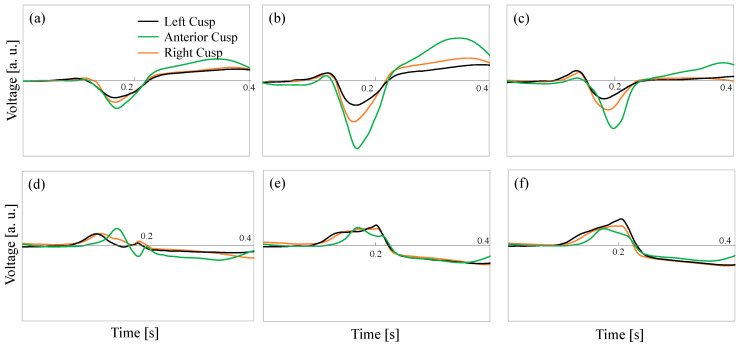
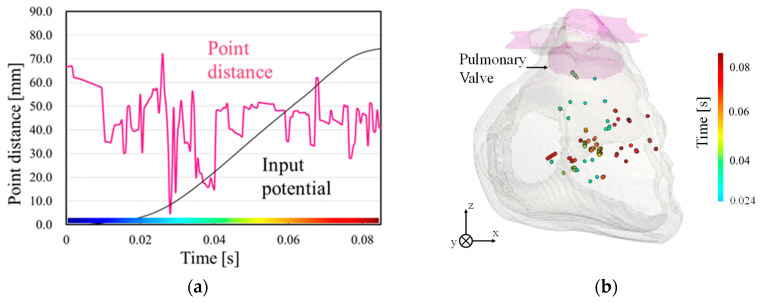
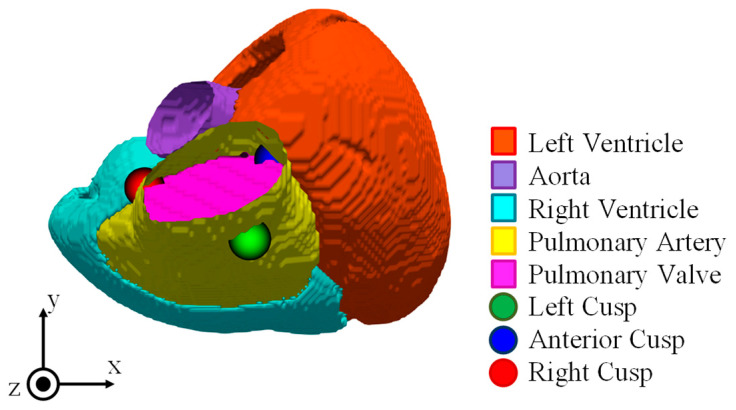
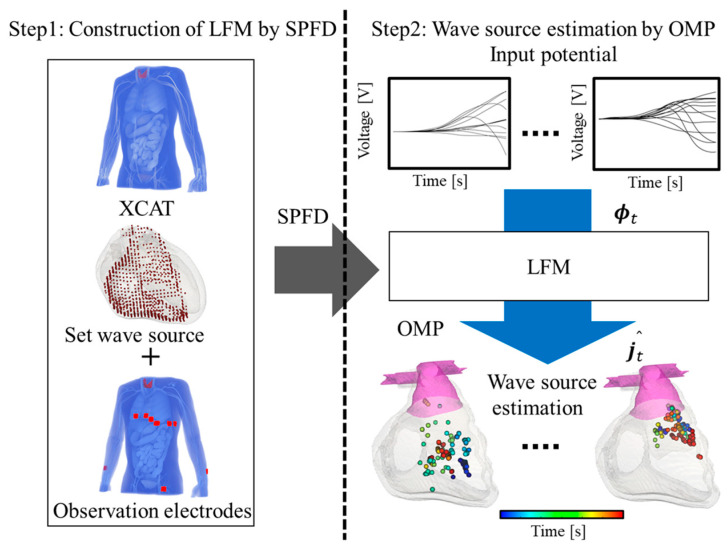
Premature ventricular contractions (PVCs) are a common arrhythmia characterized by ectopic excitations within the ventricles. Accurately estimating the ablation site using an electrocardiogram (ECG) is crucial for the initial classification of PVC origins, typically focusing on the right and left ventricular outflow tracts. However, finer classification, specifically identifying the left cusp (LC), anterior cusp (AC), and right cusp (RC), is essential for detailed preoperative planning. This study aims to improve the accuracy of cardiac waveform source estimation and classification in 27 patients with PVCs originating from the pulmonary valve. We utilized an anatomical human model and electromagnetic simulations to estimate wave source positions from 12-lead ECG data. Time-series source points were identified for each measured ECG waveform, focusing on the moment when the distance between the estimated wave source and the pulmonary valve was minimal. Computational analysis revealed that the distance between the estimated wave source and the pulmonary valve was reduced to less than 1 cm, with LC localization achieving errors under 5 mm. Additionally, 74.1% of the subjects were accurately classified into the correct origin (LC, AC, or RC), with each origin demonstrating the highest percentage of subjects corresponding to the targeted excitation origin. Our findings underscore the novel potential of this source localization method as a valuable complement to traditional waveform classification, offering enhanced diagnostic precision and improved preoperative planning for PVC ablation procedures.
室性期前收缩(PVCs)是一种常见的心律失常,其特征为心室内部的异位兴奋。使用心电图(ECG)准确估计消融部位对于 PVC 起源的初始分类至关重要,通常侧重于右心室和左心室流出道。然而,更精细的分类,特别是识别左冠(LC)、前冠(AC)和右冠(RC),对于详细的术前规划至关重要。本研究旨在提高源自肺动脉瓣的 PVC 患者 27 例的心脏波形源估计和分类的准确性。我们利用解剖学人体模型和电磁模拟从 12 导联 ECG 数据估计波源位置。为每个测量的 ECG 波形确定了时序列源点,重点是估计的波源与肺动脉瓣之间的距离最小时刻。计算分析表明,估计的波源与肺动脉瓣之间的距离减少到 1 厘米以下,LC 定位误差小于 5 毫米。此外,74.1%的受试者被准确地分类到正确的起源(LC、AC 或 RC),每个起源的受试者百分比最高对应于目标兴奋起源。我们的研究结果强调了这种源定位方法的新颖潜力,它是传统波形分类的有价值的补充,为 PVC 消融程序提供了更高的诊断精度和改进的术前规划。