Jaquerod Manon E, Knight Ramisha S, Lintas Alessandra, Villa Alessandro E P
NeuroHeuristic Research Group, University of Lausanne, Quartier UNIL-Chamberonne, 1015 Lausanne, Switzerland.
Beckman Institute, University of Illinois at Urbana-Champaign, 405 N Mathews Ave., Urbana, IL 61801, USA.
Brain Sci. 2024 Sep 29;14(10):994. doi: 10.3390/brainsci14100994.
In the oddball paradigm, the dorsolateral prefrontal cortex (DLPFC) is often associated with active cognitive responses, such as maintaining information in working memory or adapting response strategies. While some evidence points to the DLPFC's role in passive auditory deviance perception, a detailed understanding of the spatiotemporal neurodynamics involved remains unclear.
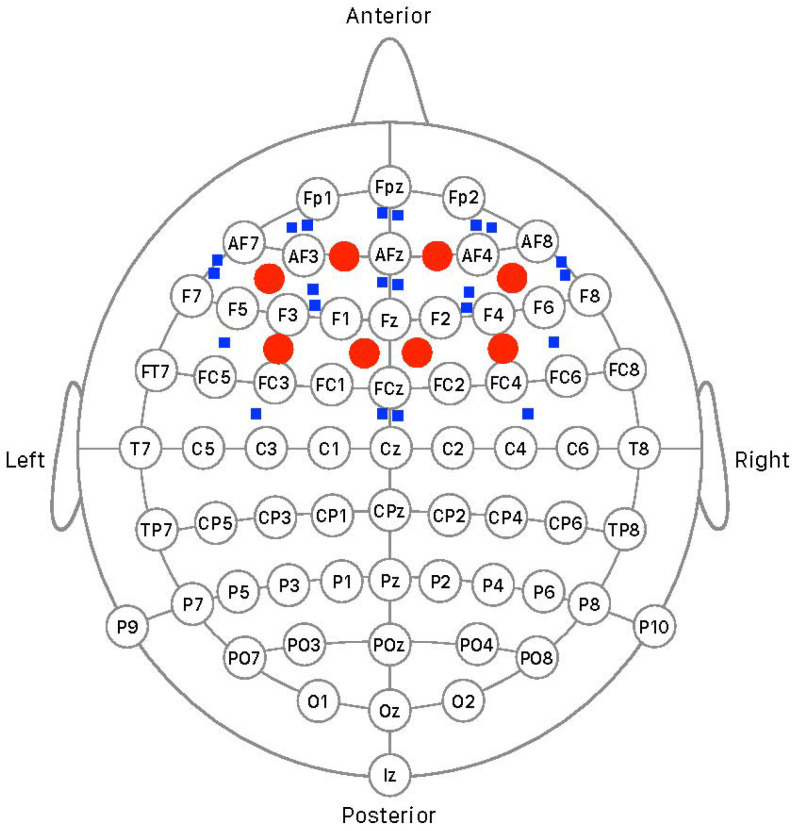
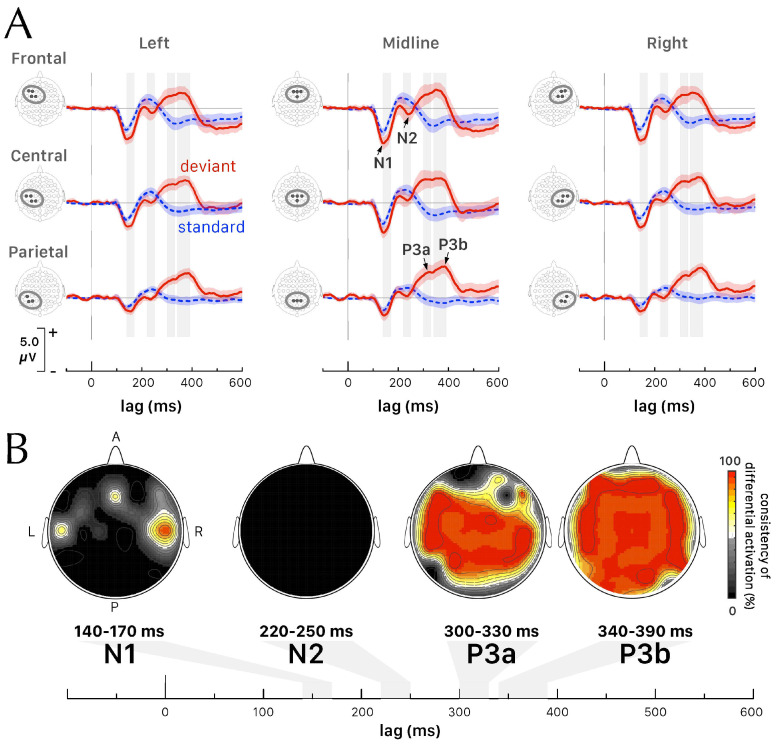
In this study, event-related optical signals (EROS) and event-related potentials (ERPs) were simultaneously recorded for the first time over the prefrontal cortex using a 64-channel electroencephalography (EEG) system, during passive auditory deviance perception in 12 right-handed young adults (7 women and 5 men). In this oddball paradigm, deviant stimuli (a 1500 Hz pure tone) elicited a negative shift in the N1 ERP component, related to mismatch negativity (MMN), and a significant positive deflection associated with the P300, compared to standard stimuli (a 1000 Hz tone).
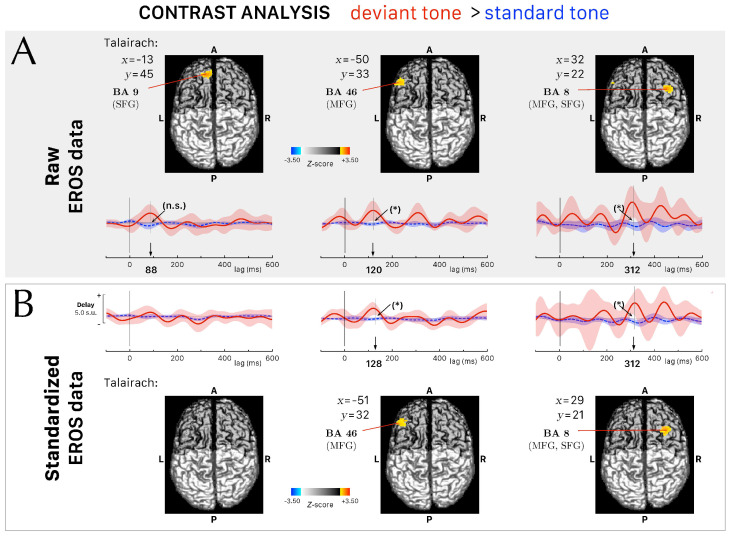
We hypothesize that the DLPFC not only participates in active tasks but also plays a critical role in processing deviant stimuli in passive conditions, shifting from pre-attentive to attentive processing. We detected enhanced neural activity in the left middle frontal gyrus (MFG), at the same timing of the MMN component, followed by later activation at the timing of the P3a ERP component in the right MFG.
Understanding these dynamics will provide deeper insights into the DLPFC's role in evaluating the novelty or unexpectedness of the deviant stimulus, updating its cognitive value, and adjusting future predictions accordingly. However, the small number of subjects could limit the generalizability of the observations, in particular with respect to the effect of handedness, and additional studies with larger and more diverse samples are necessary to validate our conclusions.
在异常刺激范式中,背外侧前额叶皮层(DLPFC)通常与积极的认知反应相关,比如在工作记忆中保持信息或调整反应策略。虽然有一些证据表明DLPFC在被动听觉偏差感知中发挥作用,但对其中涉及的时空神经动力学的详细理解仍不清楚。
在本研究中,首次使用64通道脑电图(EEG)系统,在12名右利手年轻成年人(7名女性和5名男性)进行被动听觉偏差感知期间,同时在前额叶皮层记录事件相关光信号(EROS)和事件相关电位(ERP)。在这个异常刺激范式中,与标准刺激(1000赫兹音调)相比,异常刺激(1500赫兹纯音)会引起ERP成分N1中与失配负波(MMN)相关的负向偏移,以及与P300相关的显著正向偏转。
我们假设DLPFC不仅参与主动任务,而且在被动条件下处理异常刺激时也起着关键作用,从预注意处理转变为注意处理。我们在左侧额中回(MFG)检测到在MMN成分相同时间点增强的神经活动,随后在右侧MFG中P3a ERP成分的时间点出现后期激活。
了解这些动力学将为DLPFC在评估异常刺激的新颖性或意外性、更新其认知价值以及相应调整未来预测方面的作用提供更深入的见解。然而,受试者数量较少可能会限制观察结果的普遍性,特别是关于利手的影响,需要更多更大且更多样化样本的研究来验证我们的结论。