Li Rihui, Yang Dalin, Fang Feng, Hong Keum-Shik, Reiss Allan L, Zhang Yingchun
Center for Interdisciplinary Brain Sciences Research, Department of Psychiatry and Behavioral Sciences, Stanford University School of Medicine, Stanford, CA 94305, USA.
Department of Biomedical Engineering, University of Houston, Houston, TX 77004, USA.
Sensors (Basel). 2022 Aug 5;22(15):5865. doi: 10.3390/s22155865.
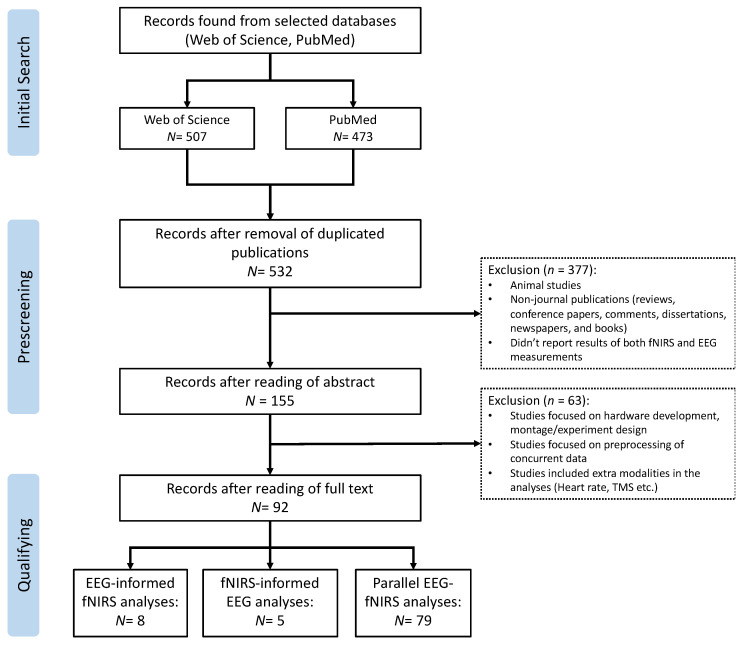
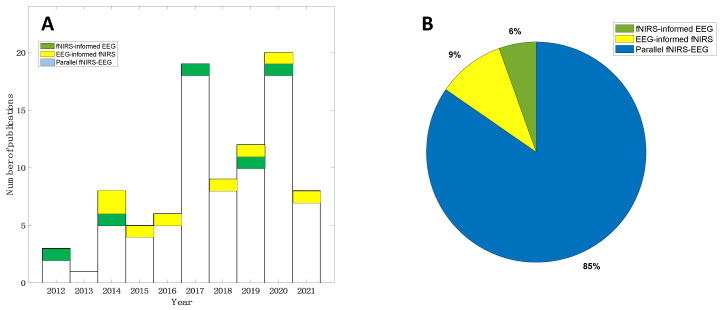
Electroencephalography (EEG) and functional near-infrared spectroscopy (fNIRS) stand as state-of-the-art techniques for non-invasive functional neuroimaging. On a unimodal basis, EEG has poor spatial resolution while presenting high temporal resolution. In contrast, fNIRS offers better spatial resolution, though it is constrained by its poor temporal resolution. One important merit shared by the EEG and fNIRS is that both modalities have favorable portability and could be integrated into a compatible experimental setup, providing a compelling ground for the development of a multimodal fNIRS-EEG integration analysis approach. Despite a growing number of studies using concurrent fNIRS-EEG designs reported in recent years, the methodological reference of past studies remains unclear. To fill this knowledge gap, this review critically summarizes the status of analysis methods currently used in concurrent fNIRS-EEG studies, providing an up-to-date overview and guideline for future projects to conduct concurrent fNIRS-EEG studies. A literature search was conducted using PubMed and Web of Science through 31 August 2021. After screening and qualification assessment, 92 studies involving concurrent fNIRS-EEG data recordings and analyses were included in the final methodological review. Specifically, three methodological categories of concurrent fNIRS-EEG data analyses, including EEG-informed fNIRS analyses, fNIRS-informed EEG analyses, and parallel fNIRS-EEG analyses, were identified and explained with detailed description. Finally, we highlighted current challenges and potential directions in concurrent fNIRS-EEG data analyses in future research.
脑电图(EEG)和功能近红外光谱(fNIRS)是用于非侵入性功能神经成像的先进技术。在单模态基础上,EEG的空间分辨率较差,但具有高时间分辨率。相比之下,fNIRS提供了更好的空间分辨率,尽管其时间分辨率较差。EEG和fNIRS的一个重要优点是,这两种模态都具有良好的便携性,可以集成到一个兼容的实验设置中,为多模态fNIRS-EEG集成分析方法的发展提供了有力依据。尽管近年来有越来越多使用同步fNIRS-EEG设计的研究报道,但过去研究的方法学参考仍不明确。为了填补这一知识空白,本综述批判性地总结了当前同步fNIRS-EEG研究中使用的分析方法的现状,为未来开展同步fNIRS-EEG研究的项目提供了最新的概述和指导方针。通过PubMed和Web of Science对截至2021年8月31日的文献进行了检索。经过筛选和资格评估,92项涉及同步fNIRS-EEG数据记录和分析的研究被纳入最终的方法学综述。具体来说,确定并详细解释了同步fNIRS-EEG数据分析的三类方法,包括基于EEG的fNIRS分析、基于fNIRS的EEG分析和并行fNIRS-EEG分析。最后,我们强调了未来研究中同步fNIRS-EEG数据分析的当前挑战和潜在方向。