• 文献检索
  • 文档翻译
  • 深度研究
  • 学术资讯
  • Suppr Zotero 插件Zotero 插件
  • 邀请有礼
  • 套餐&价格
  • 历史记录
应用&插件
Suppr Zotero 插件Zotero 插件浏览器插件Mac 客户端Windows 客户端微信小程序
定价
高级版会员购买积分包购买API积分包
服务
文献检索文档翻译深度研究API 文档MCP 服务
关于我们
关于 Suppr公司介绍联系我们用户协议隐私条款
关注我们

Suppr 超能文献

核心技术专利:CN118964589B侵权必究
粤ICP备2023148730 号-1Suppr @ 2026

文献检索

告别复杂PubMed语法,用中文像聊天一样搜索,搜遍4000万医学文献。AI智能推荐,让科研检索更轻松。

立即免费搜索

文件翻译

保留排版,准确专业,支持PDF/Word/PPT等文件格式,支持 12+语言互译。

免费翻译文档

深度研究

AI帮你快速写综述,25分钟生成高质量综述,智能提取关键信息,辅助科研写作。

立即免费体验

仓鸮孵化后姿势与行为的发育:从脊椎动物的一般行为模式到典型的鸮类行为

Post-Hatching Development of Posture and Behavior in the Barn Owl (): From a General Behavioral Pattern of Vertebrates to the Typical Owl Behavior.

作者信息

Eilam David, Hagbi Zohar

机构信息

George S. Wise Faculty of Life Sciences, School of Zoology, Tel-Aviv University, Tel Aviv 6997801, Israel.

Department of Psychological and Brain Sciences, Dartmouth College, Hanover, NH 03755, USA.

出版信息

Biology (Basel). 2024 Oct 17;13(10):834. doi: 10.3390/biology13100834.

DOI:10.3390/biology13100834
PMID:39452142
原文链接:https://pmc.ncbi.nlm.nih.gov/articles/PMC11504010/
Abstract

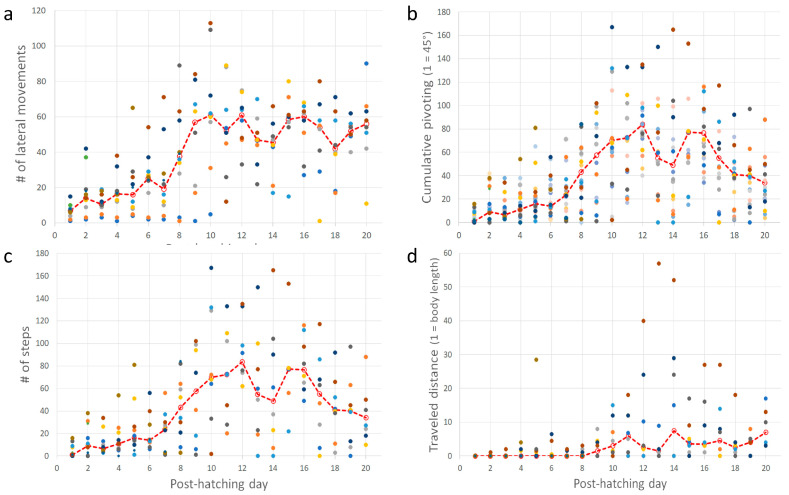
Hatching captive barn owl chicks underwent four developmental phases. In the first 10 days (phase 1), behavior consisted of lateral movements that gradually changed to forward progression and peaked a few days before and after eye-opening. This behavior resembled a general developmental pattern that characterizes other vertebrates. Chicks also underwent a postural change, from head bent underneath the ventrum to resting on the rear end of the trunk with the head lifted in the air. Then, once their eyes were opened, chicks became more stationary and preoccupied with visual exploration, manifested in lateral head movements and peering episodes (phase 2, until day 20). The latter behavior, which is also typical of mature owls when not on the wing, characterized the chicks' behavior after post-hatching day 20 (phase 3), when their flight and contour feathers grew, along with shedding the down plumage and standing tall. Development culminated in active flight, first observed by days 50-60 (phase 4). Altogether, during post-hatching development, barn owl chicks gradually shifted from egg posture to the adult upright body posture. At the same time, their behavior consisted of speciation from the general developmental pattern to the typical stationary barn owl behavior, and, finally, flight was incorporated.

摘要

人工孵化的仓鸮雏鸟经历了四个发育阶段。在最初的10天(阶段1),其行为包括侧向移动,这种移动逐渐转变为向前移动,并在睁眼前后几天达到顶峰。这种行为类似于其他脊椎动物的一般发育模式。雏鸟还经历了姿势变化,从头部弯曲在腹部下方到头部抬起,身体靠在躯干后端休息。然后,一旦它们睁开眼睛,雏鸟就变得更加静止,专注于视觉探索,表现为头部侧向移动和凝视(阶段2,直到第20天)。后一种行为在成熟的鸮类不飞行时也很典型,它是雏鸟在孵化后第20天(阶段3)后的行为特征,此时它们的飞羽和廓羽开始生长,同时褪去绒羽并站直。发育最终以主动飞行告终,最早在第50 - 60天观察到(阶段4)。总之,在孵化后的发育过程中,仓鸮雏鸟逐渐从蛋的姿势转变为成年的直立身体姿势。与此同时,它们的行为从一般发育模式演变为典型的静止仓鸮行为,最终学会了飞行。

https://cdn.ncbi.nlm.nih.gov/pmc/blobs/54b1/11504010/16ee79833e51/biology-13-00834-g014.jpg
https://cdn.ncbi.nlm.nih.gov/pmc/blobs/54b1/11504010/292dbca6e09a/biology-13-00834-g001.jpg
https://cdn.ncbi.nlm.nih.gov/pmc/blobs/54b1/11504010/8041f1325ef9/biology-13-00834-g002.jpg
https://cdn.ncbi.nlm.nih.gov/pmc/blobs/54b1/11504010/2db825f14613/biology-13-00834-g003.jpg
https://cdn.ncbi.nlm.nih.gov/pmc/blobs/54b1/11504010/ca256816a59b/biology-13-00834-g004.jpg
https://cdn.ncbi.nlm.nih.gov/pmc/blobs/54b1/11504010/a6042b7a1d18/biology-13-00834-g005.jpg
https://cdn.ncbi.nlm.nih.gov/pmc/blobs/54b1/11504010/5dfb90d8da2f/biology-13-00834-g006.jpg
https://cdn.ncbi.nlm.nih.gov/pmc/blobs/54b1/11504010/c891c6fe96f5/biology-13-00834-g007.jpg
https://cdn.ncbi.nlm.nih.gov/pmc/blobs/54b1/11504010/c8b67cd028cd/biology-13-00834-g008.jpg
https://cdn.ncbi.nlm.nih.gov/pmc/blobs/54b1/11504010/f1574d82c0fd/biology-13-00834-g009.jpg
https://cdn.ncbi.nlm.nih.gov/pmc/blobs/54b1/11504010/b6bc64ae6f67/biology-13-00834-g010.jpg
https://cdn.ncbi.nlm.nih.gov/pmc/blobs/54b1/11504010/5be8da9d688e/biology-13-00834-g011.jpg
https://cdn.ncbi.nlm.nih.gov/pmc/blobs/54b1/11504010/f867ee3d72d0/biology-13-00834-g012.jpg
https://cdn.ncbi.nlm.nih.gov/pmc/blobs/54b1/11504010/fc01ec6801de/biology-13-00834-g013.jpg
https://cdn.ncbi.nlm.nih.gov/pmc/blobs/54b1/11504010/16ee79833e51/biology-13-00834-g014.jpg
https://cdn.ncbi.nlm.nih.gov/pmc/blobs/54b1/11504010/292dbca6e09a/biology-13-00834-g001.jpg
https://cdn.ncbi.nlm.nih.gov/pmc/blobs/54b1/11504010/8041f1325ef9/biology-13-00834-g002.jpg
https://cdn.ncbi.nlm.nih.gov/pmc/blobs/54b1/11504010/2db825f14613/biology-13-00834-g003.jpg
https://cdn.ncbi.nlm.nih.gov/pmc/blobs/54b1/11504010/ca256816a59b/biology-13-00834-g004.jpg
https://cdn.ncbi.nlm.nih.gov/pmc/blobs/54b1/11504010/a6042b7a1d18/biology-13-00834-g005.jpg
https://cdn.ncbi.nlm.nih.gov/pmc/blobs/54b1/11504010/5dfb90d8da2f/biology-13-00834-g006.jpg
https://cdn.ncbi.nlm.nih.gov/pmc/blobs/54b1/11504010/c891c6fe96f5/biology-13-00834-g007.jpg
https://cdn.ncbi.nlm.nih.gov/pmc/blobs/54b1/11504010/c8b67cd028cd/biology-13-00834-g008.jpg
https://cdn.ncbi.nlm.nih.gov/pmc/blobs/54b1/11504010/f1574d82c0fd/biology-13-00834-g009.jpg
https://cdn.ncbi.nlm.nih.gov/pmc/blobs/54b1/11504010/b6bc64ae6f67/biology-13-00834-g010.jpg
https://cdn.ncbi.nlm.nih.gov/pmc/blobs/54b1/11504010/5be8da9d688e/biology-13-00834-g011.jpg
https://cdn.ncbi.nlm.nih.gov/pmc/blobs/54b1/11504010/f867ee3d72d0/biology-13-00834-g012.jpg
https://cdn.ncbi.nlm.nih.gov/pmc/blobs/54b1/11504010/fc01ec6801de/biology-13-00834-g013.jpg
https://cdn.ncbi.nlm.nih.gov/pmc/blobs/54b1/11504010/16ee79833e51/biology-13-00834-g014.jpg

相似文献

1
Post-Hatching Development of Posture and Behavior in the Barn Owl (): From a General Behavioral Pattern of Vertebrates to the Typical Owl Behavior.仓鸮孵化后姿势与行为的发育:从脊椎动物的一般行为模式到典型的鸮类行为
Biology (Basel). 2024 Oct 17;13(10):834. doi: 10.3390/biology13100834.
2
Morphometric characterisation of wing feathers of the barn owl Tyto alba pratincola and the pigeon Columba livia.大草鸮 Tyto alba pratincola 和鸽子 Columba livia 翅膀羽毛的形态特征。
Front Zool. 2007 Nov 21;4:23. doi: 10.1186/1742-9994-4-23.
3
How barn owls (Tyto alba) visually follow moving voles (Microtus socialis) before attacking them.仓鸮(Tyto alba)在攻击群居田鼠(Microtus socialis)之前是如何通过视觉追踪移动的群居田鼠的。
Physiol Behav. 2009 Sep 7;98(3):359-66. doi: 10.1016/j.physbeh.2009.06.016. Epub 2009 Jul 3.
4
Avian Binocularity and Adaptation to Nocturnal Environments: Genomic Insights from a Highly Derived Visual Phenotype.鸟类的双眼视觉和对夜间环境的适应:高度衍生视觉表型的基因组见解。
Genome Biol Evol. 2019 Aug 1;11(8):2244-2255. doi: 10.1093/gbe/evz111.
5
Trace metals in primary feathers of the Barn Owl (Tyto alba guttatus) in The Netherlands.荷兰仓鸮(Tyto alba guttatus)初级飞羽中的痕量金属。
Environ Pollut. 1993;82(3):301-10. doi: 10.1016/0269-7491(93)90133-9.
6
Morphometry of auricular feathers of barn owls (Tyto alba).仓鸮(Tyto alba)耳羽的形态测量学
Eur J Morphol. 2002 Feb;40(1):15-21. doi: 10.1076/ejom.40.1.15.13957.
7
Composition of the body mass overshoot in European barn owl nestlings (Tyto alba): insurance against scarcity of energy or water?欧洲仓鸮雏鸟(Tyto alba)体重超标的构成:是应对能量或水分短缺的保障机制吗?
J Comp Physiol B. 2008 Jul;178(5):563-71. doi: 10.1007/s00360-007-0246-4. Epub 2008 Jan 9.
8
Microsatellite markers characterized in the barn owl (Tyto alba) and of high utility in other owls (Strigiformes: AVES).微卫星标记在仓鸮(Tyto alba)中的特征及其在其他鸮形目鸟类(Strigiformes:AVES)中的高实用性。
Mol Ecol Resour. 2009 Nov;9(6):1512-9. doi: 10.1111/j.1755-0998.2009.02715.x. Epub 2009 May 15.
9
Comprehensive molecular phylogeny of barn owls and relatives (Family: Tytonidae), and their six major Pleistocene radiations.仓鸮及其近缘物种(Tytonidae 科)的综合分子系统发育,以及它们在六大更新世辐射中的演化。
Mol Phylogenet Evol. 2018 Aug;125:127-137. doi: 10.1016/j.ympev.2018.03.013. Epub 2018 Mar 11.
10
Feather folliculoma in a captive-bred barn owl (Tyto alba).人工饲养的仓鸮(Tyto alba)身上的羽毛毛囊瘤
Avian Dis. 1999 Jul-Sep;43(3):616-21.

本文引用的文献

1
Landing force reveals new form of motion-induced sound camouflage in a wild predator.着陆力揭示了野生捕食者中一种新形式的运动诱导声伪装。
Elife. 2024 Jul 24;12:RP87775. doi: 10.7554/eLife.87775.
2
Motion parallax via head movements modulates visuo-motor control in pigeons.头部运动产生的运动视差调节鸽子的视动控制。
J Exp Biol. 2021 Feb 10;224(Pt 3):jeb236547. doi: 10.1242/jeb.236547.
3
The sounds of silence: Barn owl noise in landing and taking off.寂静之声:仓鸮着陆和起飞时的声响
Behav Processes. 2018 Dec;157:484-488. doi: 10.1016/j.beproc.2018.06.011. Epub 2018 Jun 19.
4
Side-to-side head movements to obtain motion depth cues: A short review of research on the praying mantis.通过头部左右移动获取运动深度线索:关于螳螂的研究综述
Behav Processes. 1998 Apr;43(1):71-7. doi: 10.1016/s0376-6357(98)00007-2.
5
The developmental dynamics of behavioral growth processes in rodent egocentric and allocentric space.啮齿类动物自我中心和以客体为中心的空间行为生长过程的发展动态。
Behav Brain Res. 2012 Jun 1;231(2):309-16. doi: 10.1016/j.bbr.2012.01.039. Epub 2012 Jan 28.
6
How barn owls (Tyto alba) visually follow moving voles (Microtus socialis) before attacking them.仓鸮(Tyto alba)在攻击群居田鼠(Microtus socialis)之前是如何通过视觉追踪移动的群居田鼠的。
Physiol Behav. 2009 Sep 7;98(3):359-66. doi: 10.1016/j.physbeh.2009.06.016. Epub 2009 Jul 3.
7
On the barn owl's visual pre-attack behavior: I. Structure of head movements and motion patterns.关于仓鸮的视觉攻击前行为:I. 头部运动结构和运动模式
J Comp Physiol A Neuroethol Sens Neural Behav Physiol. 2006 Sep;192(9):927-40. doi: 10.1007/s00359-006-0130-9. Epub 2006 May 16.
8
Die hard: a blend of freezing and fleeing as a dynamic defense--implications for the control of defensive behavior.顽强抵抗:冻结与逃避相结合作为一种动态防御——对防御行为控制的启示
Neurosci Biobehav Rev. 2005;29(8):1181-91. doi: 10.1016/j.neubiorev.2005.03.027. Epub 2005 Aug 8.
9
Protean behavior under barn-owl attack: voles alternate between freezing and fleeing and spiny mice flee in alternating patterns.谷仓猫头鹰攻击下的多变行为:田鼠在静止不动和逃窜之间交替,而刺毛鼠则以交替模式逃窜。
Behav Brain Res. 2004 Dec 6;155(2):207-16. doi: 10.1016/j.bbr.2004.04.018.
10
Coding of auditory space.听觉空间编码
Annu Rev Neurosci. 2003;26:31-55. doi: 10.1146/annurev.neuro.26.041002.131123.