Zhang He-Li, Qiu Xi-Xi, Liao Xin-Hua
School of Environmental and Chemical Engineering, Shanghai University, Shanghai 200444, China.
School of Life Sciences, Shanghai University, Shanghai 200444, China.
Biology (Basel). 2024 Oct 20;13(10):842. doi: 10.3390/biology13100842.
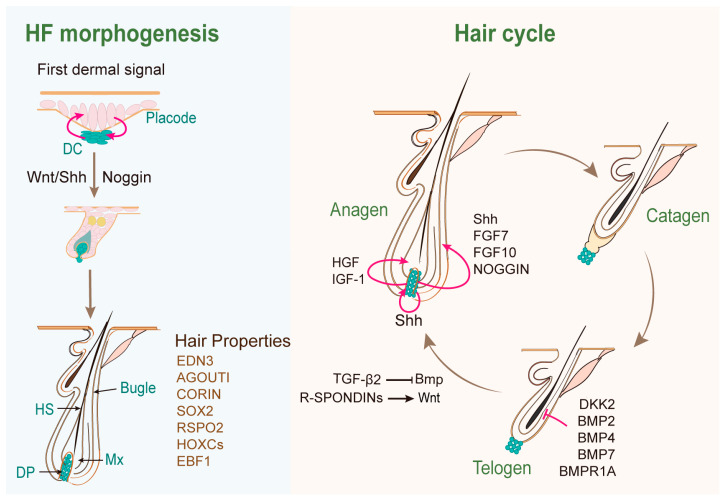
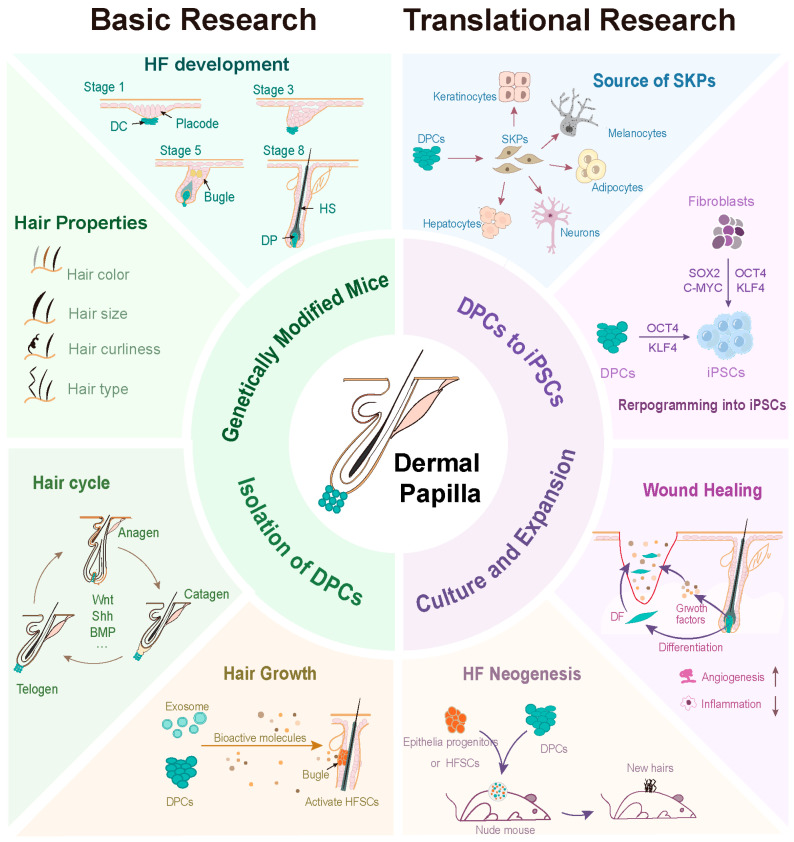
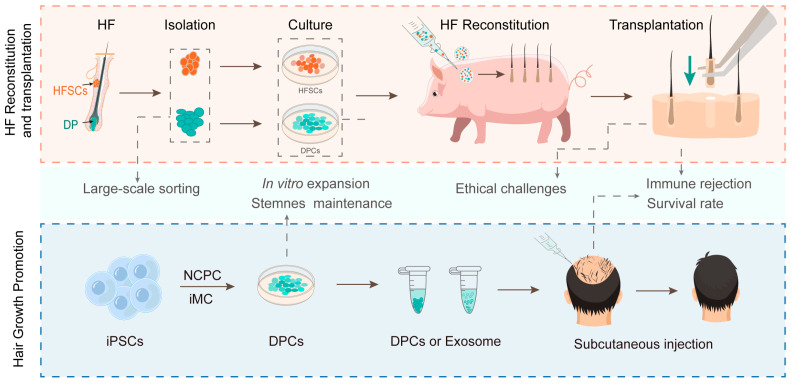
As an appendage of the skin, hair protects against ultraviolet radiation and mechanical damage and regulates body temperature. It also reflects an individual's health status and serves as an important method of expressing personality. Hair loss and graying are significant psychosocial burdens for many people. Hair is produced from hair follicles, which are exclusively controlled by the dermal papilla (DP) at their base. The dermal papilla cells (DPCs) comprise a cluster of specialized mesenchymal cells that induce the formation of hair follicles during early embryonic development through interaction with epithelial precursor cells. They continue to regulate the growth cycle, color, size, and type of hair after the hair follicle matures by secreting various factors. DPCs possess stem cell characteristics and can be cultured and expanded in vitro. DPCs express numerous stemness-related factors, enabling them to be reprogrammed into induced pluripotent stem cells (iPSCs) using only two, or even one, Yamanaka factor. DPCs are an important source of skin-derived precursors (SKPs). When combined with epithelial stem cells, they can reconstitute skin and hair follicles, participating in the regeneration of the dermis, including the DP and dermal sheath. When implanted between the epidermis and dermis, DPCs can induce the formation of new hair follicles on hairless skin. Subcutaneous injection of DPCs and their exosomes can promote hair growth. This review summarizes the in vivo functions of the DP; highlights the potential of DPCs in cell therapy, particularly for the treatment of hair loss; and discusses the challenges and recent advances in the field, from basic research to translational applications.
作为皮肤的附属器,毛发可抵御紫外线辐射和机械损伤,并调节体温。它还反映个体的健康状况,是表达个性的重要方式。脱发和白发对许多人来说是重大的心理社会负担。毛发由毛囊产生,毛囊在其基部完全由真皮乳头(DP)控制。真皮乳头细胞(DPCs)是一群特殊的间充质细胞,在胚胎发育早期通过与上皮前体细胞相互作用诱导毛囊形成。毛囊成熟后,它们通过分泌各种因子继续调节毛发的生长周期、颜色、大小和类型。DPCs具有干细胞特征,可在体外培养和扩增。DPCs表达众多与干性相关的因子,仅使用两种甚至一种山中因子就能将它们重编程为诱导多能干细胞(iPSCs)。DPCs是皮肤来源前体细胞(SKPs)的重要来源。与上皮干细胞结合时,它们可以重建皮肤和毛囊,参与包括DP和真皮鞘在内的真皮再生。当植入表皮和真皮之间时,DPCs可以在无毛皮肤上诱导新毛囊的形成。皮下注射DPCs及其外泌体可促进头发生长。本综述总结了DP的体内功能;强调了DPCs在细胞治疗中的潜力,特别是在治疗脱发方面;并讨论了该领域从基础研究到转化应用的挑战和最新进展。