Hamida Ons Ben, Kim Moon Kyu, Sung Young Kwan, Kim Min Kyu, Kwack Mi Hee
Department of Immunology, School of Medicine, Kyungpook National University, Daegu 41944, Republic of Korea.
Hair Transplantation Center, Kyungpook National University Hospital, Daegu 41944, Republic of Korea.
Cells. 2024 Dec 25;14(1):7. doi: 10.3390/cells14010007.
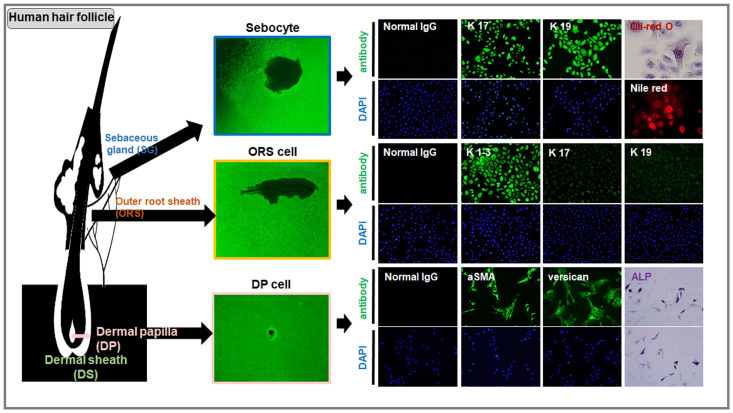
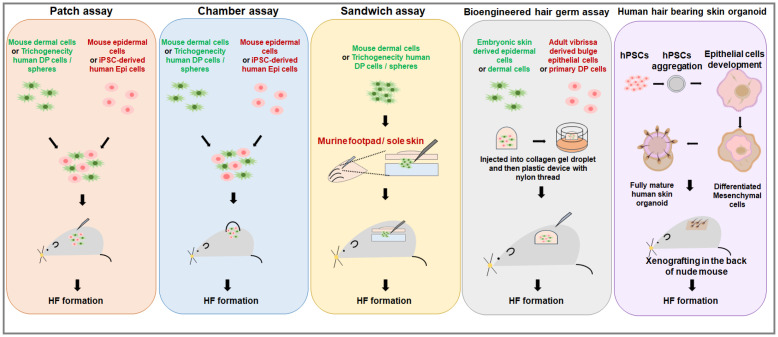
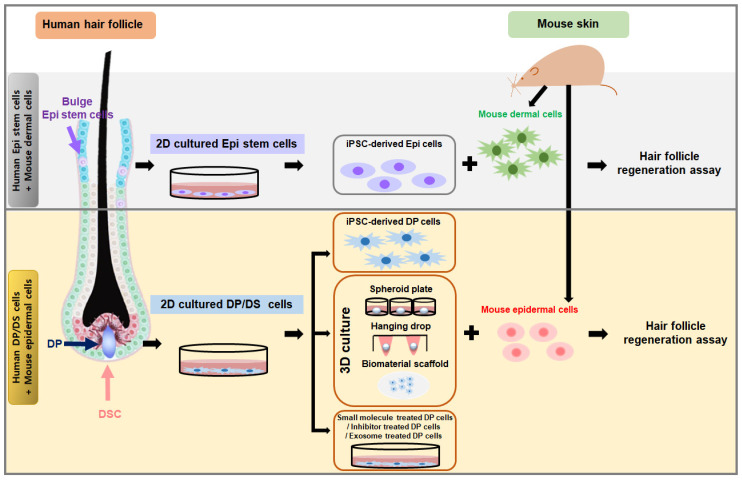
The hair follicle is a complex of mesenchymal and epithelial cells acquiring different properties and characteristics responsible for fulfilling its inductive and regenerative role. The epidermal and dermal crosstalk induces morphogenesis and maintains hair follicle cycling properties. The hair follicle is enriched with pluripotent stem cells, where dermal papilla (DP) cells and dermal sheath (DS) cells constitute the dermal compartment and the epithelial stem cells existing in the bulge region exert their regenerative role by mediating the epithelial-mesenchymal interaction (EMI). Many studies have developed and focused on various methods to optimize the EMI through in vivo and in vitro approaches for hair regeneration. The culturing of human hair mesenchymal cells resulted in the loss of trichogenicity and inductive properties of DP cells, limiting their potential application in de novo hair follicle generation in vivo. Epithelial stem cells derived from human hair follicles are challenging to isolate and culture, making it difficult to obtain enough cells for hair regeneration purposes. Mesenchymal stem cells and epithelial stem cells derived from human hair follicles lose their ability to form hair follicles during culture, limiting the study of hair follicle formation in vivo. Therefore, many attempts and methods have been developed to overcome these limitations. Here, we review the possible and necessary cell methods and techniques used for human hair follicle regeneration and the restoration of hair follicle cell inductivity in culture.
毛囊是由间充质细胞和上皮细胞组成的复合体,这些细胞具有不同的特性和特征,负责发挥其诱导和再生作用。表皮和真皮之间的相互作用诱导形态发生并维持毛囊的周期性特性。毛囊富含多能干细胞,其中真皮乳头(DP)细胞和真皮鞘(DS)细胞构成真皮部分,而存在于隆突区的上皮干细胞通过介导上皮-间充质相互作用(EMI)发挥其再生作用。许多研究已经开发并专注于通过体内和体外方法优化EMI以促进毛发再生的各种方法。人毛发间充质细胞的培养导致DP细胞的生毛能力和诱导特性丧失,限制了它们在体内从头生成毛囊中的潜在应用。源自人毛囊的上皮干细胞难以分离和培养,因此难以获得足够数量的细胞用于毛发再生。源自人毛囊的间充质干细胞和上皮干细胞在培养过程中失去了形成毛囊的能力,限制了体内毛囊形成的研究。因此,已经开发了许多尝试和方法来克服这些限制。在这里,我们综述了用于人毛囊再生和恢复培养中毛囊细胞诱导能力的可能且必要的细胞方法和技术。