Triposkiadis Filippos, Xanthopoulos Andrew, Skoularigis John
School of Medicine, European University Cyprus, 2404 Nicosia, Cyprus.
Department of Cardiology, University Hospital of Larissa, 41110 Larissa, Greece.
J Pers Med. 2024 Oct 17;14(10):1064. doi: 10.3390/jpm14101064.
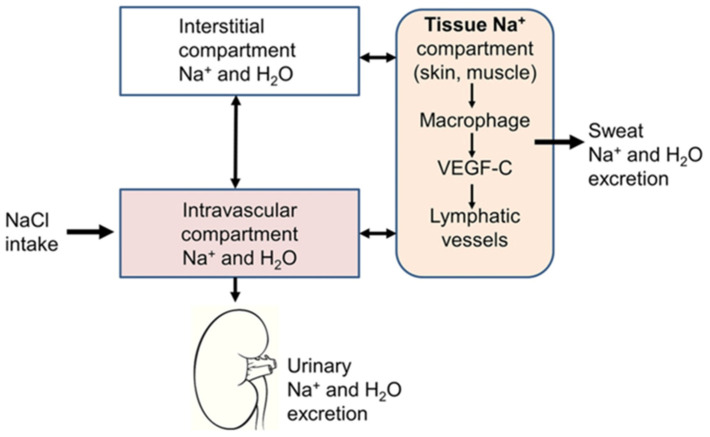
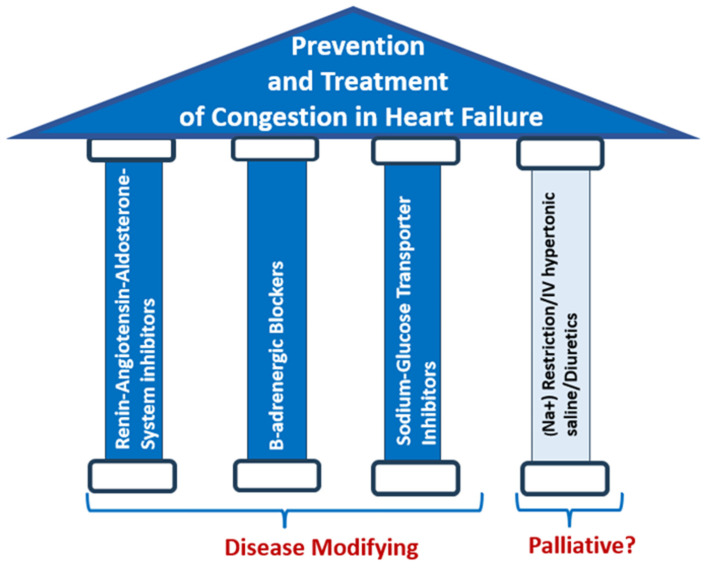
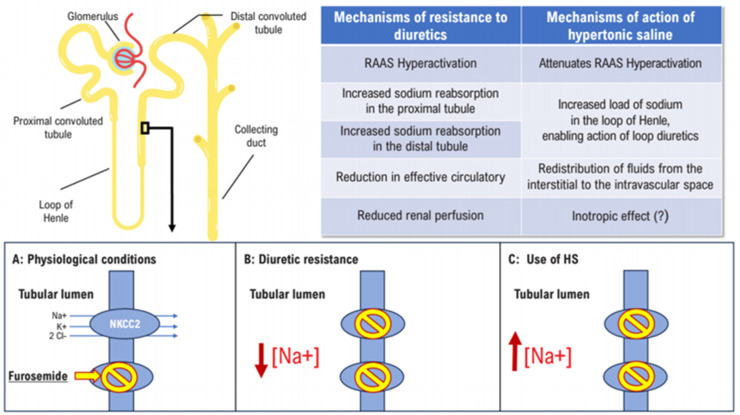
A dominant event determining the course of heart failure (HF) includes the disruption of the delicate sodium (Na) and water balance leading to (Na) and water retention and edema formation. Although incomplete decongestion adversely affects outcomes, it is unknown whether interventions directly targeting (Na), such as strict dietary (Na) restriction, intravenous hypertonic saline, and diuretics, reverse this effect. As a result, it is imperative to implement (Na)-targeting interventions in selected HF patients with established congestion on top of quadruple therapy with angiotensin receptor neprilysin inhibitor, β-adrenergic receptor blocker, mineralocorticoid receptor antagonist, and sodium glucose cotransporter 2 inhibitor, which dramatically improves outcomes. The limited effectiveness of (Na)-targeting treatments may be partly due to the fact that the current metrics of HF severity have a limited capacity of foreseeing and averting episodes of congestion and guiding (Na)-targeting treatments, which often leads to dysnatremias, adversely affecting outcomes. Recent evidence suggests that spot urinary sodium measurements may be used as a guide to monitor (Na)-targeting interventions both in chronic and acute HF. Further, the classical (2)-compartment model of (Na) storage has been displaced by the (3)-compartment model emphasizing the non-osmotic accumulation of (Na), chiefly in the skin. 23(Na) magnetic resonance imaging (MRI) enables the accurate and reliable quantification of tissue (Na). Another promising approach enabling tissue (Na) monitoring is based on wearable devices employing ion-selective electrodes for electrolyte detection, including (Na) and (Cl). Undoubtably, further studies using 23(Na)-MRI technology and wearable sensors are required to learn more about the clinical significance of tissue (Na) storage and (Na)-related mechanisms of morbidity and mortality in HF.
决定心力衰竭(HF)病程的一个主要事件包括破坏微妙的钠(Na)和水平衡,导致钠潴留和水肿形成。尽管不完全消除充血会对预后产生不利影响,但尚不清楚直接针对钠的干预措施,如严格的饮食钠限制、静脉注射高渗盐水和利尿剂,是否能逆转这种影响。因此,对于已确诊充血的特定HF患者,在使用血管紧张素受体脑啡肽酶抑制剂、β-肾上腺素能受体阻滞剂、盐皮质激素受体拮抗剂和钠-葡萄糖协同转运蛋白2抑制剂进行四联治疗的基础上,实施针对钠的干预措施至关重要,这能显著改善预后。针对钠的治疗效果有限,部分原因可能是目前HF严重程度的衡量指标预测和避免充血发作以及指导针对钠的治疗的能力有限,这往往会导致低钠血症,对预后产生不利影响。最近的证据表明,即时尿钠测量可作为监测慢性和急性HF中针对钠的干预措施的指南。此外,经典的钠储存二室模型已被强调钠主要在皮肤中非渗透性积聚的三室模型所取代。23Na磁共振成像(MRI)能够准确可靠地定量组织钠含量。另一种有前景的组织钠监测方法是基于采用离子选择性电极进行电解质检测(包括钠和氯)的可穿戴设备。毫无疑问,需要进一步开展使用23Na-MRI技术和可穿戴传感器的研究,以更多地了解组织钠储存的临床意义以及HF中与钠相关的发病和死亡机制。