Zhou Qiaorui, Li Huixin, Zhang Ye, Zhao Yirui, Wang Can, Liu Chang
College of Food Science & Nutritional Engineering, China Agricultural University, Beijing 100083, China.
School of Sport Science, Beijing Sport University, Beijing 100084, China.
Metabolites. 2024 Oct 7;14(10):537. doi: 10.3390/metabo14100537.
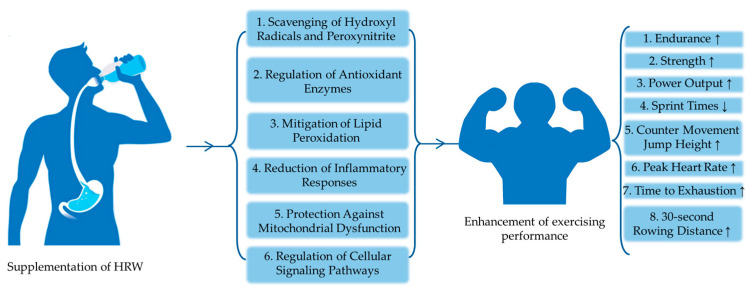
: Hydrogen-rich water (HRW) has garnered significant interest within the sports and exercise science community due to its selective antioxidant properties. Despite its potential benefits, comprehensive reviews specifically addressing its effects on athletic performance are limited. This review aims to assess the impact of HRW on sports performance and explore the underlying molecular biological mechanisms, with the goal of elucidating how HRW might enhance athletic performance. : This review synthesizes research on HRW by examining articles published between 1980 and April 2024 in databases such as PubMed, the Cochrane Library, Embase, Scopus, and Web of Science. : It highlights HRW's effects on various aspects of athletic performance, including endurance, strength, sprint times, lunge movements, countermovement jump height, and time to exhaustion. While the precise mechanisms by which HRW affects athletic performance remain unclear, this review investigates its general molecular biological mechanisms beyond the specific context of sports. This provides a theoretical foundation for future research aimed at understanding how HRW can enhance athletic performance. HRW targets the harmful reactive oxygen and nitrogen species produced during intense exercise, thereby reducing oxidative stress-a critical factor in muscle fatigue, inflammation, and diminished athletic performance. HRW helps to scavenge hydroxyl radicals and peroxynitrite, regulate antioxidant enzymes, mitigate lipid peroxidation, reduce inflammation, protect against mitochondrial dysfunction, and modulate cellular signaling pathways. : In summary, while a few studies have indicated that HRW may not produce significant beneficial effects, the majority of research supports the conclusion that HRW may enhance athletic performance across various sports. The potential mechanisms underlying these benefits are thought to involve HRW's role as a selective antioxidant, its impact on oxidative stress, and its regulation of redox homeostasis. However, the specific molecular biological mechanisms through which HRW improves athletic performance remain to be fully elucidated.
富氢水(HRW)因其选择性抗氧化特性而在体育与运动科学界引起了广泛关注。尽管具有潜在益处,但专门针对其对运动表现影响的全面综述却很有限。本综述旨在评估富氢水对运动表现的影响,并探索其潜在的分子生物学机制,以阐明富氢水如何提高运动表现。:本综述通过查阅1980年至2024年4月期间在PubMed、Cochrane图书馆、Embase、Scopus和Web of Science等数据库中发表的文章,对富氢水的研究进行了综合分析。:它强调了富氢水对运动表现各个方面的影响,包括耐力、力量、短跑时间、弓步动作、反向纵跳高度和力竭时间。虽然富氢水影响运动表现的确切机制尚不清楚,但本综述研究了其在运动特定背景之外的一般分子生物学机制。这为未来旨在了解富氢水如何提高运动表现的研究提供了理论基础。富氢水针对剧烈运动期间产生的有害活性氧和氮物种,从而减少氧化应激——这是肌肉疲劳、炎症和运动表现下降的关键因素。富氢水有助于清除羟基自由基和过氧亚硝酸盐,调节抗氧化酶,减轻脂质过氧化,减少炎症,预防线粒体功能障碍,并调节细胞信号通路。:总之,虽然一些研究表明富氢水可能不会产生显著的有益效果,但大多数研究支持富氢水可能提高各类运动项目运动表现的结论。这些益处背后的潜在机制被认为涉及富氢水作为选择性抗氧化剂的作用、其对氧化应激的影响以及对氧化还原稳态的调节。然而,富氢水提高运动表现的具体分子生物学机制仍有待充分阐明。