Treuman Katz Center for Pediatric Bioethics and Palliative Care, Seattle Children's Research Institute, 4800 Sand Point Way NE, M/S FA.2.113 Neonatology, Seattle, WA, 98105, USA.
Department of Pediatrics, University of Washington School of Medicine, Seattle, WA, USA.
Trials. 2024 Sep 12;25(1):610. doi: 10.1186/s13063-024-08446-6.
Recruitment for neonatal clinical trials can be particularly challenging. Low enrollment rates bias the research population and decrease generalizability of findings. We identified a critical need for an intervention to improve how researchers recruit for neonatal clinical trials. Working within the US neonatal research context, we developed the Better Research Interactions for Every Family (BRIEF) Intervention, which had two overarching goals: to improve the recruitment experience for all parents, focusing on minoritized populations, and to increase participation, focusing on decreasing disparities in research participation.
We used intervention mapping (IM) to guide all steps of intervention development. IM is a planning framework that provides a systematic process and detailed protocol for step-by-step decision-making for intervention development, implementation, and evaluation.
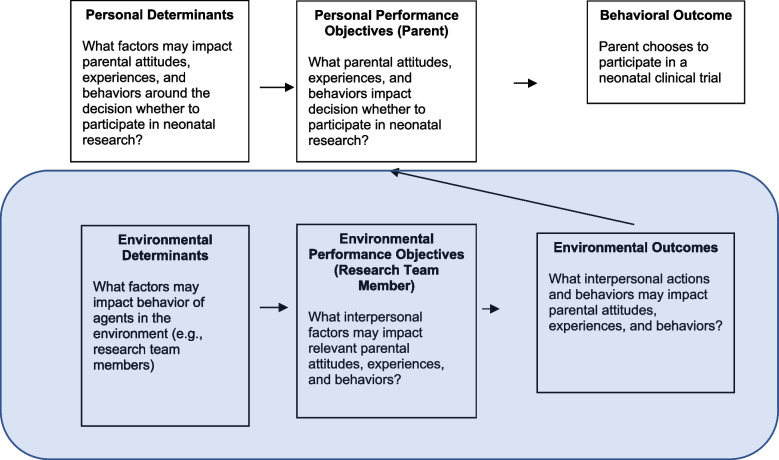
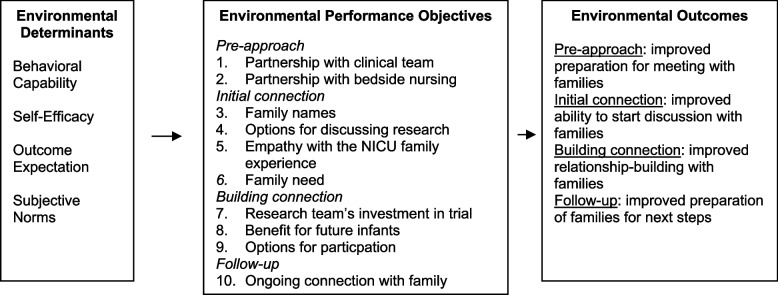
We performed IM's six steps. In step 1, we convened two stakeholder groups, a parent panel and an expert panel, who provided guidance through development of all BRIEF components. Through a recent systematic review, empirical data collected by our team, and consultations with the panels, we identified key determinants (barriers and facilitators) of low enrollment rates and research team members as change agents. In step 2, we iteratively refined our list of key factors to include and linked determinants of behavior changes to these performance objectives. In step 3, we chose three theories (social cognitive theory, theory of information processing, and the trans-theoretical model), methods from identified practical applications suitable for the population (research team members) and the context (busy research NICU teams). In step 4, we developed and refined the intervention components, including self-guided pre-work and a single in-person session. In step 5, we identified the Darbepoetin plus slow-release intravenous iron trial as our partner study in which to pilot BRIEF. In step 6, we developed a multi-stage evaluation plan that included five distinct levels of outcomes.
This manuscript shares our rationale and processes for the creation of a research team member-facing intervention aiming to improve recruitment processes for neonatal clinical trials. Our approach can inform those aiming to improve recruitment for neonatal clinical trials and those who may be considering use of IM within similar contexts.
新生儿临床试验的招募可能特别具有挑战性。低入组率会使研究人群产生偏差,并降低研究结果的普遍性。我们发现,非常有必要采取干预措施来改善研究人员招募新生儿临床试验的方式。我们在美国新生儿研究背景下开展工作,开发了“BRIEF 干预措施”,该措施有两个总体目标:一是改善所有父母(重点是少数族裔群体)的招募体验;二是提高参与度(重点是减少研究参与方面的差异)。
我们使用干预映射(IM)来指导干预措施的所有开发步骤。IM 是一个规划框架,为干预措施的开发、实施和评估提供了一个系统的过程和详细的协议,用于逐步决策。
我们完成了 IM 的六个步骤。在步骤 1 中,我们召集了两个利益相关者群体,一个是家长小组,另一个是专家小组,他们通过制定 BRIEF 的所有组成部分为我们提供了指导。通过最近的系统评价、我们团队收集的实证数据以及与小组的磋商,我们确定了低入组率的关键决定因素(障碍和促进因素)以及研究团队成员作为变革推动者。在步骤 2 中,我们反复完善了关键因素清单,并将行为变化的决定因素与这些绩效目标联系起来。在步骤 3 中,我们选择了三个理论(社会认知理论、信息处理理论和跨理论模型)、适合人群(研究团队成员)和背景(繁忙的新生儿重症监护病房研究团队)的已确定实用应用方法。在步骤 4 中,我们开发并完善了干预措施组成部分,包括自我指导的预备工作和一次单独的面对面会议。在步骤 5 中,我们确定了达贝泊汀加缓释静脉铁剂试验作为我们的试点 BRIEF 的合作研究。在步骤 6 中,我们制定了一个多阶段评估计划,包括五个不同层次的结果。
本文介绍了我们创建面向研究团队成员的干预措施的基本原理和过程,旨在改善新生儿临床试验的招募流程。我们的方法可以为那些旨在改善新生儿临床试验招募工作的人员以及那些可能在类似背景下考虑使用 IM 的人员提供参考。