Division of Nephrology and Hypertension, Department of Medicine, Vanderbilt University Medical Center, Nashville, Tennessee.
Department of Biostatistics, Vanderbilt University Medical Center, Nashville, Tennessee.
JAMA Netw Open. 2024 Oct 1;7(10):e2440286. doi: 10.1001/jamanetworkopen.2024.40286.
Glucagon-like peptide 1 receptor agonists (GLP-1RAs) may have nephroprotective properties beyond those related to weight loss and glycemic control.
To investigate the association of genetically proxied GLP-1RAs with kidney disease progression.
DESIGN, SETTING, AND PARTICIPANTS: This genetic association study assembled a national retrospective cohort of veterans aged 18 years or older from the US Department of Veterans Affairs Million Veteran Program between January 10, 2011, and December 31, 2021. Data were analyzed from November 2023 to February 2024.
Genetic risk score for systemic GLP1R gene expression that was calculated for each study participant based on genetic variants associated with GLP1R mRNA levels across all tissue samples within the Genotype-Tissue Expression project.
The primary composite outcome was incident end-stage kidney disease or a 40% decline in estimated glomerular filtration rate. Cox proportional hazards regression survival analysis assessed the association between genetically proxied GLP-1RAs and kidney disease progression.
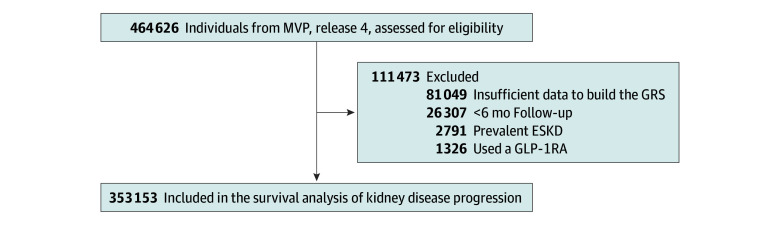
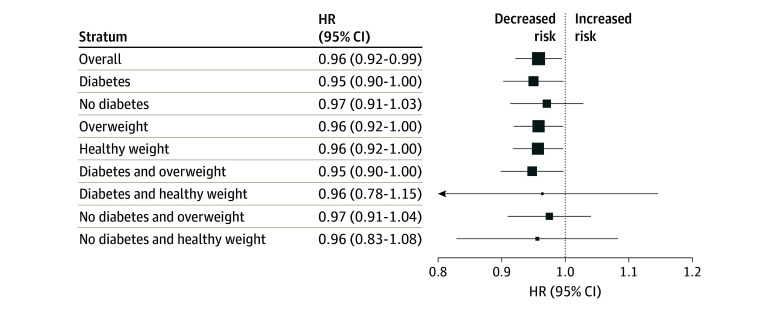
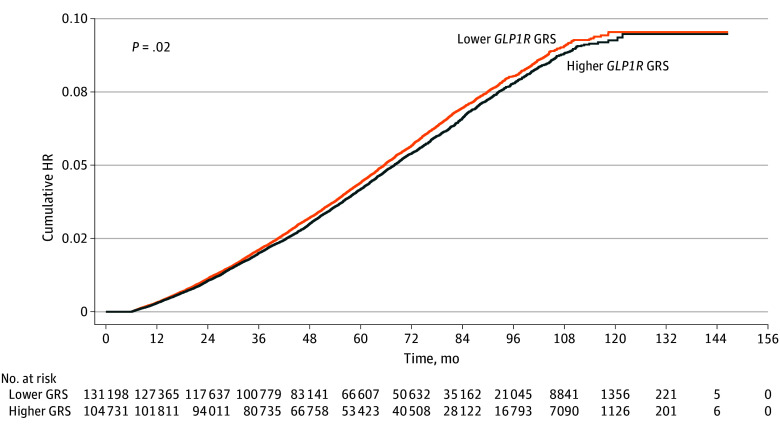
Among 353 153 individuals (92.5% men), median age was 66 years (IQR, 58.0-72.0 years) and median follow-up was 5.1 years (IQR, 3.1-7.2 years). Overall, 25.7% had diabetes, and 45.0% had obesity. A total of 4.6% experienced kidney disease progression. Overall, higher genetic GLP1R gene expression was associated with a lower risk of kidney disease progression in the unadjusted model (hazard ratio [HR], 0.96; 95% CI, 0.92-0.99; P = .02) and in the fully adjusted model accounting for baseline patient characteristics, body mass index, and the presence or absence of diabetes (HR, 0.96; 95% CI, 0.92-1.00; P = .04). The results were similar in sensitivity analyses stratified by diabetes or obesity status.
In this genetic association study, higher GLP1R gene expression was associated with a small reduction in risk of kidney disease progression. These findings support pleiotropic nephroprotective mechanisms of GLP-1RAs independent of their effects on body weight and glycemic control.
胰高血糖素样肽 1 受体激动剂 (GLP-1RAs) 除了与体重减轻和血糖控制相关之外,可能还有肾脏保护作用。
研究与 GLP-1RA 相关的基因与肾脏疾病进展的关联。
设计、地点和参与者:这项遗传关联研究在美国退伍军人事务部百万退伍军人计划中,从 2011 年 1 月 10 日至 2021 年 12 月 31 日,汇集了全国范围内年龄在 18 岁或以上的退伍军人的回顾性队列。数据于 2023 年 11 月至 2024 年 2 月进行分析。
根据与 Genotype-Tissue Expression 项目中所有组织样本中的 GLP1R mRNA 水平相关的遗传变异,为每位研究参与者计算了全身 GLP1R 基因表达的遗传风险评分。
主要复合结局是终末期肾病或估算肾小球滤过率下降 40%。Cox 比例风险回归生存分析评估了与 GLP-1RA 相关的基因与肾脏疾病进展之间的关联。
在 353153 名参与者(92.5%为男性)中,中位年龄为 66 岁(IQR,58.0-72.0 岁),中位随访时间为 5.1 年(IQR,3.1-7.2 年)。总体而言,25.7%有糖尿病,45.0%有肥胖症。共有 4.6%的人经历了肾脏疾病的进展。总体而言,在未经调整的模型中(HR,0.96;95%CI,0.92-0.99;P=0.02)和在考虑基线患者特征、体重指数以及糖尿病存在或不存在的完全调整模型中(HR,0.96;95%CI,0.92-1.00;P=0.04),更高的遗传 GLP1R 基因表达与肾脏疾病进展风险降低相关。在按糖尿病或肥胖状态分层的敏感性分析中,结果相似。
在这项遗传关联研究中,更高的 GLP1R 基因表达与肾脏疾病进展风险的微小降低相关。这些发现支持 GLP-1RA 的多效性肾脏保护机制独立于其对体重和血糖控制的影响。