Department of Chemistry and Biochemistry, University of California - Merced, 5200 N. Lake Road, Merced, California 95343, United States.
Quantitative and Systems Biology Graduate Program, University of California - Merced, 5200 N. Lake Road, Merced, California 95343, United States.
J Am Chem Soc. 2024 Nov 6;146(44):30252-30261. doi: 10.1021/jacs.4c09531. Epub 2024 Oct 25.
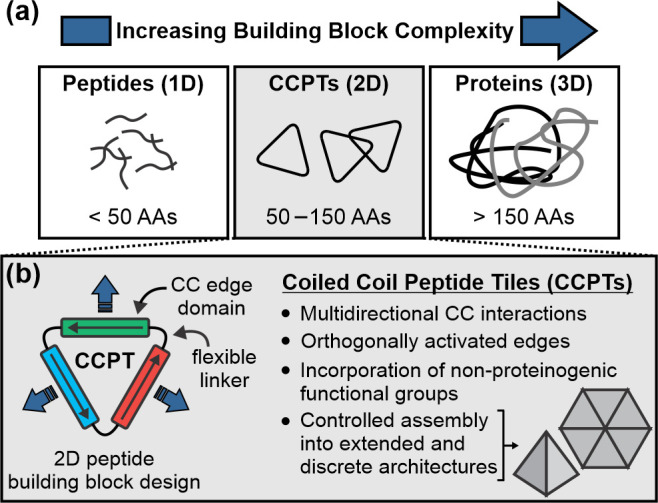
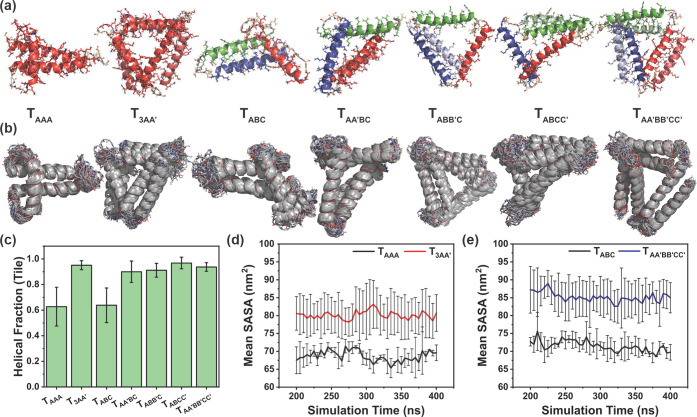
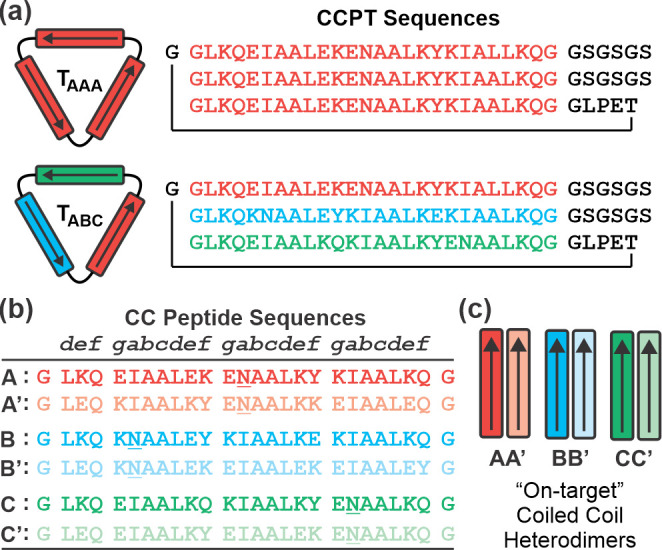
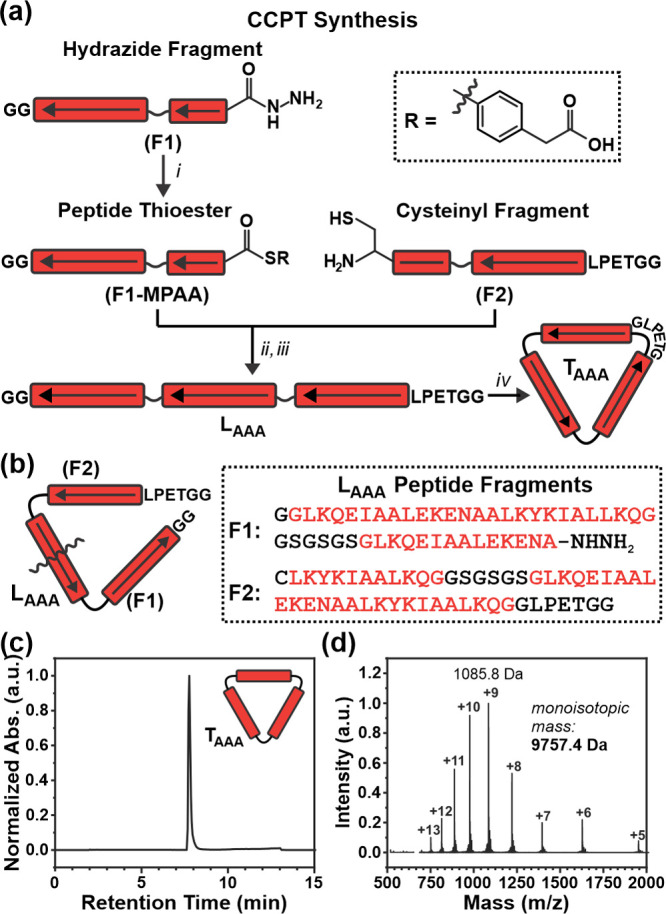
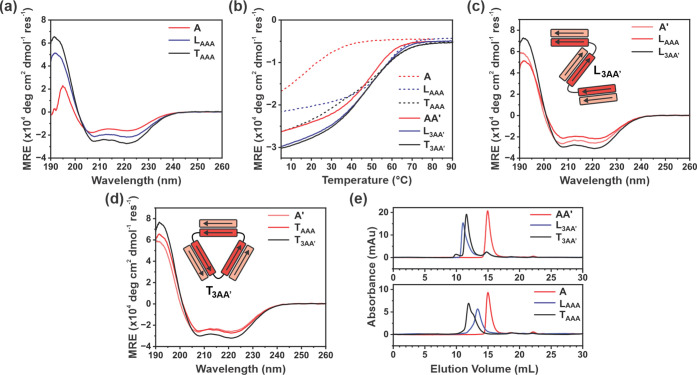
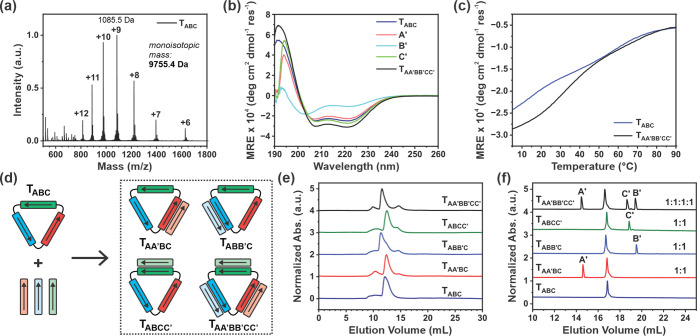
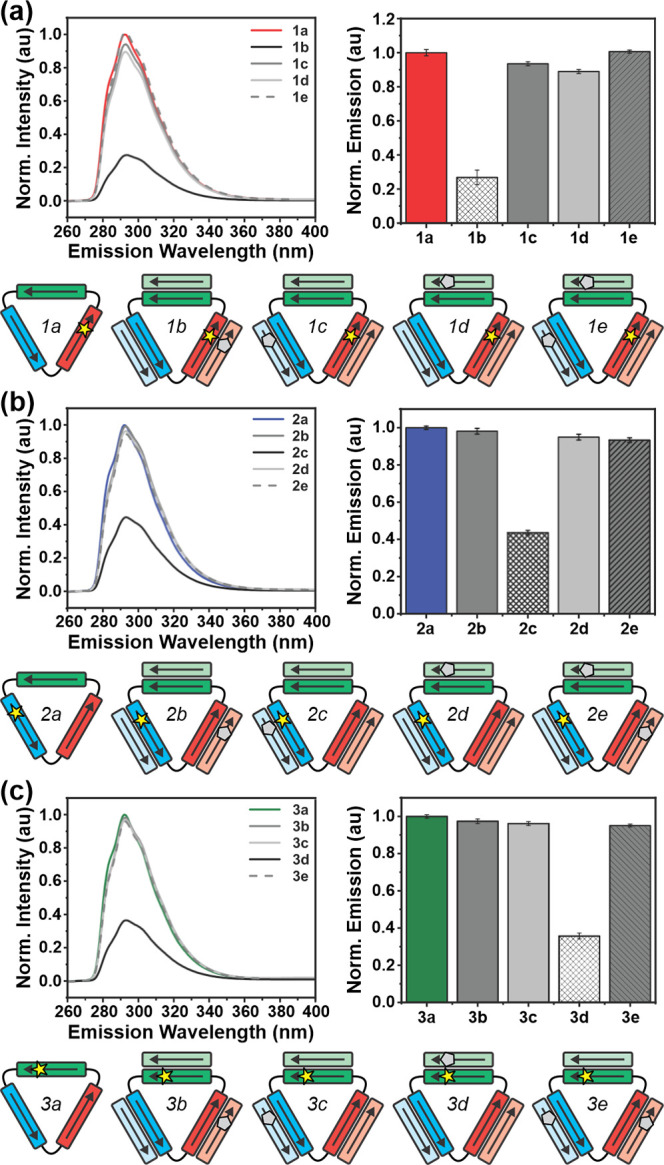
Owing to their synthetic accessibility and protein-mimetic features, peptides represent an attractive biomolecular building block for the fabrication of artificial biomimetic materials with emergent properties and functions. Here, we expand the peptide building block design space through unveiling the design, synthesis, and characterization of novel, multivalent peptide macrocycles (96mers), termed coiled coil peptide tiles (CCPTs). CCPTs comprise multiple orthogonal coiled coil peptide domains that are separated by flexible linkers. The constraints, imposed by cyclization, confer CCPTs with the ability to direct programmable, multidirectional interactions between coiled coil-forming "edge" domains of CCPTs and their free peptide binding partners. These fully synthetic constructs are assembled using a convergent synthetic strategy via a combination of native chemical ligation and Sortase A-mediated cyclization. Circular dichroism (CD) studies reveal the increased helical stability associated with cyclization and subsequent coiled coil formation along the CCPT edges. Size-exclusion chromatography (SEC), analytical high-performance liquid chromatography (HPLC), and fluorescence quenching assays provide a comprehensive biophysical characterization of various assembled CCPT complexes and confirm the orthogonal colocalization between coiled coil domains within CCPTs and their designed on-target free peptide partners. Lastly, we employ molecular dynamics (MD) simulations, which provide molecular-level insights into experimental results, as a supporting method for understanding the structural dynamics of CCPTs and their complexes. MD analysis of the simulated CCPT architectures reveals the rigidification and expansion of CCPTs upon complexation, i.e., coiled coil formation with their designed binding partners, and provides insights for guiding the designs of future generations of CCPTs. The addition of CCPTs into the repertoire of coiled coil-based building blocks has the potential for expanding the coiled coil assembly landscape by unlocking new topologies having designable intermolecular interfaces.
由于其合成的可及性和蛋白质模拟特性,肽代表了一种有吸引力的生物分子构建块,可用于制造具有新兴特性和功能的人工仿生材料。在这里,我们通过揭示新型多价肽大环(96 个残基)的设计、合成和表征来扩展肽构建块设计空间,将其称为螺旋肽砖(CCPT)。CCPT 由多个正交的螺旋肽结构域组成,这些结构域由柔性接头隔开。环化所产生的约束赋予 CCPT 能力,以指导 CCPT 的卷曲螺旋形成“边缘”结构域与它们的游离肽配体之间可编程的、多方向的相互作用。这些完全合成的构建体是通过使用天然化学连接和 Sortase A 介导的环化的组合的收敛合成策略组装而成。圆二色性(CD)研究表明,与环化和随后的 CCPT 边缘处的卷曲螺旋形成相关的螺旋稳定性增加。尺寸排阻色谱(SEC)、分析高效液相色谱(HPLC)和荧光猝灭测定法提供了对各种组装的 CCPT 复合物的全面生物物理特性分析,并证实了 CCPT 内卷曲螺旋结构域与其设计的游离肽靶标配体之间的正交共定位。最后,我们使用分子动力学(MD)模拟作为理解 CCPT 及其复合物结构动力学的支持方法,该方法提供了对实验结果的分子水平的深入了解。模拟 CCPT 结构的 MD 分析揭示了 CCPT 复合物化时的刚性和扩展,即与它们设计的结合配体形成卷曲螺旋,为指导下一代 CCPT 的设计提供了见解。CCPT 的加入为基于卷曲螺旋的构建块的集合提供了扩展的可能性,通过解锁具有可设计的分子间界面的新拓扑结构来解锁新的拓扑结构。