
设计的卷曲螺旋肽组装体中的交换、混杂性和正交性。
Exchange, promiscuity, and orthogonality in designed coiled-coil peptide assemblies.
作者信息
Kurgan Kathleen W, Martin Freddie J O, Dawson William M, Brunnock Thomas, Orr-Ewing Andrew J, Woolfson Derek N
机构信息
School of Chemistry, University of Bristol Cantock's Close Bristol BS8 1TS UK
Max Planck-Bristol Centre for Minimal Biology, University of Bristol Cantock's Close Bristol BS8 1TS UK.
出版信息
Chem Sci. 2024 Dec 9;16(4):1826-1836. doi: 10.1039/d4sc06329e. eCollection 2025 Jan 22.
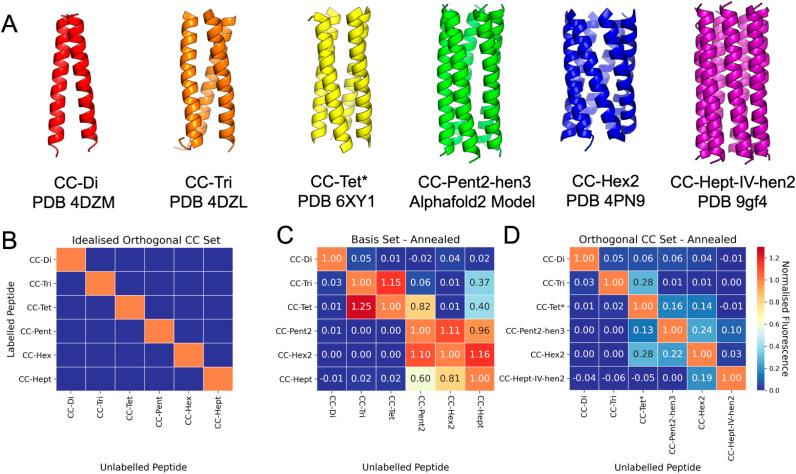
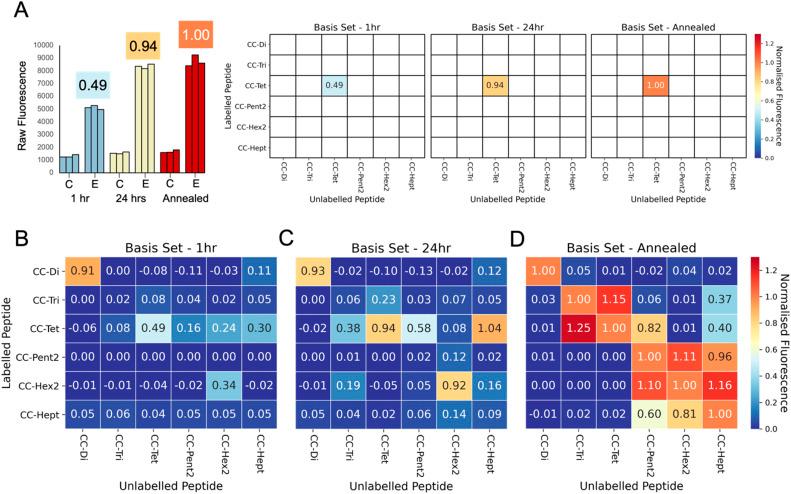
protein design is delivering new peptide and protein structures at a rapid pace. Many of these synthetic polypeptides form well-defined and hyperthermal-stable structures. Generally, however, less is known about the dynamic properties of the designed structures. Here, we explore one aspect of dynamics in a series of coiled-coil peptide assemblies: namely, peptide exchange within and between different oligomers from dimers through to heptamers. First, we develop a fluorescence-based reporter assay for peptide exchange that is straightforward to implement, and, thus, would be useful to others examining similar systems. We apply this assay to explore both homotypic exchange within single species, and heterotypic exchange between coiled coils of different oligomeric states. For the former, we provide a detailed study for a dimeric coiled coil, CC-Di, finding a half-life for exchange of 4.2 ± 0.3 minutes at a peptide concentration of 200 μM. Interestingly, more broadly when assessing exchange across all of the oligomeric states, we find that some of the designs are faithful and only undergo homotypic strand exchange, whereas others are promiscuous and exchange to form unexpected hetero-oligomers. Finally, we develop two design strategies to improve the orthogonality of the different oligomers: (i) using alternate positioning of salt bridge interactions; and (ii) incorporating non-canonical repeats into the designed sequences. In so doing, we reconcile the promiscuity and deliver a set of faithful homo-oligomeric coiled-coil peptides. Our findings have implications for the application of these and other coiled coils as modules in chemical and synthetic biology.
蛋白质设计正迅速催生新的肽和蛋白质结构。许多这类合成多肽形成了明确且热稳定性高的结构。然而,总体而言,人们对所设计结构的动态特性了解较少。在此,我们探讨了一系列卷曲螺旋肽组装体动力学的一个方面:即从二聚体到七聚体的不同寡聚体内部及之间的肽交换。首先,我们开发了一种基于荧光的肽交换报告检测法,该方法易于实施,因此对研究类似系统的其他人会很有用。我们应用此检测法来探究单一物种内的同型交换以及不同寡聚状态的卷曲螺旋之间的异型交换。对于前者,我们对二聚体卷曲螺旋CC-Di进行了详细研究,发现在肽浓度为200μM时交换的半衰期为4.2±0.3分钟。有趣的是,在更广泛地评估所有寡聚状态的交换时,我们发现一些设计是忠实的,仅进行同型链交换,而其他设计则是混杂的,会交换形成意想不到的异源寡聚体。最后,我们开发了两种设计策略来提高不同寡聚体的正交性:(i)使用盐桥相互作用的交替定位;(ii)在设计序列中纳入非经典重复序列。通过这样做,我们调和了混杂性,得到了一组忠实的同型寡聚卷曲螺旋肽。我们的研究结果对这些及其他卷曲螺旋作为化学和合成生物学模块的应用具有启示意义。




 Zotero 插件