Nature Research Centre, Akademijos 2, Vilnius, LT-08412, Lithuania.
Laboratoire de Santé Animale, ANSES, INRAE, Ecole Nationale Vétérinaire d'Alfort, UMR BIPAR, Maisons-Alfort, F-94700, France.
BMC Microbiol. 2024 Oct 26;24(1):434. doi: 10.1186/s12866-024-03593-x.
Mosquitoes serve as vectors for numerous pathogens, posing significant health risks to humans and animals. Understanding the complex interactions within mosquito microbiota is crucial for deciphering vector-pathogen dynamics and developing effective disease management strategies. Here, we investigated the nested patterns of Wolbachia endosymbionts and Escherichia-Shigella within the microbiota of laboratory-reared Culex pipiens f. molestus and Culex quinquefasciatus mosquitoes. We hypothesized that Wolbachia would exhibit a structured pattern reflective of its co-evolved relationship with both mosquito species, while Escherichia-Shigella would display a more dynamic pattern influenced by environmental factors.
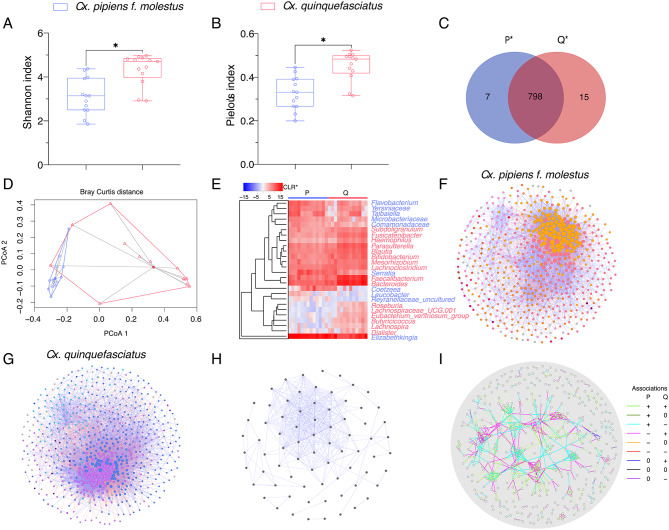
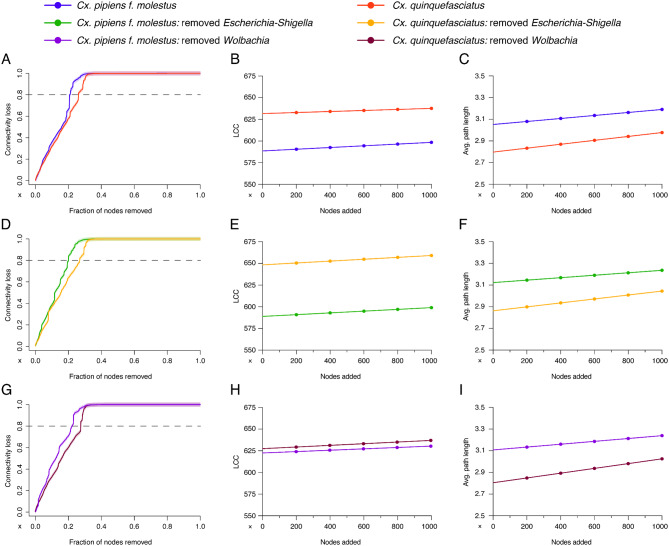
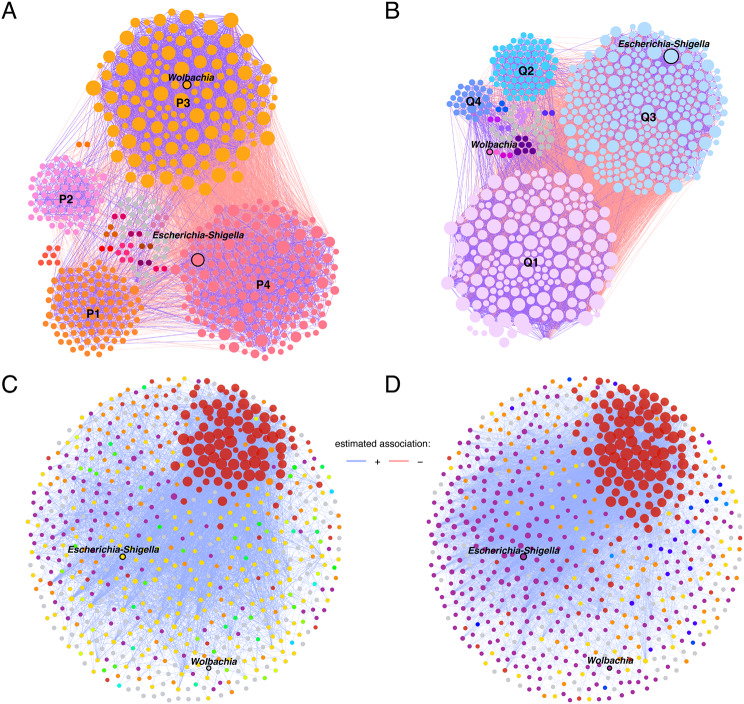
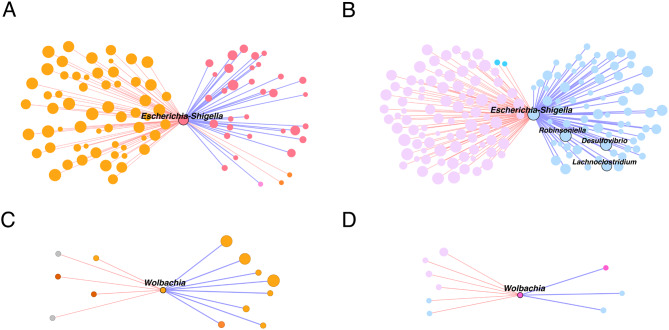
Our analysis revealed different microbial compositions between the two mosquito species, although some microorganisms were common to both. Network analysis revealed distinct community structures and interaction patterns for these bacteria in the microbiota of each mosquito species. Escherichia-Shigella appeared prominently within major network modules in both mosquito species, particularly in module P4 of Cx. pipiens f. molestus, interacting with 93 nodes, and in module Q3 of Cx. quinquefasciatus, interacting with 161 nodes, sharing 55 nodes across both species. On the other hand, Wolbachia appeared in disparate modules: module P3 in Cx. pipiens f. molestus and a distinct module with a single additional taxon in Cx. quinquefasciatus, showing species-specific interactions and no shared taxa. Through computer simulations, we evaluated how the removal of Wolbachia or Escherichia-Shigella affects network robustness. In Cx. pipiens f. molestus, removal of Wolbachia led to a decrease in network connectivity, while Escherichia-Shigella removal had a minimal impact. Conversely, in Cx. quinquefasciatus, removal of Escherichia-Shigella resulted in decreased network stability, whereas Wolbachia removal had minimal effect.
Contrary to our hypothesis, the findings indicate that Wolbachia displays a more dynamic pattern of associations within the microbiota of Culex pipiens f. molestus and Culex quinquefasciatus mosquitoes, than Escherichia-Shigella. The differential effects on network robustness upon Wolbachia or Escherichia-Shigella removal suggest that these bacteria play distinct roles in maintaining community stability within the microbiota of the two mosquito species.
蚊子作为多种病原体的载体,对人类和动物的健康构成重大威胁。了解蚊子微生物组内的复杂相互作用对于破译媒介-病原体动态以及制定有效的疾病管理策略至关重要。在这里,我们研究了实验室饲养的致倦库蚊和白纹伊蚊的微生物组内沃尔巴克氏体内共生菌和大肠杆菌-志贺氏菌的嵌套模式。我们假设沃尔巴克氏体将表现出与其与两种蚊子物种共同进化的关系相一致的结构模式,而大肠杆菌-志贺氏菌将表现出受环境因素影响的更动态的模式。
我们的分析显示,这两种蚊子的微生物组成不同,尽管有些微生物是两者共有的。网络分析显示,这些细菌在两种蚊子的微生物组中具有不同的群落结构和相互作用模式。大肠杆菌-志贺氏菌在这两种蚊子的主要网络模块中显得突出,特别是在致倦库蚊的模块 P4 中,与 93 个节点相互作用,在白纹伊蚊的模块 Q3 中,与 161 个节点相互作用,在两个物种中共有的节点有 55 个。另一方面,沃尔巴克氏体出现在不同的模块中:致倦库蚊的模块 P3 和白纹伊蚊的一个独特模块,其中包含一个额外的单一分类群,表现出物种特异性相互作用,没有共同的分类群。通过计算机模拟,我们评估了去除沃尔巴克氏体或大肠杆菌-志贺氏菌如何影响网络的稳健性。在致倦库蚊中,去除沃尔巴克氏体导致网络连通性降低,而去除大肠杆菌-志贺氏菌的影响最小。相反,在白纹伊蚊中,去除大肠杆菌-志贺氏菌导致网络稳定性降低,而去除沃尔巴克氏体的影响最小。
与我们的假设相反,研究结果表明,沃尔巴克氏体在致倦库蚊和白纹伊蚊的微生物组内的关联模式比大肠杆菌-志贺氏菌更具动态性。在去除沃尔巴克氏体或大肠杆菌-志贺氏菌后对网络稳健性的不同影响表明,这些细菌在维持这两种蚊子微生物组内的群落稳定性方面发挥着不同的作用。