The Second Department of Critical Care Medicine, the Second Affiliated Hospital of Anhui Medical University, 230601, Anhui, Hefei, P.R. China.
The Laboratory of Cardiopulmonary Resuscitation and Critical Care Medicine, the Second Affiliated Hospital of Anhui Medical University, 230601, Anhui, Hefei, P.R. China.
BMC Infect Dis. 2024 Oct 25;24(1):1206. doi: 10.1186/s12879-024-10106-8.
Severe fever with thrombocytopenia syndrome (SFTS) is an emerging global infectious disease with a high mortality rate. Clinicians lack a convenient tool for early identification of critically ill SFTS patients. The aim of this study was to construct a simple and accurate nomogarm to predict the prognosis of SFTS patients.
We retrospectively analyzed the clinical data of 372 SFTS patients collected between May 2015 and June 2023, which were divided 7:3 into a training set and an internal validation set. We used LASSO regression to select predictor variables and multivariable logistic regression to identify independent predictor variables. Prognostic nomograms for SFTS were constructed based on these factors and analysed for concordance index, calibration curves and area under the curve (AUC) to determine the predictive accuracy and consistency of the model.
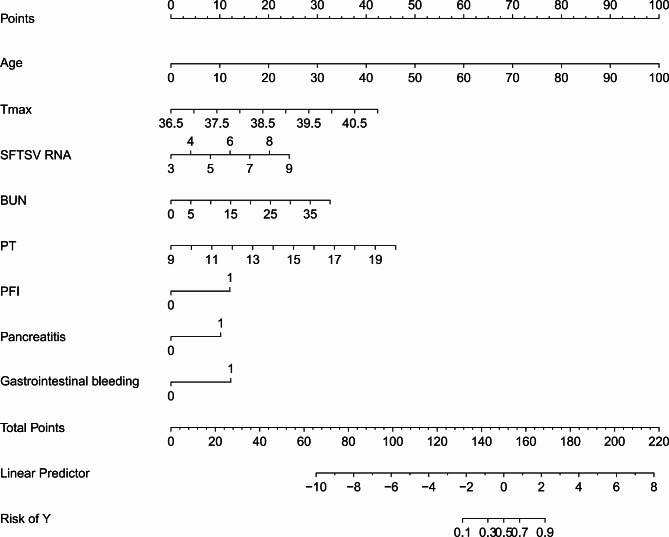
In the training set, LASSO and multivariate logistic regression analyses showed that age, SFTSV RNA, maximum body temperature, pancreatitis, gastrointestinal bleeding, pulmonary fungal infection (PFI), BUN, and PT were independent risk factors for death in SFTS patients. There was a strong correlation between neurological symptoms and mortality (P < 0.001, OR = 108.92). Excluding neurological symptoms, nomograms constructed based on the other eight variables had AUCs of 0.937 and 0.943 for the training and validation sets, respectively. Furthermore, we found that age, gastrointestinal bleeding, PFI, bacteraemia, SFTSV RNA, platelets, and PT were the independent risk factors for neurological symptoms, with SFTSV RNA having the highest diagnostic value (AUC = 0.785).
The nomogram constructed on the basis of eight common clinical variables can easily and accurately predict the prognosis of SFTS patients. Moreover, the diagnostic value of neurological symptoms far exceeded that of other predictors, and SFTSV RNA was the strongest independent risk factor for neurological symptoms, but these need to be further verified by external data.
严重发热伴血小板减少综合征(SFTS)是一种新兴的全球传染病,死亡率高。临床医生缺乏一种方便的工具来早期识别重症 SFTS 患者。本研究旨在构建一个简单而准确的诺莫图来预测 SFTS 患者的预后。
我们回顾性分析了 2015 年 5 月至 2023 年 6 月期间收集的 372 例 SFTS 患者的临床资料,将其分为 7:3 进入训练集和内部验证集。我们使用 LASSO 回归选择预测变量,多变量逻辑回归识别独立预测变量。基于这些因素构建 SFTS 预后诺莫图,并分析一致性指数、校准曲线和曲线下面积(AUC),以确定模型的预测准确性和一致性。
在训练集中,LASSO 和多变量逻辑回归分析显示,年龄、SFTSV RNA、最高体温、胰腺炎、胃肠道出血、肺部真菌感染(PFI)、BUN 和 PT 是 SFTS 患者死亡的独立危险因素。神经系统症状与死亡率之间存在很强的相关性(P<0.001,OR=108.92)。排除神经系统症状后,基于其他 8 个变量构建的诺莫图在训练集和验证集中的 AUC 分别为 0.937 和 0.943。此外,我们发现年龄、胃肠道出血、PFI、菌血症、SFTSV RNA、血小板和 PT 是神经系统症状的独立危险因素,其中 SFTSV RNA 具有最高的诊断价值(AUC=0.785)。
基于 8 个常见临床变量构建的诺莫图可以简单准确地预测 SFTS 患者的预后。此外,神经系统症状的诊断价值远高于其他预测因素,SFTSV RNA 是神经系统症状的最强独立危险因素,但这些仍需通过外部数据进一步验证。