School of Automation, Nanjing University of Information Science and Technology, No.219, Ningliu Road, Nanjing, 210044, Jiangsu, China.
Collaborative Innovation Center on Atmospheric Environment and Equipment Technology, Nanjing University of Information Science and Technology, No.219, Ningliu Road, Nanjing, 210044, Jiangsu, China.
BMC Oral Health. 2024 Oct 25;24(1):1287. doi: 10.1186/s12903-024-05072-1.
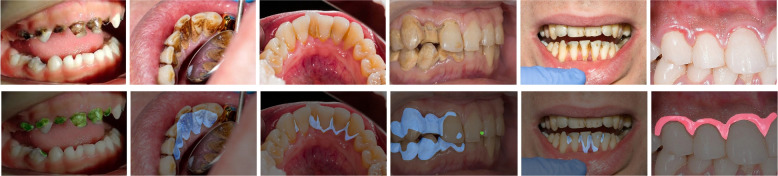
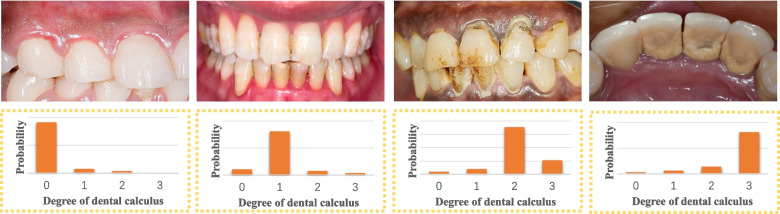
Intraoral photographic images are instrumental in the early screening and clinical diagnosis of oral diseases. In addition, people have been trying to apply artificial intelligence to these images. The purpose of this study is to investigate and evaluate a deep learning system designed to segment intraoral photographic images for the detection of dental caries, dental calculus, and gingivitis, and to assess the degree of dental calculus based on the overall features of the tooth surface and gingival margin.
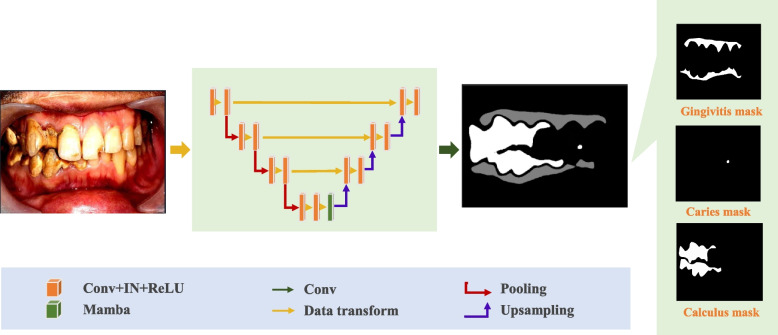
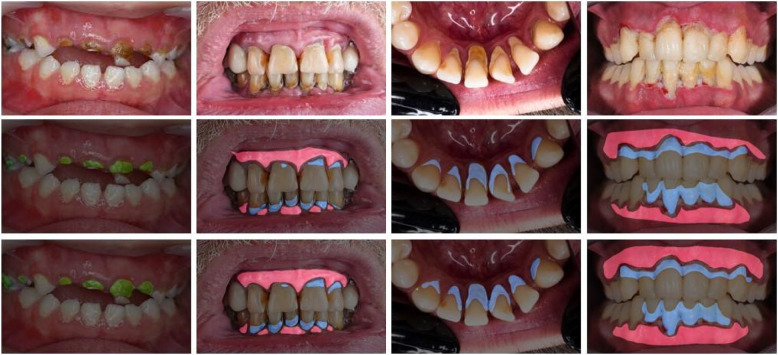
This cross-sectional study collected 3,365 oral endoscopic images, randomly distributed in training datasets (2,019 images), validation dataset (673 images), and test dataset (673 images). The training set and verification set images are manually labeled. An oral endoscopic image segmentation method based on Mamba (Oral-Mamba) and an intelligent evaluation model of dental calculus degree were proposed, achieving the segmentation of two types of oral diseases, namely gingivitis and dental caries, as well as the segmentation of dental calculus regions, and the intelligent evaluation of the degree of dental calculus.
Oral-Mamba demonstrated high accuracy in segmentation, with accuracy rates for gingivitis, dental caries, and dental calculus at 0.83, 0.83, and 0.81, respectively. In particular, these rates surpassed those of the U-Net model in IoU, accuracy, and recall metrics. Furthermore, Oral-Mamba runs 25% faster than U-Net.The accuracy of degree classification in the intelligent evaluation model of dental calculus degree is 85%.
The proposed deep learning system is expected to be used for the detection of two types of oral diseases and dental calculus, and the degree judgment of photographic images from an intraoral camera. This system offers a practical method to assist in the oral screening of dental caries, dental calculus, and gingivitis, providing benefits such as intuitive use, time efficiency, cost-effectiveness, and ease of deployment.
口腔内摄影图像在口腔疾病的早期筛查和临床诊断中发挥着重要作用。此外,人们一直在尝试将人工智能应用于这些图像。本研究旨在调查和评估一种深度学习系统,该系统旨在对口腔摄影图像进行分割,以检测龋齿、牙石和牙龈炎,并根据牙齿表面和牙龈边缘的整体特征评估牙石程度。
本横断面研究收集了 3365 张口腔内窥镜图像,随机分布在训练数据集(2019 张图像)、验证数据集(673 张图像)和测试数据集(673 张图像)中。训练集和验证集图像是手动标记的。提出了一种基于 Mamba(口腔-Mamba)的口腔内窥镜图像分割方法和一种智能牙石程度评估模型,实现了两种口腔疾病(牙龈炎和龋齿)以及牙石区域的分割和牙石程度的智能评估。
口腔-Mamba 在分割方面表现出很高的准确性,牙龈炎、龋齿和牙石的准确率分别为 0.83、0.83 和 0.81。特别是,这些比率在 IoU、准确性和召回率指标方面超过了 U-Net 模型。此外,口腔-Mamba 的运行速度比 U-Net 快 25%。智能牙石程度评估模型的牙石程度分类准确率为 85%。
所提出的深度学习系统有望用于检测两种类型的口腔疾病和牙石,以及来自口腔内相机的摄影图像的牙石程度判断。该系统提供了一种实用的方法,可用于辅助口腔筛查龋齿、牙石和牙龈炎,具有直观使用、省时、高性价比和易于部署等优点。